An woman and her father share a conversation about a family car that was the source of much consternation — and pride
by Maneesha Lassiter

On his 80th birthday, I asked my father, “What happened to MYB-77?” He paused, then took a bite of toast after dipping it in his daal soup. With a twinkle in his eye, he exclaimed, “Ahhhh, MYB, the evergreen car!”
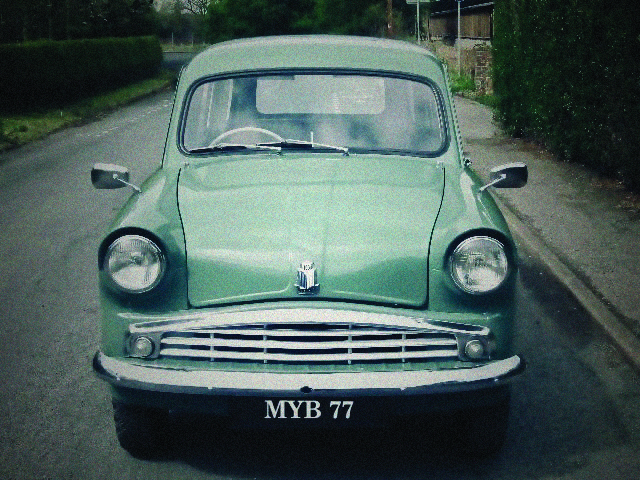
MYB-77 was our family car throughout my childhood in India. My dad was in the Indian air force, so we moved often: to Bangalore in the south, Pune in the west, Jodhpur in the northwest. Though it was a remnant of the British occupation, the car was prized by my father for its utility and uniqueness. The 1959 Standard 10 Companion was a blue-green British model car with a right-side steering wheel and manual gear drive. In her heyday, she must have been a beauty — but after 20-plus years, she showed her age, her color faded to a soft grey.
Everyone we knew called the car MYB-77, as it was her license plate number. My father inherited the car sometime in the early 1980s, soon after his parents passed.
“Did you know MYB supported a lot of our family ceremonies?” Dad asked excitedly. “She helped us through all our big life events, from weddings to funerals. I had five brothers and two sisters, and they all agreed that I would be the best caregiver to maintain an old car.”
My memory of the car as a teenager was not the same as my father’s. I was very embarrassed to be seen in it. Our neighborhood friends nicknamed the car “Shikari Shambhu” after an Indian comic book character, a lazy and cowardly hunter who was always running away from dangerous animals. That’s pretty much how I felt. My sister and I often ducked down when we were driving past friends, especially since MYB frequently embarrassed us by sputtering for fuel in their presence. Her boxy body, blaring headlights and toothless grin set her apart from all the air-conditioned, fast and sleek modern cars that other families seemed to have.
Dad wiped his mustache with a napkin and set his soup bowl aside. “You see, this present generation must understand one thing,” he said. “In those days, owning a car was an enormous deal.”
India got its freedom from the British in 1947. The British colonial rule was geared to benefit Britain and even decades later, many Indians were too poor to have the privilege of owning a car. Brand new, the Standard 10 Companion was marketed as a “farm car” with the ability to carry 180 dozen eggs or five very large milk churns, along with a family of four.
My grandfather had studied economics at the University of Wisconsin in the U.S., back when a foreign education was exceedingly rare. After many years away from his family, he returned to India and got a respectable state government job with a good salary. “He decided to invest in a car so he could take vacations with his family, share the fruits of his achievements and atone for all his years away from them,” said my father.
After hearing Dad’s compassionate description, I offered a neutral response: “Well, she certainly held her own identity in any parking lot. ”
“But where do you get cars nowadays that can withstand the test of time?” Dad asked.
But did she? My memory was that the car was high-maintenance and hard to use, unattractive for most prospects. She’d often have trouble starting when we needed to go somewhere.
When MYB refused to start, I’d watch my father carefully check the connections as he replaced the battery in the car. If he turned the ignition key and the motor didn’t catch, he had to manually insert a crank rod through an access hole in the front bumper to turn the starter motor. That required him to swing his arm in a full 200-degree motion — sometimes up to six times — to get her going. If the crank didn’t work, he’d resort to pushing her to get her rolling, then shift her into gear to get her started. Most of the time it was my sister and I behind the car pushing — and that, too, was inevitably in front of our friends.
To top it all off, he had to connect two wires whenever he wanted to blow the horn. Ridiculous!
“What do you know about the mechanics of old cars?” he said. “She had her own personality! Though she was only 37 horsepower, she was built like a tank! When she was cheerful, she could easily cruise at 50 miles an hour on a flat road. But yes, when burdened, she slowed to 5 miles an hour. Like any person who has seen a lot in life, she could be a bit grumpy, but remember, she’d given decades of loyal service to our family.”
Despite her quirks, Dad cherished MYB-77 as a royal antique and member of the family. Most often, she only responded to his care.
“Remember how many long road trips she remained faithful to us?” he asked.
I did remember one trip to Ramanagara, a vacation spot with a sericulture farm. We looked forward to our weekend getaway there, where we’d visit my aunt and escape the heat of the city. Our car was filled with songs and games — until we reached the foothills of the 2,451-foot-high main Ramanagara hill. MYB protested against her load, forcing us to redistribute our passenger weight. After the adults disembarked, she sighed in relief — but still needed an additional push from the villagers to start moving uphill.
Our family rallied with shouts of “Dum lagake haisha, jor lagake haisha!” — a Hindi phrase meaning, Put in your strength! Put in your breath, to put in your strength again! With everyone pushing the car, Dad shifted her into gear. She managed to climb the hill and finally parked proudly at my aunt’s house. After a couple of days of rest, she was ready to bring us home safely.
Over the years, MYB covered long distances as we relocated from one air force base to another. She carried our family of four, along with a dog and a cat, with care and reliability. She completed a 14-hour drive from Bangalore to Pune. A few years later, she managed a 21-hour trip to my dad’s new base in Jodhpur, Rajasthan, covering nearly 2,000 kilometers through hills, sand and desert terrain. Once she took off, she was usually very sturdy. Her horn’s vitality was a measure of her mood, signaling her happiness (or not) during journeys. She served us for nearly 30 years.
I asked what happened to the car.
One year, my father said, we were making a long return trip home to Jodhpur after a family vacation. “You all had gone to sleep and were snoring,” said my father. “At one point I dozed off — for just a few seconds! — but MYB kept chugging and hissing her way up the road. She hit a deep pothole, which brought my attention back to the road, but you and everyone else, including the dog, kept snoozing.” But MYB kept overheating, and halfway through the journey, the radiator hose burst. “We had to tow her back to our house, and our mechanic worked on her for days, but parts for such an old car were hard to find,” he said. “Sadly, he was unable to bring her back. She was too tired to continue.”
As he spoke more about the car, I could see him drifting back to those earlier days, perhaps remembering his youth, his time as a pilot and wing commander, and the pride he carried as a young father. I finally asked him a question that had always puzzled me: “But why did you charge the battery inside the house?”
He wiped his eyebrow with his thumb and replied with a chuckle, “So no one could ever steal her!” We both laughed.
We sat together quietly and finished our soup. It struck me that MYB-77 had been more than a car — she was my father’s companion through life. Like MYB, Dad carried our family through countless miles, never asking for much beyond a bit of care and patience.
His stories reminded me that everything and everyone has its time, even him. Through the power of humor and shared memories, I hope to find a graceful way forward though whatever unfolds in my parents’ coming years. I’ll take the wheel from here.

This article originally appeared in the October 2025 issue of WALTER magazine.