This family home near Raleigh is filled with contemporary work by Black, African and North Carolina artists — curated to inspire its youngest residents
by Ayn-Monique Klahre | photography by Trey Thomas
Within a verdant neighborhood outside of Raleigh, a yard slopes toward a circular driveway. At its base stands a contemporary home done in stucco, stone and wood, its rectangular planes punctuated with windows. At its center, a crimson door beckons.
If the exterior seems like a work of art — a play in lines, color, material — it’s just a hint of what’s inside. Here, original work hangs on nearly every wall, a collection that’s an expression of its owners’ tastes, but also of a larger mission: to raise their children among art that’s inspiring, sometimes challenging and representative of their family.
Homeowners Erin and Tim Imafidon Jr. met in dental school in Washington, D.C. Erin grew up in Greensboro and Tim in North Raleigh (but a little bit all over — Ohio, Indonesia — due to his father’s work). Today they share a practice where he’s a pediatric dentist and she’s an orthodontist. And while that career path may not seem like a creative one, “there’s an art form there,” says Tim. “I’ve always had an appreciation for detail, for how things are created, for that intersection of form and function.”
The Imafidons made their earliest art purchases for their first home together after residency. “We had these white walls, so anytime we went to an art fair, we’d pick up whatever spoke to us,” says Tim. “We were on a quest to find things we liked and could live with.” That led to further research and social-media rabbit holes; they started collecting prints, then editions of prints, then original art. “There’s value for us in having something that not everyone has, something truly original,” says Tim, the primary collector, who also makes a point of meeting the artists behind the work and learning their stories.
As the couple started their family — adding son Timothy III and daughter Amanda — they leaned toward figurative art. “We wanted works that showed a positive view of African American people, ones that we weren’t seeing so much in museums,” says Tim. But as their collection grew, they gravitated toward the abstract: “It allows you to be more expansive in thought, it takes on a world of its own,” he says. That interest has turned into a large and growing collection of paintings, mixed-media works and sculpture, with an emphasis on contemporary work by North Carolina talent, as well as Black and African creators. The couple calls it Black Timelessness: work that treats Black life not as a moment in history but as a lasting presence within it.
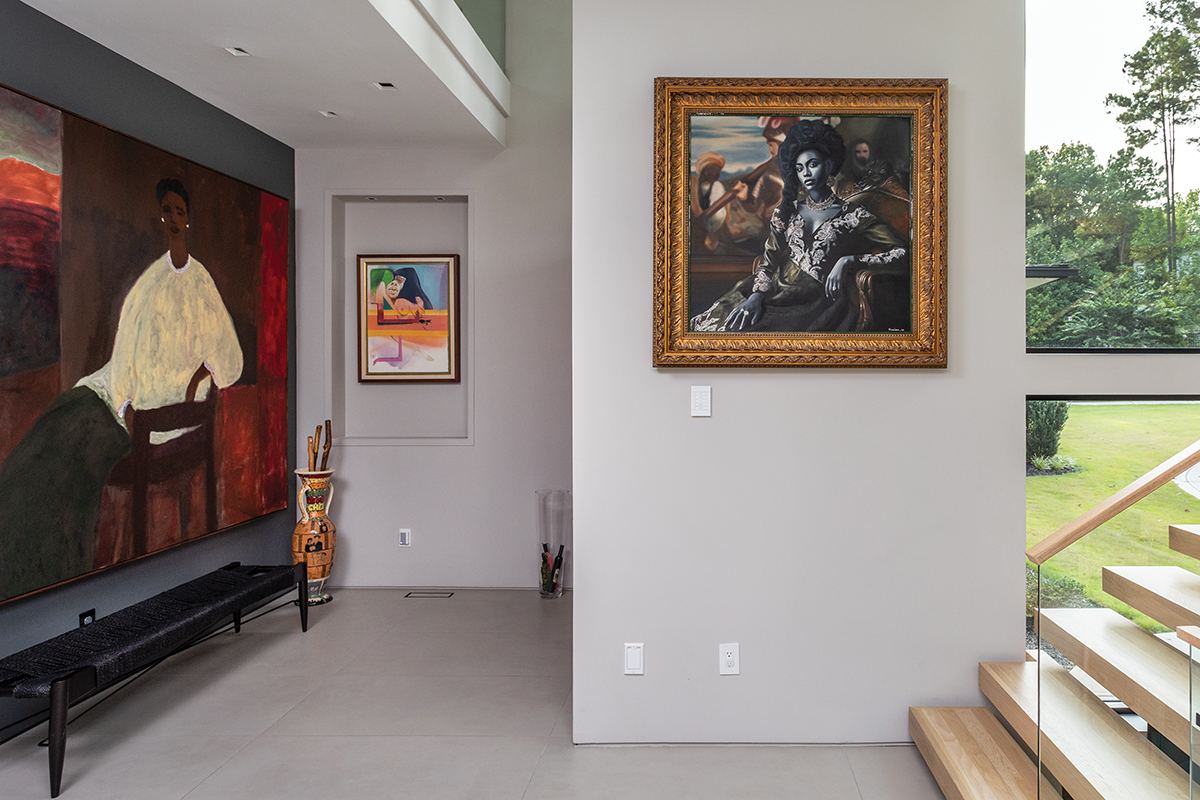
The Imafidons’ curatorial intent is evident from the minute you step through the front door, where a trio of works offers vastly different takes on portraits of Black women, by Haitian-American painter Patrick Eugene, Rwandan painter Izere Antoine and Ugandan visual artist Kansiime Brian Lister. “I love the brushwork and texture” in the Eugene piece, says Tim. “It reminds me of my mother; she had the same sense of calm.” Tucked into a corner is a vase Tim commissioned from Puerto Rican-American ceramic artist Roberto Lugo that depicts the story of his parents’ relationship, from when they first met.
Tim designed the home with DRB Design and WOLK360, and built it with Mike Evans of MJ Evans Homes, while Marquita Richards of Kikomarque handled furnishings, lighting and the kitchen and bath. The entryway leads to a double-height living area, where floor-to-ceiling windows showcase the pool and the woods beyond.
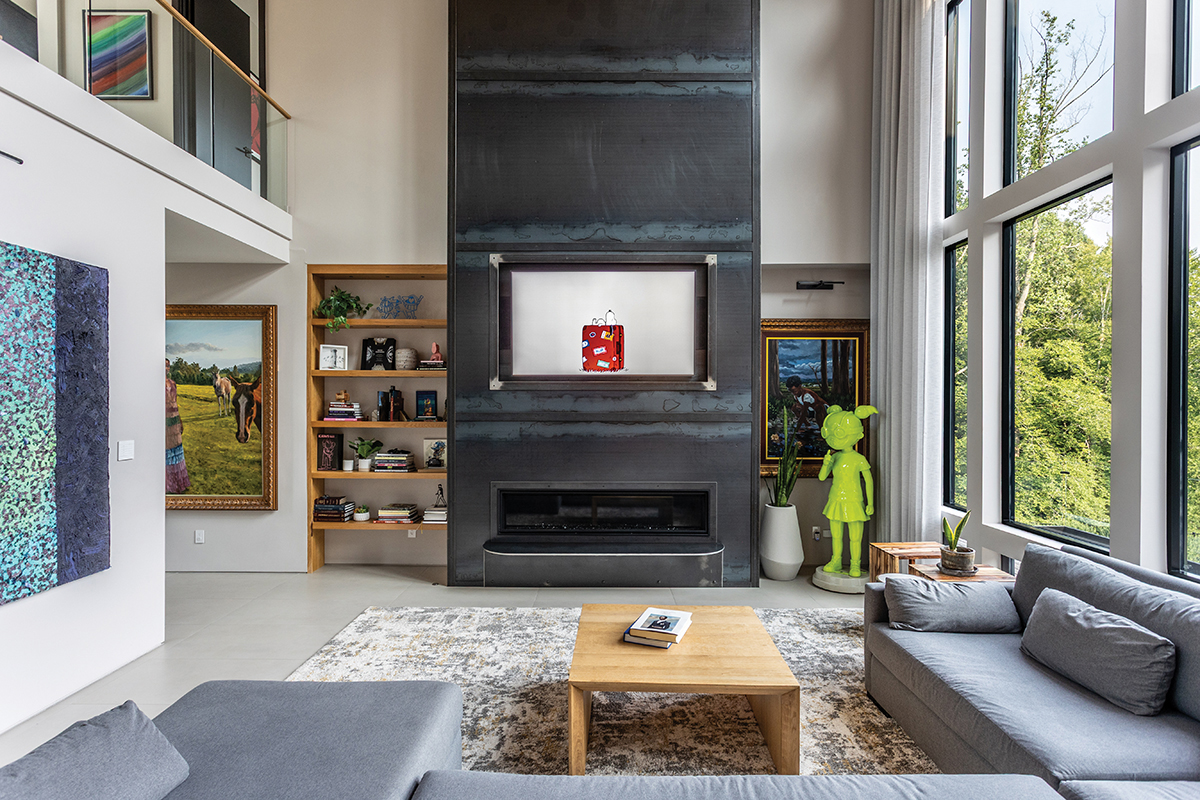
An inviting sectional anchors the room, facing an oxidized-metal fireplace surround by Oak City Customs. In one corner, a sculpture of “Lil Mama,” a comic book-style girl inspired by the Tuskegee Airmen by American Afrofuturist Hebru Brantley, holds court next to a painting of a boy dipping his hand in a creek by American fine artist Terron Cooper Sorrells. “Hebru’s work was some of the first original art I collected. I love how this piece and the one I have downstairs remind me of my kids — he’s the dreamer, she’s the tiger,” says Tim. Nearby, an iridescent piece made of hundreds of bits of glass and gemstones by New York mixed-media artist Alteronce Gumby evokes a river.
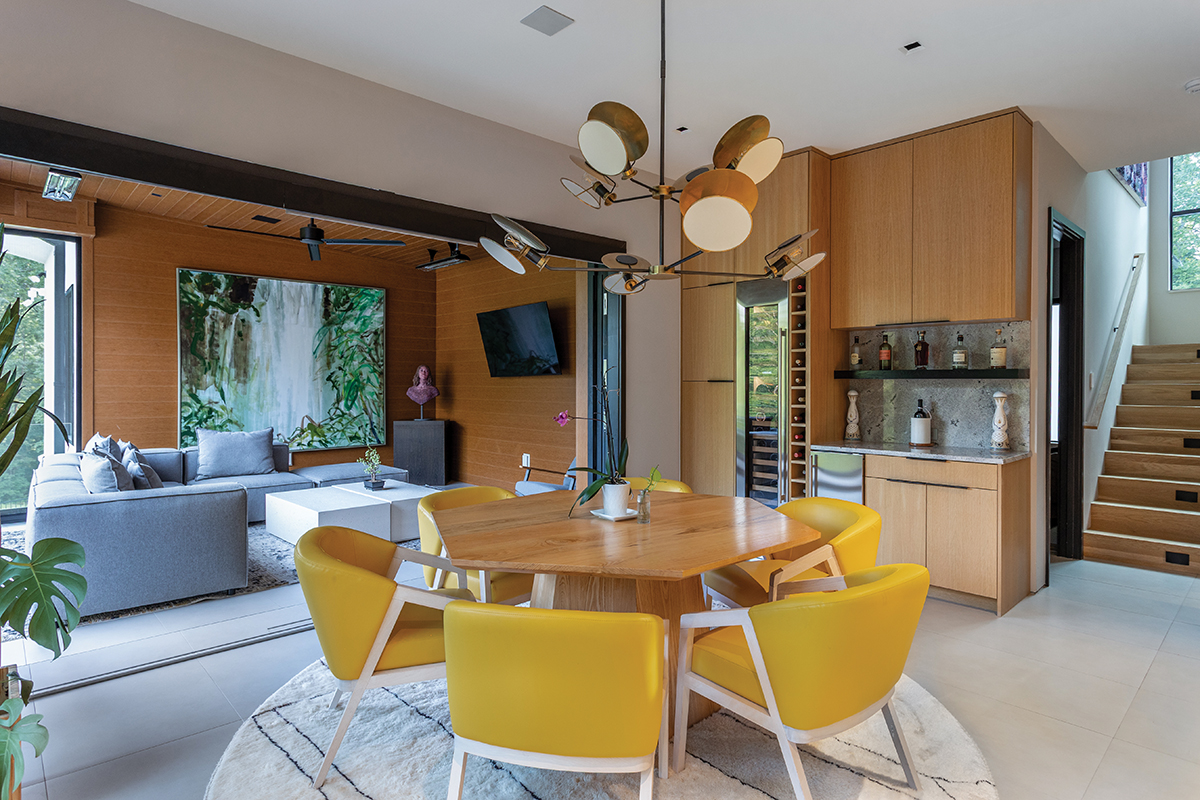
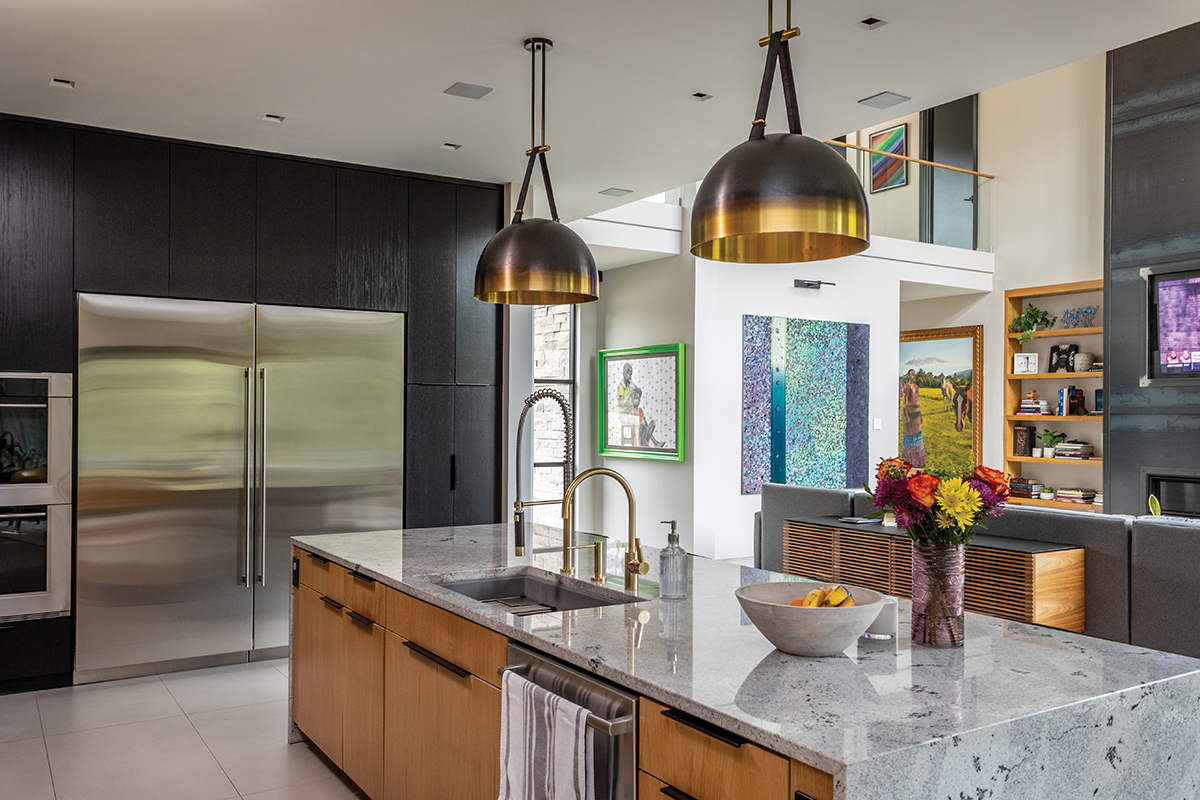
The living room opens to the kitchen, also designed with Richards: a streamlined space in black, chrome and natural wood. Beyond it, past a breakfast nook, is a screened porch whose doors slide open to fully connect the spaces. Tim commissioned the monumental abstract painting here from Chicago-based artist Terence Byas (known as Dredske); it resembles a waterfall but also evokes the green-white-green stripes of the Nigerian flag. Nearby is a bust by Nigerian sculptor Blessing Ejiro Adewale, on a custom stand by Raleigh’s Evan Lightner Studio. “This is one of our favorite spaces in the home,” says Erin.
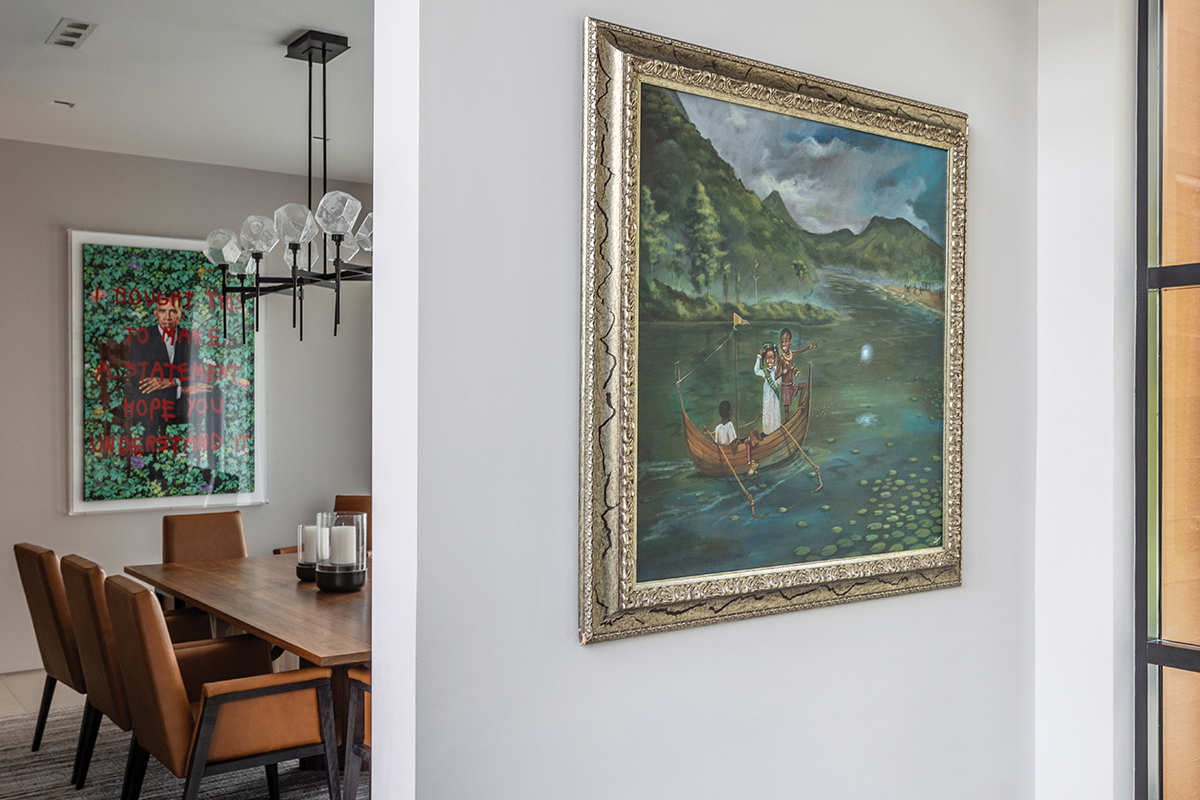
In the dining room, two paintings are hung in conversation: a satirical work by Cuban artist CB Hoyo, which layers text over a restaging of Kehinde Wiley’s famed portrait of Barack Obama, and a depiction of a child combing their sibling’s hair by Sanmi Adesiyan. “Taken together, it’s meant to be a commentary on how we can do anything — we control our destiny,” says Tim. “The portrait of Obama represents limitless possibility both for us and our kids; an inspiration,” agrees Erin. Leading into the space is a painting by Afro-Cuban artist Harmonia Rosales that imagines the family’s own fairy tale, one of the first pieces Tim commissioned. In it, Erin wears her Girl Scout sash and Tim wears clothes nodding to his Nigerian heritage. “We had Timothy at the time, but the artist added the second child — we didn’t know we’d be having a girl,” says Tim.
A hallway lined with black-and-white photographs Tim took himself, along with portraits of the family by Brittsense and a black-on-black abstract piece by Francesco Campanella (known as Lefty Out There), leads to the primary. Inside, one wall is tiled floor-to-ceiling in patterned wood as a focal point.
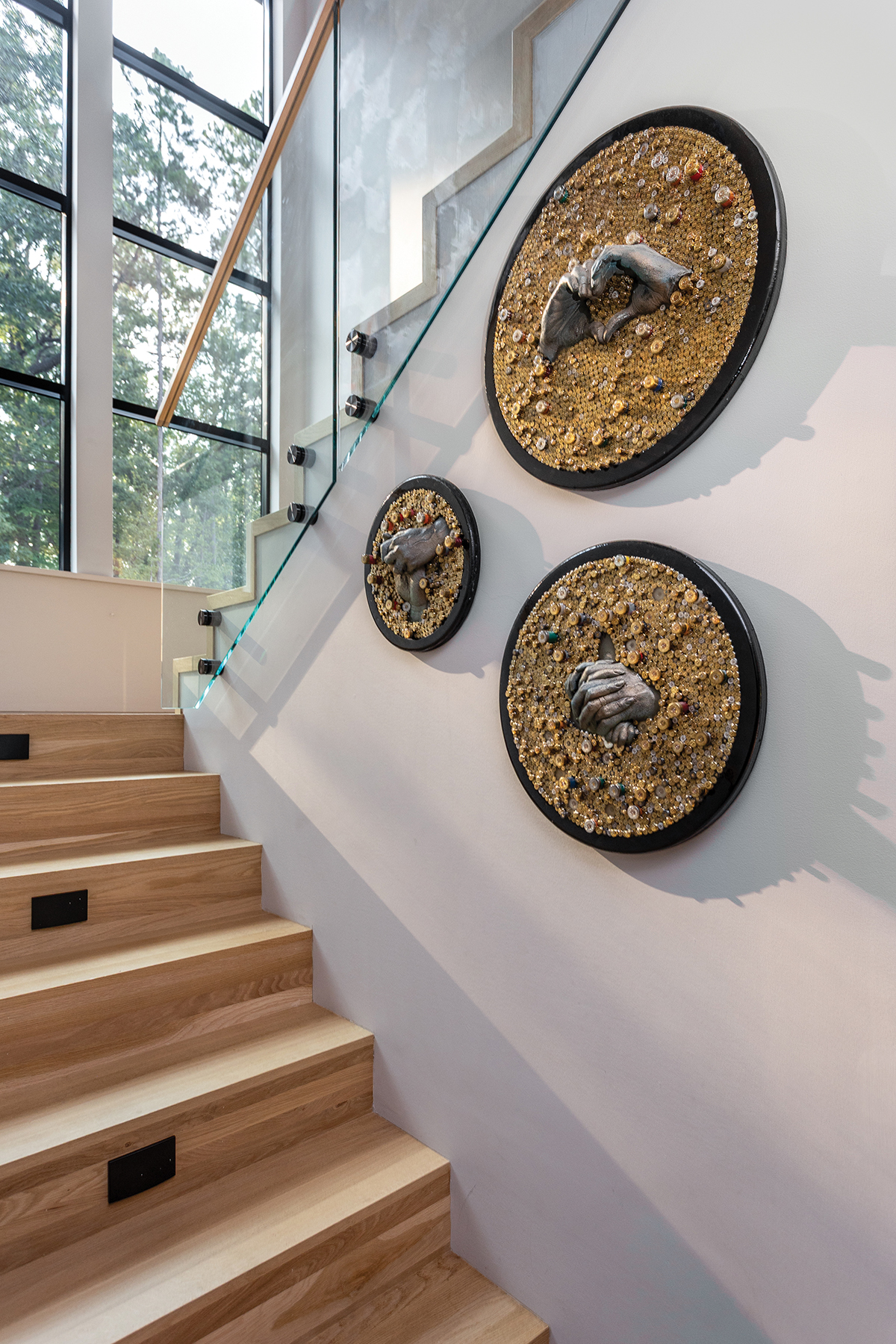
Upstairs, the kids’ rooms and a guest room open off an airy staircase that’s a gallery unto itself, anchored by a trio of works by Durham artist and Duke professor Stephen Hayes depicting cast-bronze hands — some of which Hayes cast from the family itself — in a field of bullet casings. “All four of our hands are represented here,” says Tim.
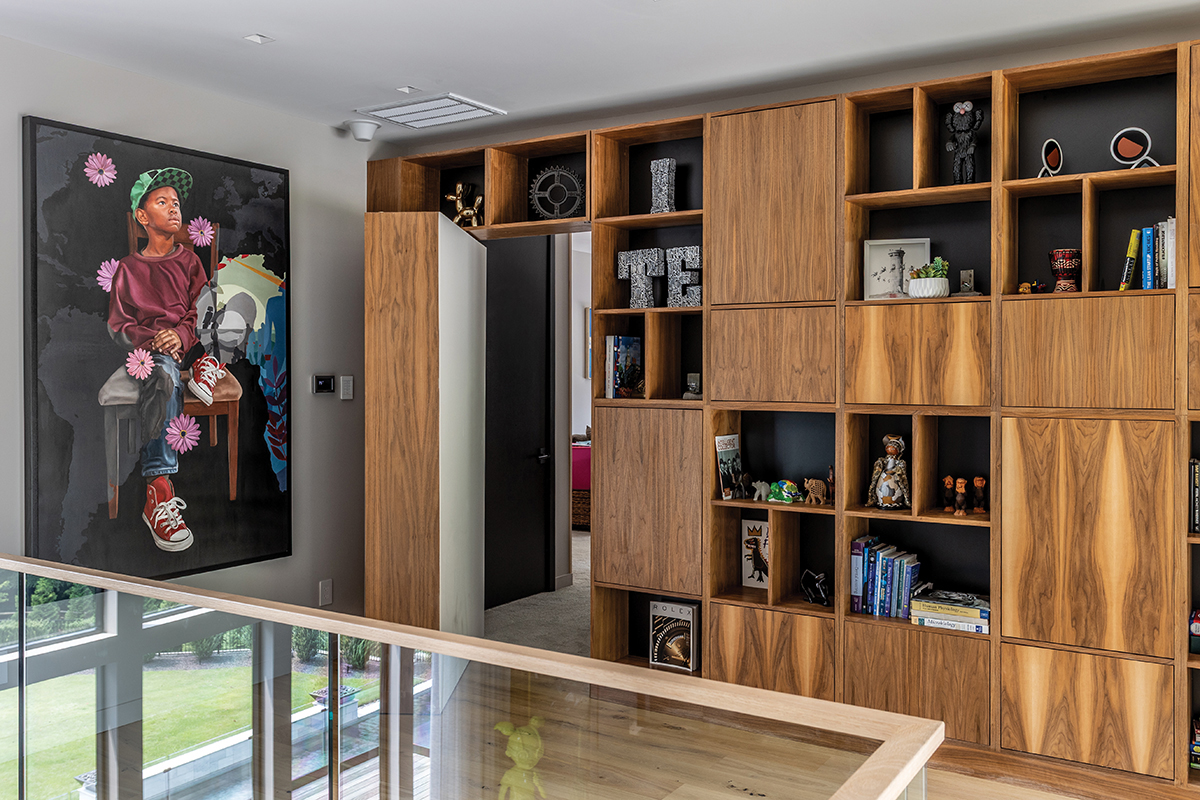
A bookcase with a secret door, designed with Bradley Woodcraft, leads to the kids’ rooms and play area. Nearby hangs a depiction of a boy with one foot in Africa and the other in North America, by Los Angeles artist Floyd Strickland. “It made me think of my own story, having grown up in the United States but with roots in Nigeria,” says Tim.
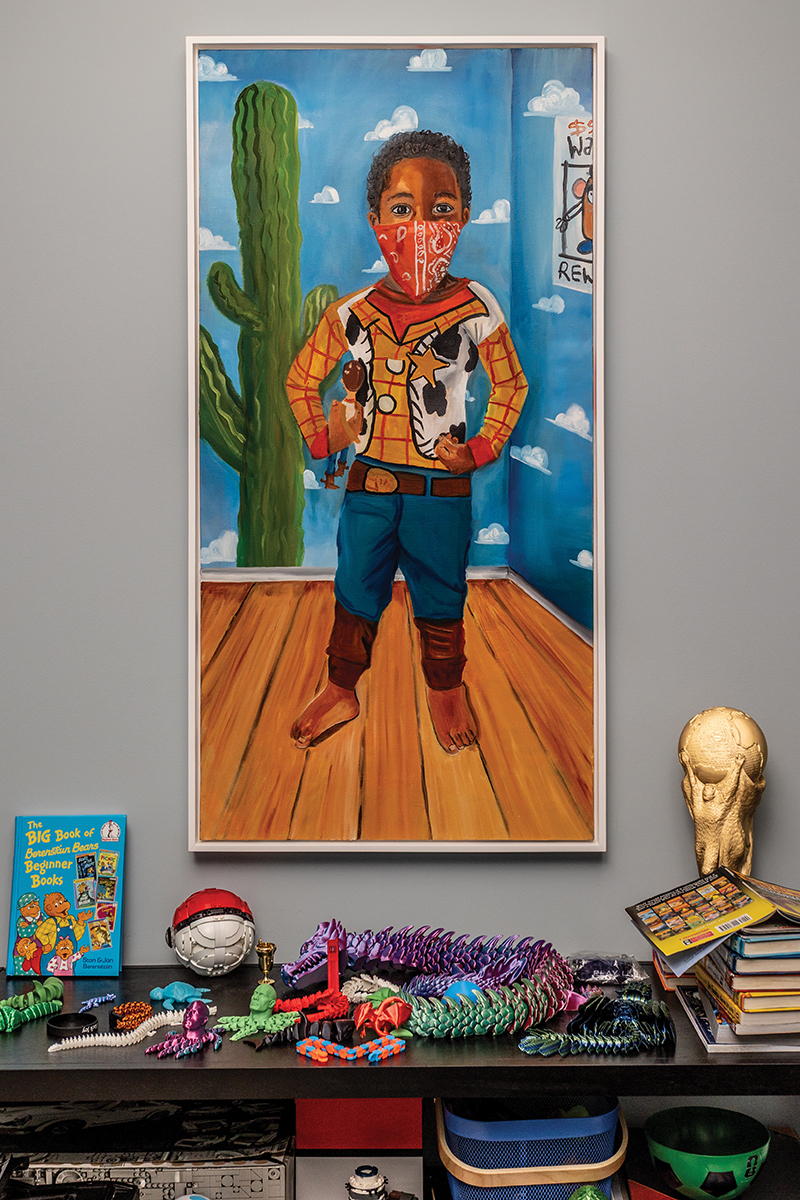
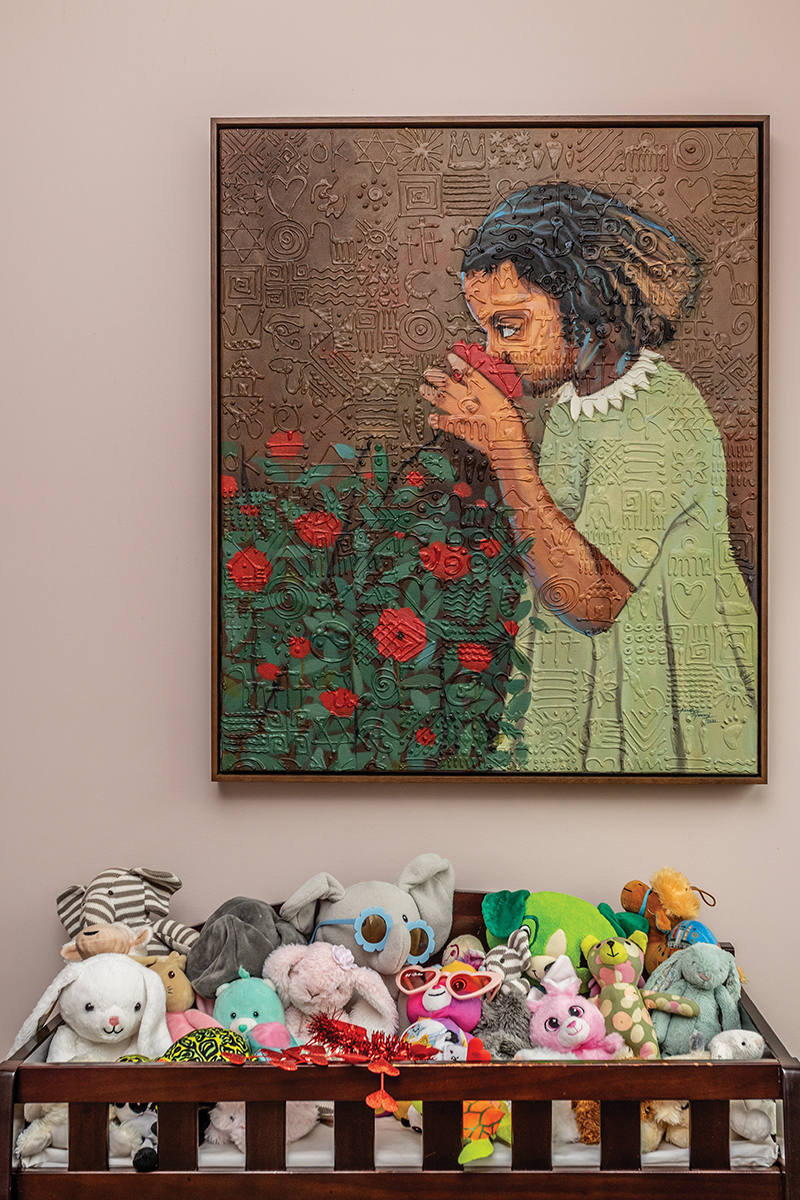
The kids’ own spaces get original art too, just more playful: character-style faces by Hebru Brantley in the playroom; a painting of a cowboy by Maryland artist Lex Marie in Timothy’s room; and, in Amanda’s, a girl sniffing a rose by Nigerian artist Awodiya Toluwani, painted over high-relief symbols evoking African language and tradition. The guest room mixes genres and mediums, from South African artist Turiya Magadlela’s layered-textile work to Brooklyn artist Derrick Adams’ backwards-facing swan rider to a pink-toned abstract by Patrick Alston — the kind of color that has Tim reconsidering his own taste. “I didn’t think I liked pink, but then I look at these paintings and realize that I do,” he laughs.
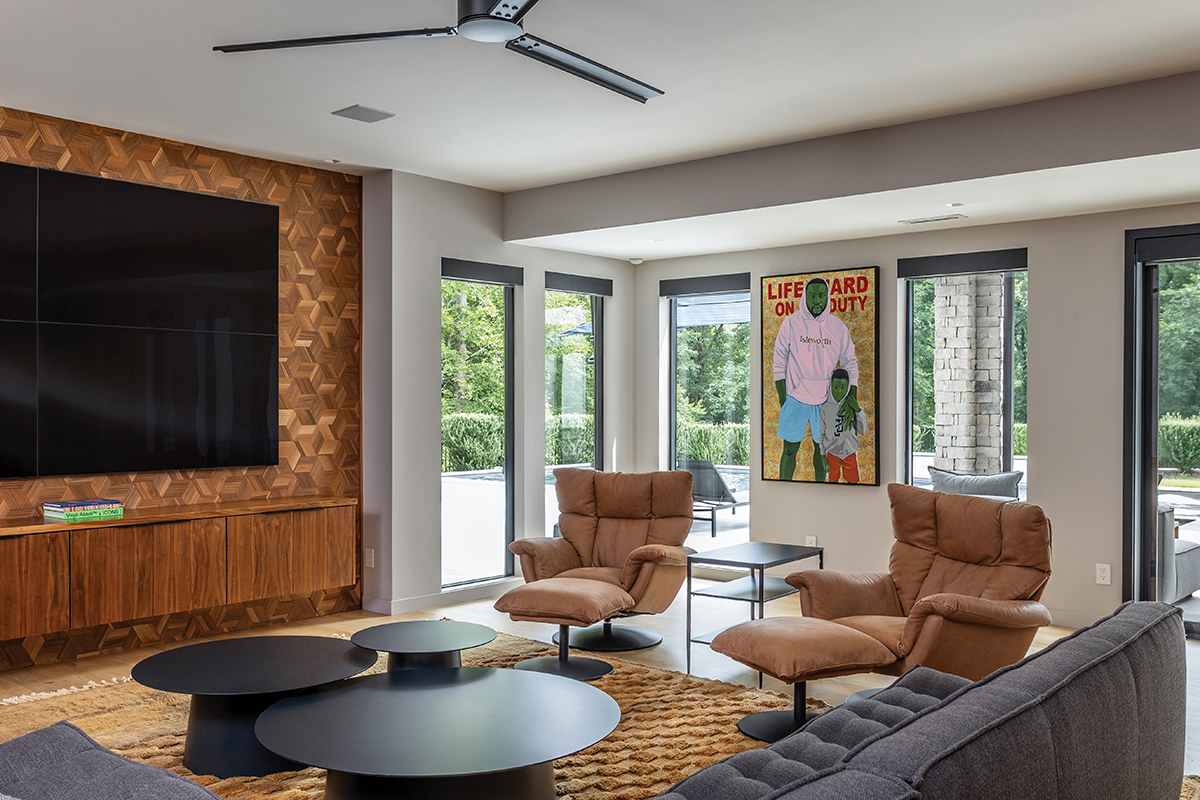
Downstairs, the garden-level family room and entertaining space holds the collection’s most personal work: a large impressionist family portrait by French artist Jerome Lagarrigue. An early Clarence Heyward painting hangs nearby, and on the opposite side of the room is a more recent piece Heyward painted of Tim and his son, called Lifeguard on Duty, in the chroma key style of the artist’s Swimming Lessons and In My Hood series. “Lifeguard on Duty represents so many layers of love, protection and exposure — the three things we have used to grow our family,” says Erin. Nearby, red-toned abstracts by Nigerian painters Michael Igwe and Victor Olaoye hold court near a “Fly Boy” sculpture by Brantley.
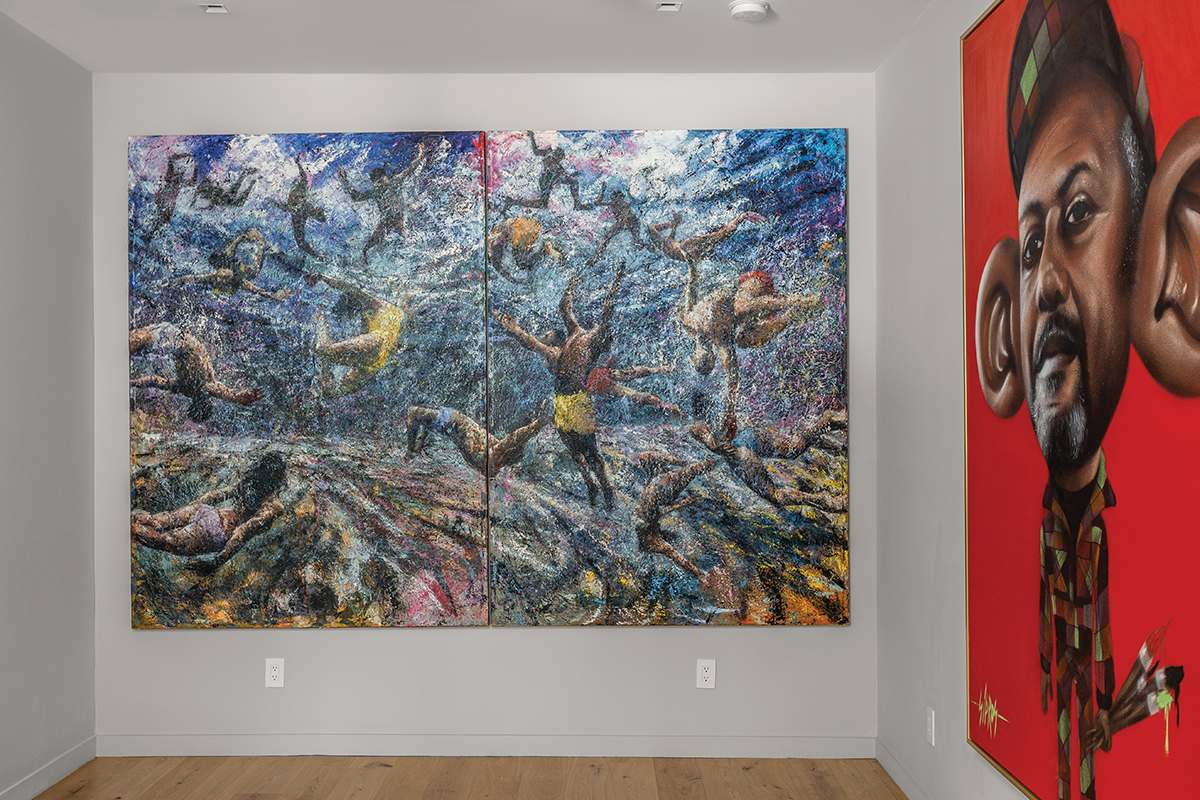
In another room are a pair of large paintings: a group of swimmers by Nigerian multimedia artist Chika Idu, a favorite of young Timothy’s (“I think it’s cool how the people are swimming and doing tricks,” he says), and a caricature-style portrait by Brazilian artist Wellington Naberezny (known as Sipros).
Many of the artists the Imafidons collect have risen in prominence since the couple first discovered their work, and a few have been lent to museums — but buying art as an investment was never the intent. “We started building this collection because this was work that resonated with us, that meant something to us. For us, the value is personal,” Tim says. Living with this art takes judgment, too: “We’ve had to move a few pieces away from where the kids might be throwing a ball.”
Ultimately, it’s about connecting with the work, supporting emerging talent and teaching their kids to appreciate both art and artists. “It’s been a fun journey, it’s been great to meet different artists and be part of their story,” says Tim. “The kids get excited when we bring home a new piece. They like to explain the work to our guests.” Do they have a favorite piece? “All of them are my favorite,” says Amanda.

This article originally appeared in the October 2026 issue of WALTER Magazine.