Raleigh artist Jackie Sanders uses materials like paint, acrylic panels and more to create a mix of abstract and figurative work
By Colony Little | Photography by Joshua Steadman and Light Creative Photography
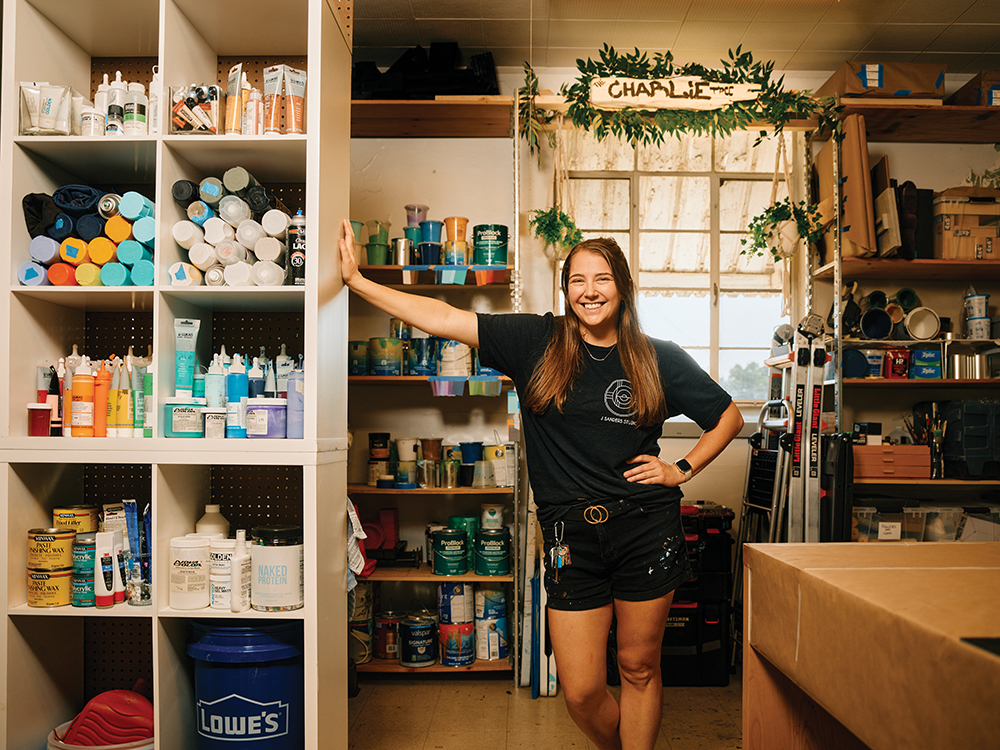
Jackie Sanders recently christened the window of her new studio space with a sign that reads, “The Charlie Tree.” The
window overlooks mounds of excavated dirt surrounding Bonded Llama, a cooperative art studio tucked away in a converted warehouse office space along Capital Boulevard’s industrial corridor. This artist enclave, she says, is relatively unknown. “Despite being pretty well connected with other artists in the area, none of them have ever mentioned this space, and it’s been here for 20 years,” she says. “I’m on a mission to make sure people know about it!”
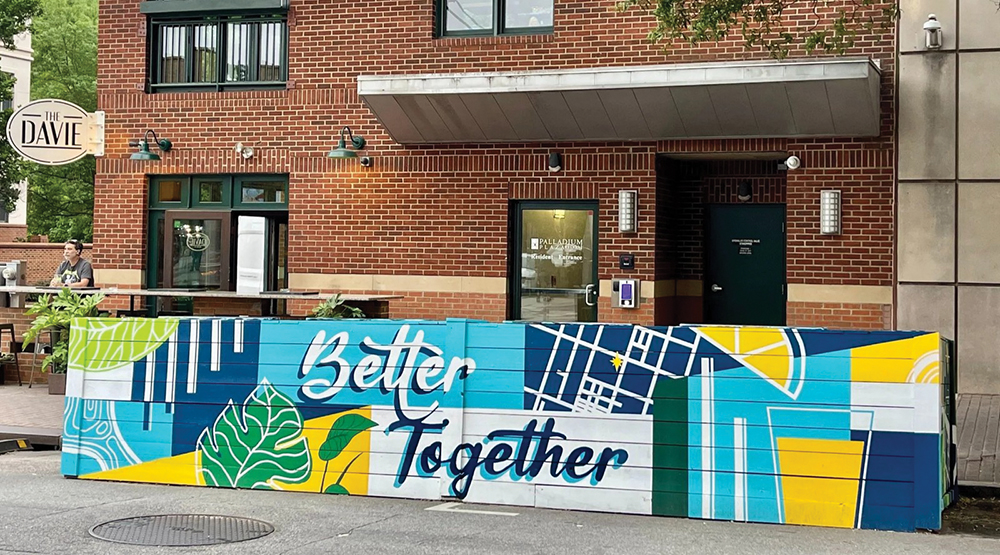
That spirit tracks with her work: Sanders is known for creating visuals that draw attention to overlooked places. Her colorful murals enliven objects in public spaces, from signal boxes to storm drains, through bold shapes, sharp lines, vibrant botanicals and figurative elements.
Sanders has long understood the importance of thoughtful placemaking. She grew up in Maryland, immersed in both design and business: her father was an architect and her mother managed the family’s architecture firm. Early on, Sanders learned how to appeal to their professional sensibilities to indulge her own artistic pursuits. In grade school, she submitted a written proposal to convert her bedroom closet into her very first studio. “I made the case to my parents that I never use any of the clothes in my closet, and my mom always would complain that my art stuff was all over the table,” she recalls. She included a scale drawing of her bedroom to show where the furniture could go. “My dad was proud of it, so he taught me how to properly measure out the room — it was a very fun lesson,” she says.
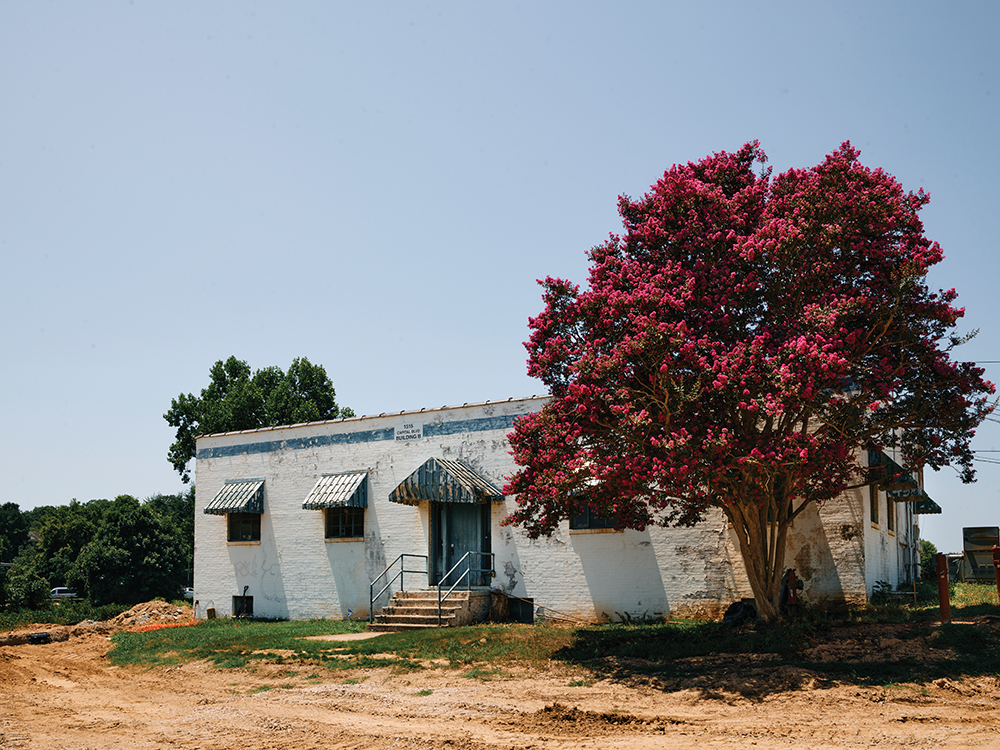
The sign in her current studio is from the space Sanders used as a studio in high school. “It was an old tree house that had a ramp going up to it and a tree through the middle, which decided to name ‘Charlie Tree,’” Sanders says. That studio was where she created work that she would later use for the portfolio that she submitted to art school.
In 2016, after earning undergraduate and graduate degrees in art from Virginia Tech, Sanders moved to Raleigh to explore a new city. The sign moved with her — to a home studio in her Raleigh apartment, followed by a six-year stint at Artspace and on to the Bonded Llama. Fashioned from distressed wood, it’s a contrast to the colorful, abstract paintings Sanders is known for.
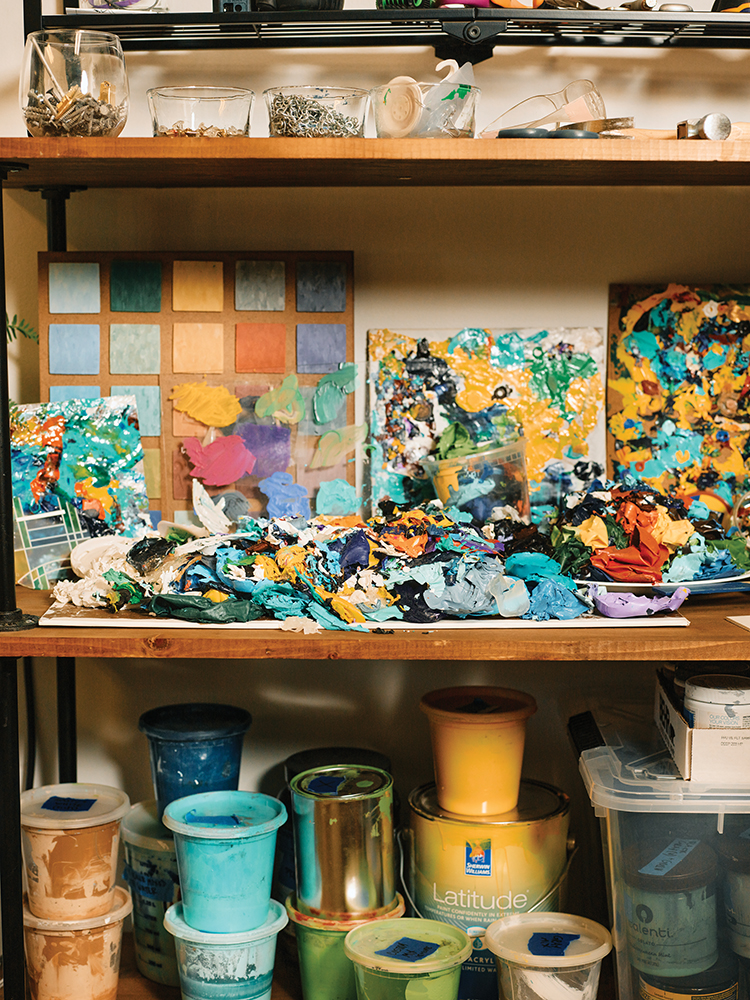
Sanders’ artwork often features repeated geometric shapes, like concentric circles bisected by gridlines and hashmarks that resemble the mappings of connections on a printed circuit board. (A stack of circuit boards can indeed be found among the tubes of acrylic paint, wood panels, sheets of plexiglass and other materials in her studio.) She paints on a variety of surfaces and materials, from canvas to wood and glass, experimenting with the way scale, light and space influence the work. “The exploration of material has always been a big part of my work,” she says.
That exploration is evident in her studio. There, you’ll find plexiglass pieces she calls “color catchers” that cast kaleidoscopic hues when light passes through them. There are small printed plexiglass discs and designs painted on glass displayed in wooden float frames, along with traditional acrylic paintings and commemorative plaques.
In addition to painting different surfaces, she experiments with different technologies and printing practices, some of which she learned in college and through working in a laser engraving studio. Lining one of the interior windows of her studio is a prototype panel of a mesh screen she created for a client using a printing process that cures through ultraviolet light. “It’s essentially a flexible ink — you can print on any material including glass, crystal and wood,” she says. “Being exposed to that early technology and being hands-on in producing all of these objects has always been very interesting to me.”
Often the first step in Sanders’ creative process is journaling. “Writing is really the start, then I move to sketching, where I begin to translate an idea or emotion into a visual piece,” she says. When Sanders operated her public-facing studio out of Artspace, she would often share the journal entries that prompted her work with visitors on First Fridays. “Many of these were a series of questions about things I don’t know, or things I wish I knew,” she says. “These questions become these very abstract, yet universal works that connect with larger emotions like longing, loss, unknowing, hope, optimism or excitement.”
The titles of some of her works correspond to those questions. One painting, titled What Would That Take?, depicts rectangles of various sizes, each a distinct color palette — purples and blues in some, yellows and greens in others. To her, it feels as if she’s mapping out the possible answers to the question she poses, and it invites the viewer to explore their own answers.
Sanders is attuned to how viewers experience art. This approach was largely borne out of her graduate school experience at Virginia Tech, studying material culture and public humanities, or the history of society through objects. She was particularly interested in the relationships between objects and the viewer within exhibition design. “It’s not just how the work is made and the creative voice, but the way you present the work that influences how people interact with it,” she says. While in school, she volunteered with the welcome center at The Moss Arts Center and recalls an exhibition that specifically explored this idea. “It was abstract art, very nature-focused, but all large-scale works,” she notes, “and throughout the exhibition they changed the orientation of the work and where it was displayed.” Sanders noticed how visitors engaged with the art during the show’s various iterations. “Orientation drastically affected people’s interactions with the piece,” she says.
During her early years in Raleigh she sought out others interested in exploring materiality and experiential applications in their art practice. Artist and curator Sterling Bowen, whom she met through one of VAE’s artist interest groups, was one of those early creative influences. “We shared a focus on non-figurative strategies, including a propensity to iterate on ideas before fabricating them, so we bonded,” Bowen says. “I appreciated that she was interested in materials and how to develop her voice through them. We’ve talked a lot about the integration of art with life — where does our practice bleed over into the objects and interventions that take it out of the white cube?”
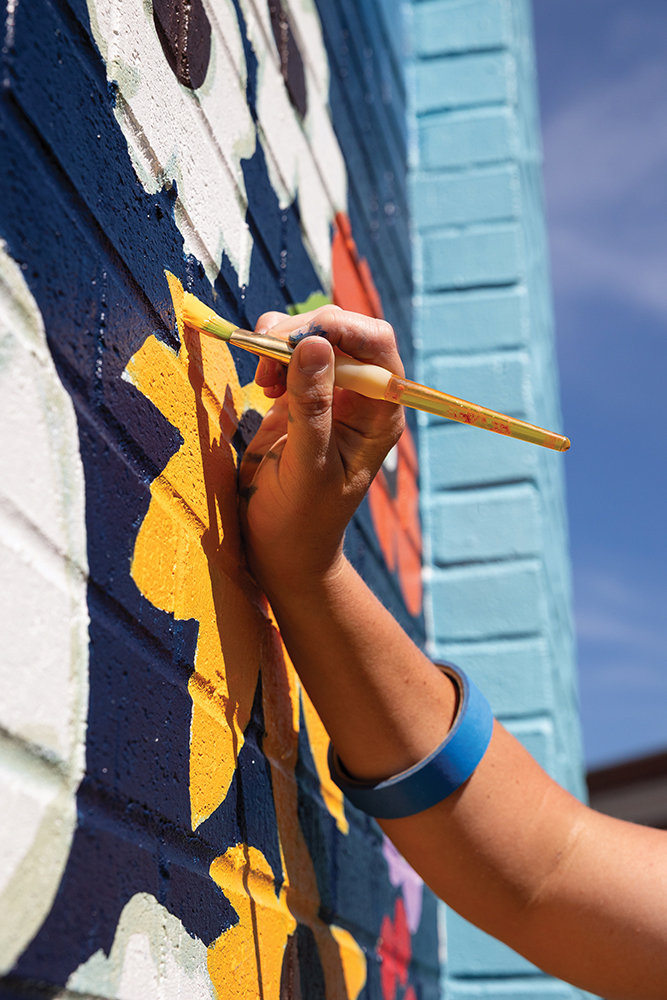
Location and scale also offer different experiences with art, and Sanders has recently incorporated street art and murals into her practice. She created her first mural in 2023, painting her signature shapes onto a concrete skate barrier at the Conlon Family Skatepark. That project led to larger commission at the King’s Auto nearby. “A huge part of my practice is making site-specific murals that can become local landmarks,” says Sanders. Her latest mural was her biggest to date, a piece commissioned by the city of Holly Springs depicting symbols that reflect the city, including local flora and fauna and the clock on top of the Town Hall building. “Seeing how intentional they were with wanting a mural to celebrate the community was a really great process,” she says. “As I was painting, I could see people connecting with it.”
Sanders is eager to move more fully into this new phase, but also looks forward to exploring other forms of creation. “I’ve loved making this body of work, but do I want to evolve in a different way?” she says. “I’m allowing myself to sit in these questions rather than having the answer.”

This article was originally published in the September 2026 issue of WALTER Magazine.