The new Jobe House on Raleigh’s West Morgan Street is a hub for arts nonprofits including VAE Raleigh, Arts Access and Artspace’s artist in residence
by Ayn-Monique Klahre | photographs courtesy VAE Raleigh
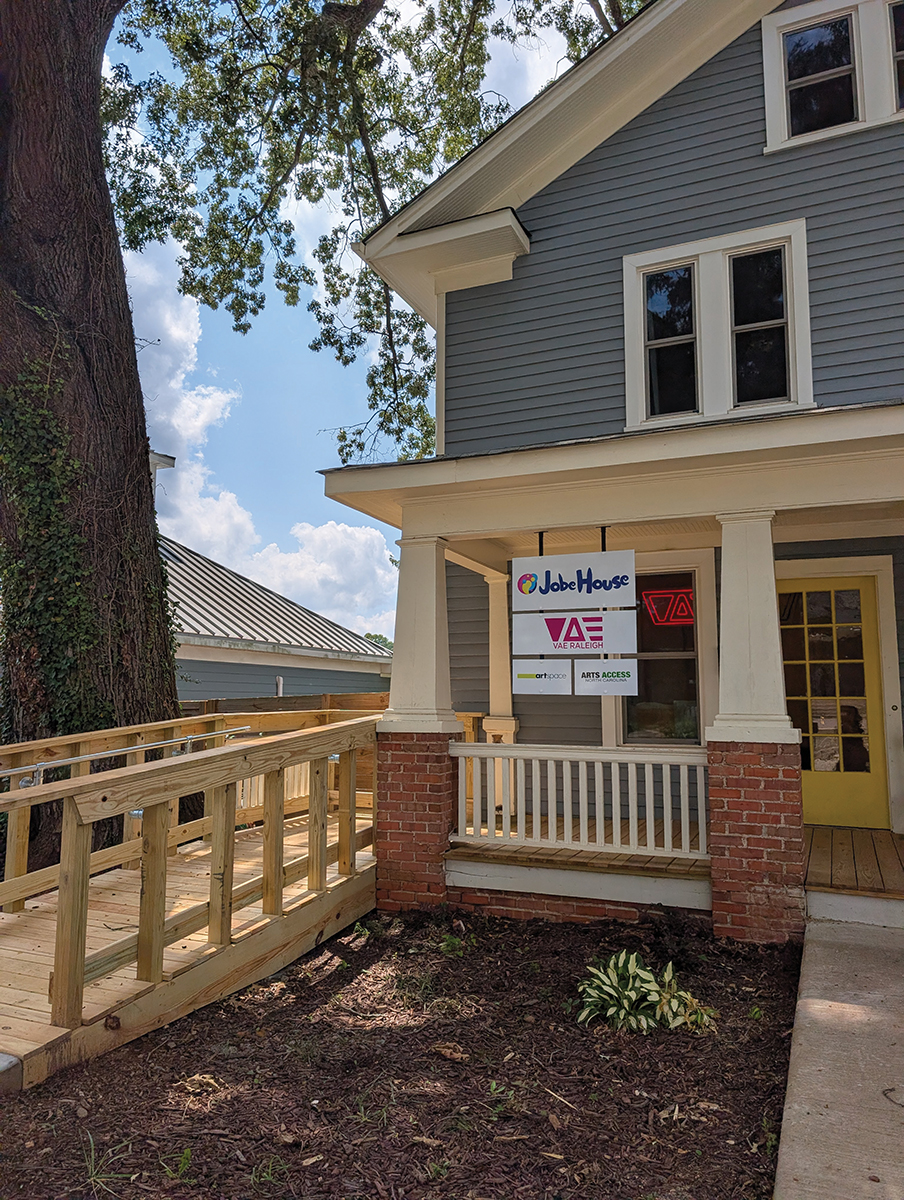
A new arts hub has taken up residence along that burgeoning bend on W. Morgan Street. Called the Jobe House, it’s serving as the office, exhibit and event space, and temporary residence for several arts nonprofits. “It allows us to share resources—both in terms of brainpower and utilities,” says Jean Gray Mohs, co-executive director of VAE Raleigh.
The house is named for its longtime resident, Mary Anne Jobe, who passed in 2022. Jobe, a Raleigh native, worked for the state of North Carolina for more than 40 years; in retirement, she worked as a docent for the NC Museum of History and supported the NC Symphony. In the neighborhood, she was known for spending time sitting on the front porch and chatting with passersby. Now, a trio of rocking chairs invites the Jobe House’s occupants to do the same. (Mohs painted them a vivid pink to match VAE’s logo.)
The home, which had previously been used as an Airbnb, became available through a partnership with the nonprofit Carlyle Adams Foundation. “Given the challenges facing the nonprofit community, the Carlyle Adams Foundation sought an opportunity to repurpose the Jobe House into an arts hub with a combination of subsidized coworking and programming space and an artist residence,” says Emily McLoughlin, managing director at Purposefuel Marketing, which consults for the foundation. “VAE collaborated with other arts nonprofits to bring the vision to life.”
The space, which opened in March, currently houses VAE Raleigh and Arts Access; both share the downstairs for office hours. In time, they hope to incorporate up to four other arts nonprofits. Upstairs, Jobe House is hosting Artspace’s current Emerging Artist in Residence, Sky Dai, for the year; there’s another room available for visiting artists as well.
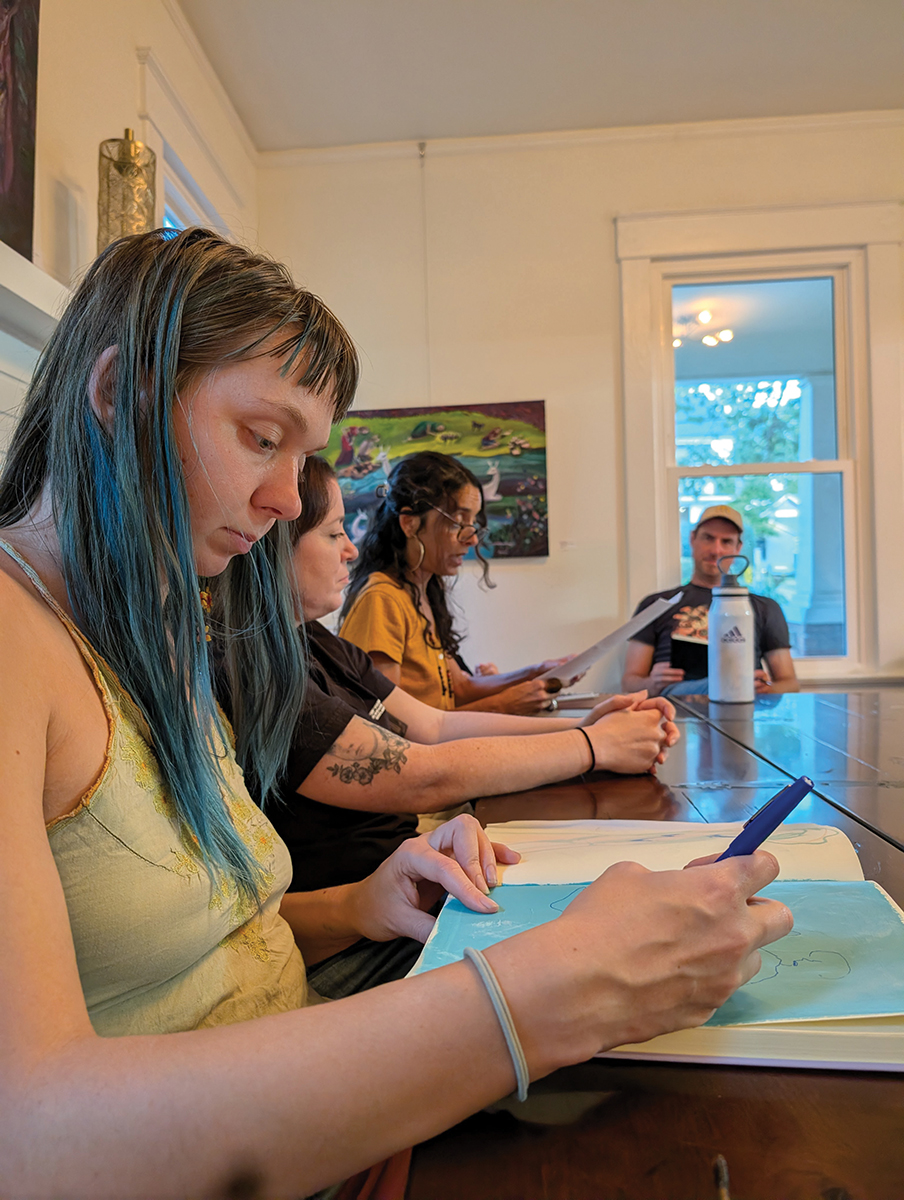
On the main floor, “everything can be moved; it’s a flex space,” says Mohs. So far, they’ve hosted several exhibits, crafting events and artist discussions. Small School has started hosting monthly dinners there, and they’ve reserved some mornings as office hours for working artists. “We serve coffee and tea; it’s a good admin time for artists,” says Mohs. “It’s a way to have that hive-mind mentality and grow within your practice.”
With Arts Access in residence, accessibility is top of mind. To that end, it was a priority to add a ramp to connect the porch to the sidewalk, and all the rooms—including the bathroom—have enough space for a person who uses a wheelchair to move comfortably. For exhibits, like its recent Prism showcase, paintings are hung lower, and large-print descriptions of the work are readily available at the front desk; audio descriptions are also available. “We’re just tapping each other’s resources,” says Aliana Ramos, interim executive director of Arts Access. “We hope to get to the point where we’re consistently open to visitors.”
Mohs, who is also a practicing visual artist, likens Jobe House to other out-of-the-box efforts in Raleigh, like VAE’s Birdland Gallery and Street View exhibit spaces, as well as artist-led maker and gallery spaces like Plum (the former Lump space) and Gallery 20 on Glenwood Avenue. “There’s just so much potential for collaboration and to act as a third space for artists,” says Mohs.

This article originally appeared in the October 2026 issue of WALTER magazine.