These frightening-looking birds may have some gross behaviors — but they play a critical role in North Carolina’s environment and beyond
by Mike Dunn
October in the Piedmont means cooler nights, the start of fall color and families preparing for some people’s favorite holiday, Halloween. Of course, Halloween is a time for treats, but it’s also a season full of eerie stories and images. I don’t usually think of the natural world as a scary place, but plenty of people associate certain critters with spooky traits — spiders, snakes and bats for starters.
Another local creature that some view as having a ghoulish reputation: vultures.
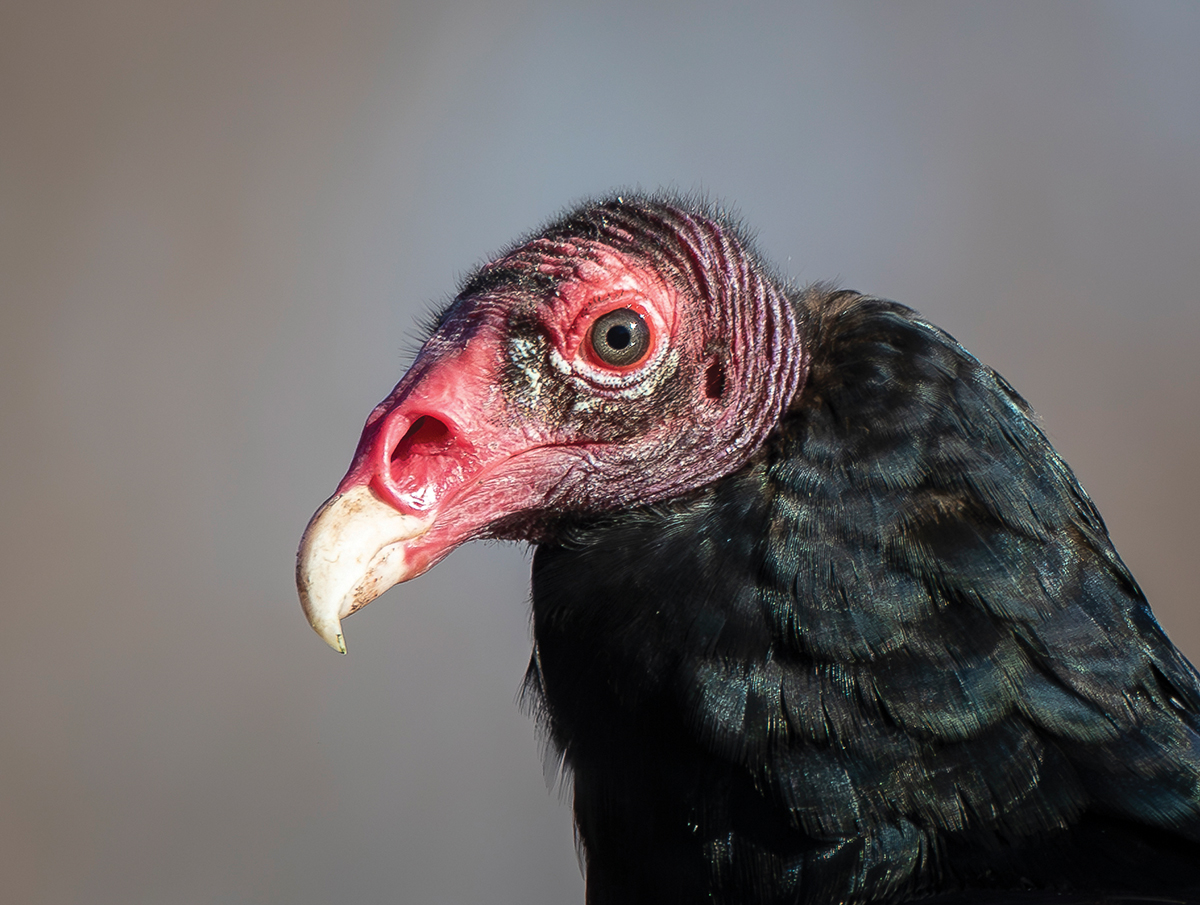
Why are vultures perceived as scary? Perhaps it is because we often associate death with scary scenes, and vultures specialize in making dead things into a diet. Often, when they’re featured in movies, they’re circling above someone in a desolate place, waiting for an unkind ending. And to be fair, the vulture’s appearance itself is a little frightening, as it resembles a feathered grim reaper with its dark coloration, naked head and scythe-like bill.
In the early 1900s, there were public calls to kill vultures due to fears of them spreading diseases from the dead animals they consumed. But the truth is just the opposite: vultures help stop the spread of disease and reduce numbers of unwanted scavengers like feral dogs and rats by removing animal carcasses from our environment. Some vultures, in fact, have stomach acids 100 times stronger than ours, with a pH similar to your car’s battery acid. This allows them to safely consume decomposing animals and helps neutralize any pathogens they encounter. Vultures are key members of nature’s “clean-up crew” and play a critical role in helping recycle the nutrients from dead animals back to the soil.

North Carolina has two species of vultures, the black vulture and the turkey vulture. Turkey vultures are larger and dark brown in color, and adults have reddish skin on their heads. (The resemblance to the head of a wild turkey is the origin of their common name.) Black vultures are slightly smaller, with dark gray heads and black feathers.
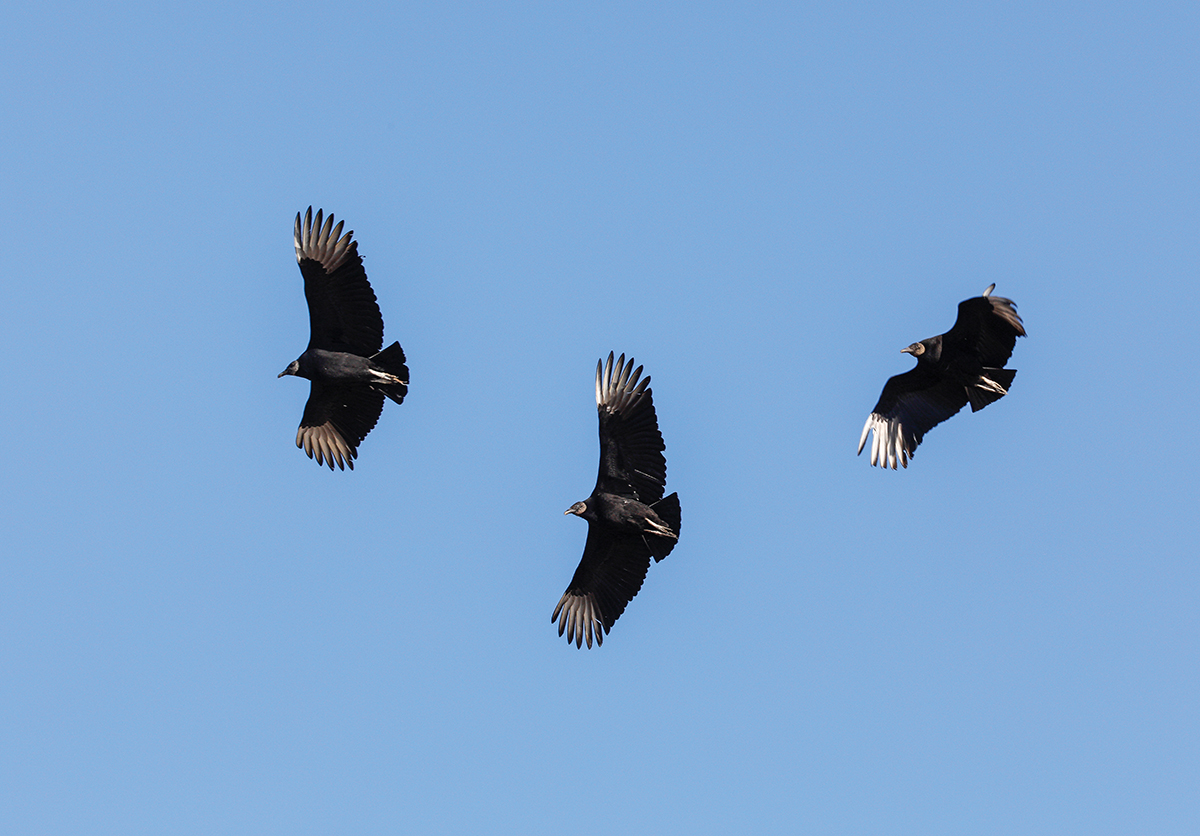
In flight, turkey vultures are able to soar on their 6-foot wingspan for hours with wings held in a slight V-shape (called a dihedral). To help people tell the difference between the two species I say the turkey vulture has a TV antenna shape to its wing profile. (Of course, I can only say that to people of a certain age, as younger folks have no idea what I am talking about when I say “TV antenna.”) Turkey vultures’ dihedral shape gives them a more stable flight and minimizes the need for flapping, undoubtedly saving them considerable energy. (Author Bernd Heinrich, a professor in Vermont who has written many books on nature, expressed it beautifully: “Vultures… find food by soaring, which has nearly the same metabolic cost as perching — it’s the equivalent of perching in the sky.”) Black vultures tend to flap more and hold their wings almost flat across (similar to many other raptors, like hawks and eagles). They also have a shorter tail and whitish patches at their wing tips when viewed from below.
Black vultures have become much more abundant in our area in recent decades, and studies show they are rapidly expanding their range northward and increasing population numbers. At a carcass, black vultures remind me of scenes from movies showing African Old World vultures (not closely related to their North American cousins) squabbling over a lion kill, with much squawking and wing-flapping as they maneuver for position. I pulled over at a feeding frenzy along the highway a couple of years ago where a group of about 20 black vultures were tearing into a roadkill deer. They were making quick work of the carcass, and I must admit it was a little difficult to watch. (In fact, the lack of head feathers that gives them a less-than-appealing look is an important trait for cleanliness, since they routinely stick their heads into a carcass to feed.) But I drove by a couple of days later and there was not much left on the scene. They are efficient recyclers indeed.
Though most of their diet is dead animals, black vultures have been known to kill small live animals such as opossums and even the occasional young livestock. On a truck-camping trip last year we saw a billboard in the Midwest featuring a black vulture photo and a message to contact the state department of agriculture if you were a farmer having problems with vultures and your livestock.
Vultures also can create some unusual issues in their interactions with us humans. On a trip to the Everglades several years ago, I came across a sign at a visitor center warning people that the black vultures might cause damage to your car. It seems vultures (and some other carrion-feeding birds around the world) have taken up the habit of tearing the rubber gaskets around windshields and the wiper blades on cars. Scientists think it may be due to the resemblance of these materials to tendons in the dead animals these birds usually feed upon. (Or maybe they are just working out to get in shape for the next feeding frenzy.) The park’s solution was to cover your car with a tarp and bungee cords, which were available to use for free in the visitor center.
Turkey vultures may be the kinder, gentler member of the avian recycling team. Even their scientific name, Cathartes aura, translates as “purifying breeze” or “golden purifier.” They tend to feed singly or in small groups. They have one of the best senses of smell in the bird world, with olfactory bulbs much larger than their black vulture brethren. Studies have shown that turkey vultures can find even small dead animals that have been hidden in stumps or hollow logs using their well-developed sense of smell. Black vultures must rely much more on their vision, and they often follow a turkey vulture to a kill site and then quickly take it over by the force of sheer numbers.

A good friend of mine, fellow naturalist Alvin Braswell (and longtime head of Herpetology at the NCMNS), shared a vulture-related story from his early teen years here in NC. He noticed some circling turkey vultures over a family farm field and had the idea to try to fool them into thinking he was a carcass available for lunch. (It seems true naturalists often think these kinds of thoughts to try to better understand our wild neighbors).
He shared this tale:
Lying still, face up, for a while got the attention of a vulture to investigate. It kept getting closer and closer. I tried to not even blink an eye. But when it flew about 15 feet overhead, I blinked — and it recognized my ruse! With rapid flapping, it departed. I considered trying again with a face cover to hide my eyes, perhaps using a roadkill critter carcass for assistance, but my mother objected.
His mother was probably in the right, but I can’t help thinking if he had just put a dead mouse in his pocket the story might have had a different ending.
I don’t think young Alvin had any fear of vultures, but there are a few more traits that may give others folks pause.

Vultures often congregate on bare branches with their huge wings outstretched, looking as if they want to welcome you into a gloomy embrace. Though ominous in appearance, it’s a behavior that can serve many functions, including drying wet feathers, thermoregulation (especially to warm up by turning their back to the sun) and exposing their feathers to the sun to help rid them of parasites.
Vultures lack a voice box, so they can only make harsh sounds like grunts, growls and hisses.
One of a vulture’s last lines of defense is to regurgitate if threatened. Needless to say, when your last meal was a dead animal, that can be a foul-smelling substance.
And on the other end, vultures have a unique way of cooling off when it’s hot: they defecate on their legs and feet (called urohidrosis). This helps reduce their body temperature through evaporative cooling.
In spite of their many unusual (and smelly) habits, vultures are well-adapted to their unique lifestyle and play an important role as nature’s recyclers.

This article originally appeared in the October 2025 issue of WALTER magazine.