Using fabric and paint, the artist creates mesmerizing, color-jangled pieces that blur the line between painting and quilting.
by Liza Roberts | portrait by Lissa Gotwalls

The paintings of Barbara Campbell Thomas are often warped, subtly but unmistakably. Their geometry, the linear shapes and pieces and colors that comprise them, have a slightly distorted quality. Rectangles are implied, but some appear to have had a bounce or inhaled a lungful of air. Others seem to have been shaken up or spun around. That’s partly due to the kinetic energy they capture, which seems to indicate recent — even ongoing — movement. It’s also because they are surprising. Campbell Thomas calls these works paintings, but a careful look makes it clear they are made mostly of pieced fabric. They’re quiltlike, hand-sewn, dimensional. Stretched in unexpected ways. And then painted.
“The pulling and the tension is still an important part of it,” she says. “It’s become even more magical. I spend all of this time in this initial phase, and I kind of have an idea of what it’s going to look like when I finish. Then I put it up, and it’s interesting to see what has been pulled and how the image has come to life in a different way.”
Campbell Thomas is the director of the School of Art at University of North Carolina Greensboro and has taught there for more than two decades. Her resume is filled with solo and group exhibitions at museums and galleries around the country. Last year alone, her work was shown in solo and two-person exhibitions in Chicago, Illinois; Milwaukee, Wisconsin; Charlottesville, Virginia; and Columbus, Ohio. She has been awarded a number of prestigious residencies, including at the Virginia Center for Creative Arts, and has been a recipient of a North Carolina Arts Council fellowship.
When she takes on a new body of work (like the 10 paintings she’s currently preparing for a November exhibition at Charlotte’s Hidell Brooks Gallery), she approaches it with the businesslike, step-by-step planning of a senior academic administrator — but she executes that work with daring and intuition. Campbell Thomas has learned to navigate this duality effectively with time, even as her art has become increasingly complex and her process more fully immersive.


“The piecing and sewing portion has become more complicated and elaborate, involving a lot more small pieces of fabric,” she says. “I’m understanding that layer of the process in a deeper way, so I’m spending more time in that part of the process.”
The stretching of the pieced fabric, which creates its cantilevered quality, comes next. Once this “ground” of her paintings is set, Campbell Thomas hangs them all around her in her studio. In that way, her physical space can better reflect her “headspace,” she says, “and then the imagery: I understand better what it wants to be.” She can visualize how paint and collage will come together upon these sewn surfaces: “The movement of the pieces feels like the big strokes,” she says, “and the collage will be how I refine them, add nuances or cover things that need to be pushed down. The paintings become more refined. I begin to understand how to contend with the edges.”
The studio where she does this work, next to her house in rural Climax, North Carolina, is about 14 miles south of Greensboro. It is a color-jangled, layered collage of a space, overflowing with textiles, history, tradition, mysticism, books, paints, and threads and fabrics of every imaginable color, pattern, size and shape.
What’s outside — the fields and trees and open expanse of nature — is just as important. “I live out in the country and walking has been very important to me for my whole life. Walking on country roads, being in a beautiful landscape, has always been a touchstone,” she says.
Lately, Campbell Thomas has been creating “landscapes” of a different sort: “I’ve been thinking about inhabiting a body, and what it means to feel somehow spacious internally. What would it be to create landscapes that are suggestive of our interior landscape? How do we create spaciousness for ourselves?”
The fractalized nature of her paintings, the way they often begin in the center and move out to the edges, is her way of representing that phenomenon: “That’s me grappling with that question: how do we inhabit interior spaciousness?”
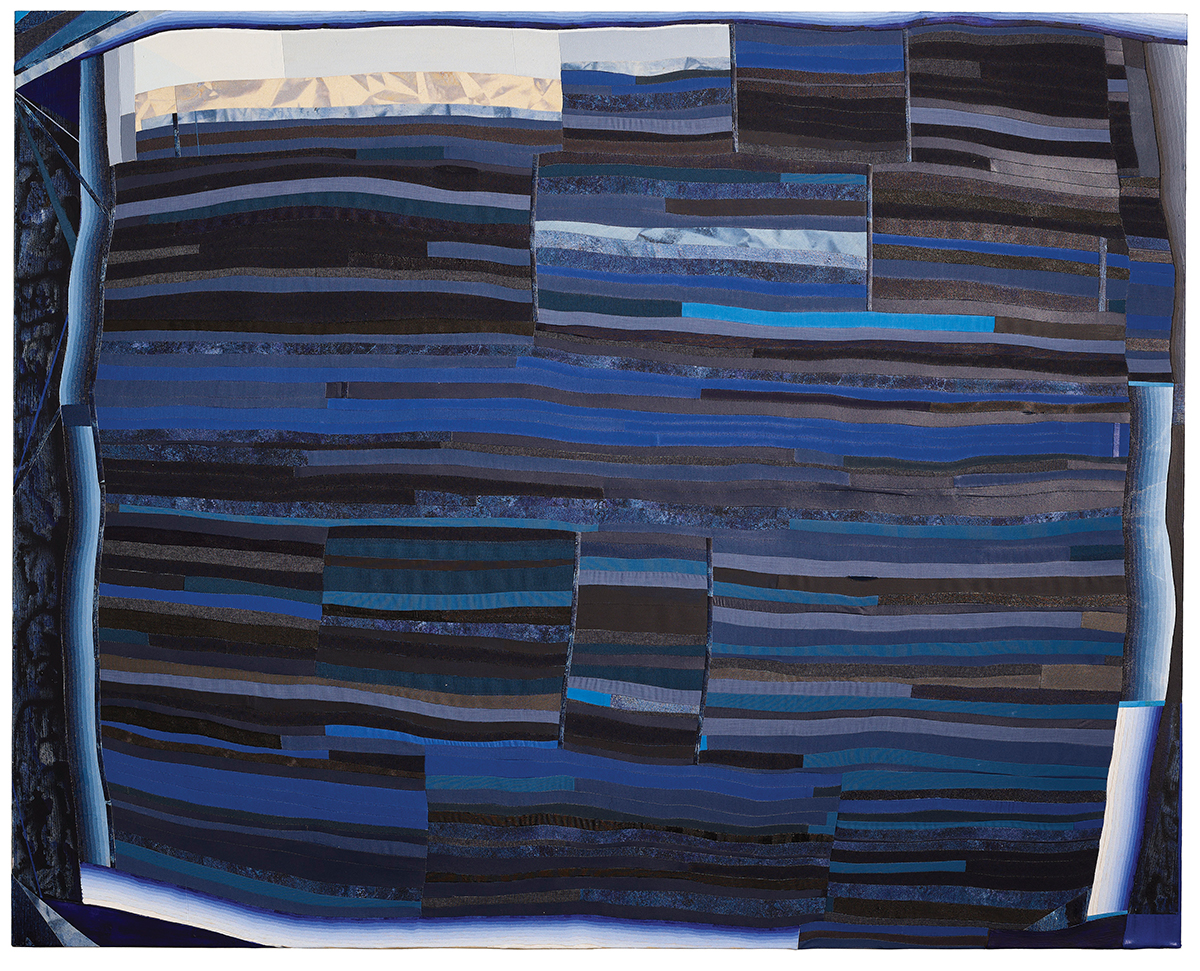
Navigating dichotomies fuels other types of her work, too. The line where quilting ends and painting begins is another puzzle to ponder, as is the difference between a painting (or, her version of a painting) and a quilt (a distinct form of art she also makes).
It’s something she’s often asked about, and something she thinks about a lot. But even as piecing and sewing has become a more comprehensive part of her painting process, she has no doubt that what she makes are paintings. “My orientation as an artist is born in paint and the framework I still operate within has matured and evolved from an understanding of paint as a material,” she says. “That continues to inform everything.”
That dialogue began many years ago with her mother. She’s the one who taught Campbell Thomas how to quilt. But it extends through her family tree, to her grandmother and great-grandmothers, makers and stitchers and quilters all. Campbell Thomas has their names listed on her studio wall as inspiration and as a reminder of her heritage. The art journals she carefully keeps are bound with cloth covers made by her mother, who sends her a regular supply.
In these journals, she examines her process and her purpose. Abstraction, she says, allows her to say things she can’t with more literal or figurative types of work. “I’m really fascinated with my sense that there is more to the world than what we can see, and of course that starts to tap into realms of the spirit,” she says. “On the one hand, I’m engaging in this intensely material endeavor, through paint; through fabric. But there’s also this way that this engagement, which is now well over 20 years for me, is a way into spirit.”

This article originally appeared in the August 2025 issue of WALTER magazine.