Eric Huynh and Jared Faulk founded Raijin Sumo Club five years ago on the grounds of NC State. Today it has more than 20 members and some of the country’s top athletes
by Jarrett Van Meter | photography by Bryan Regan
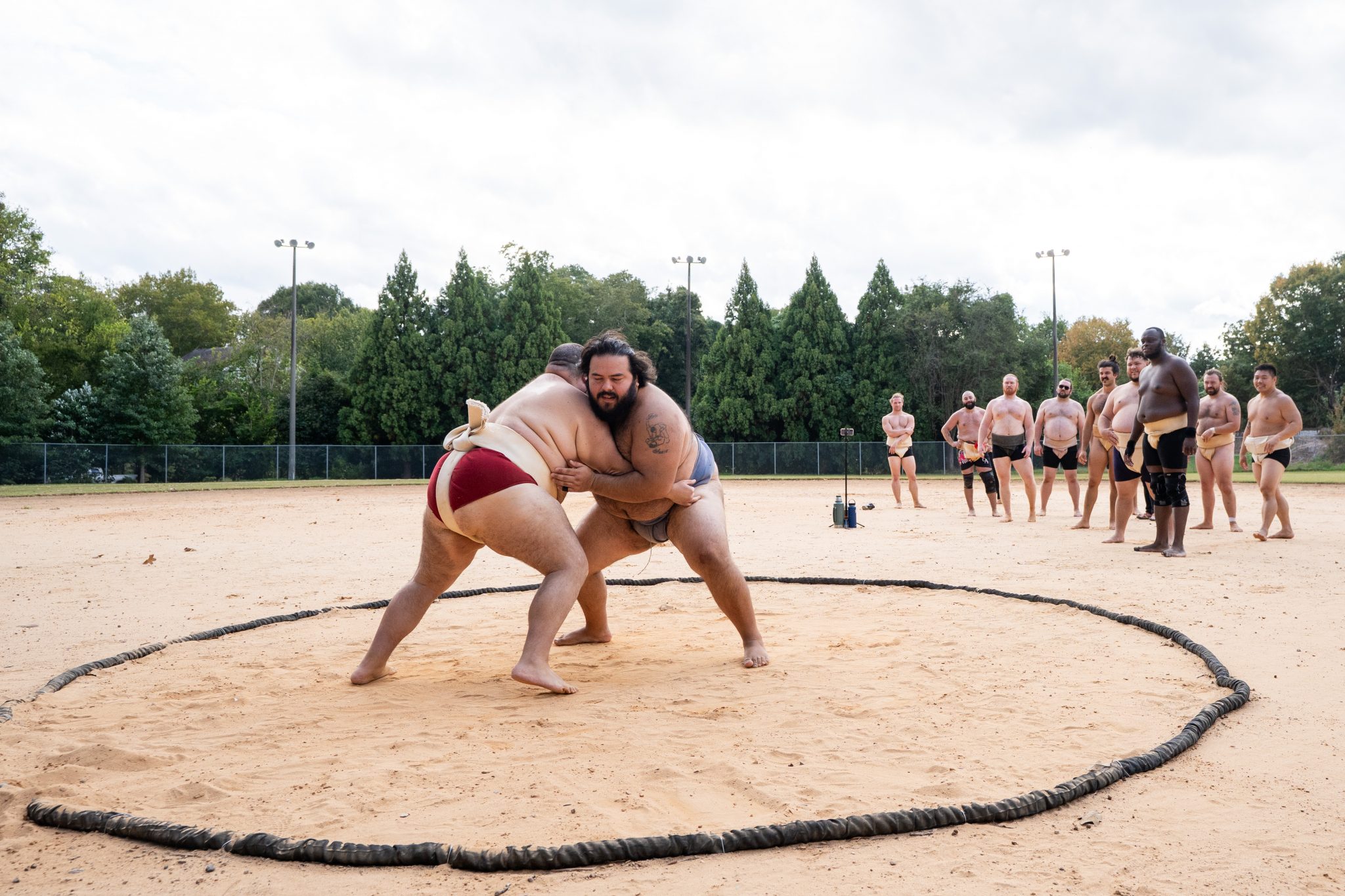
To those outside the know, the two men were a spectacle. Time after time, on the grass of Miller Fields at North Carolina State University, they rumbled towards each other and collided in a thundering clap of flesh. The two bodies — Eric Huynh clocking in at 285 pounds and Jared Faulk at 180 — locked into a brutish sort of waltz, tussling, pushing and scrapping for leverage. After a few seconds, they released and took a few steps in opposite directions. Once 15 feet apart, they turned back around to face each other and do it all again.
This was the origin of Raleigh’s Raijin Sumo Club, founded in 2021 by Huynh and Faulk. Today the club boasts more than 20 members, but in the early going it was just two of them.
“We would get a lot of looks, obviously,” remembers Faulk.
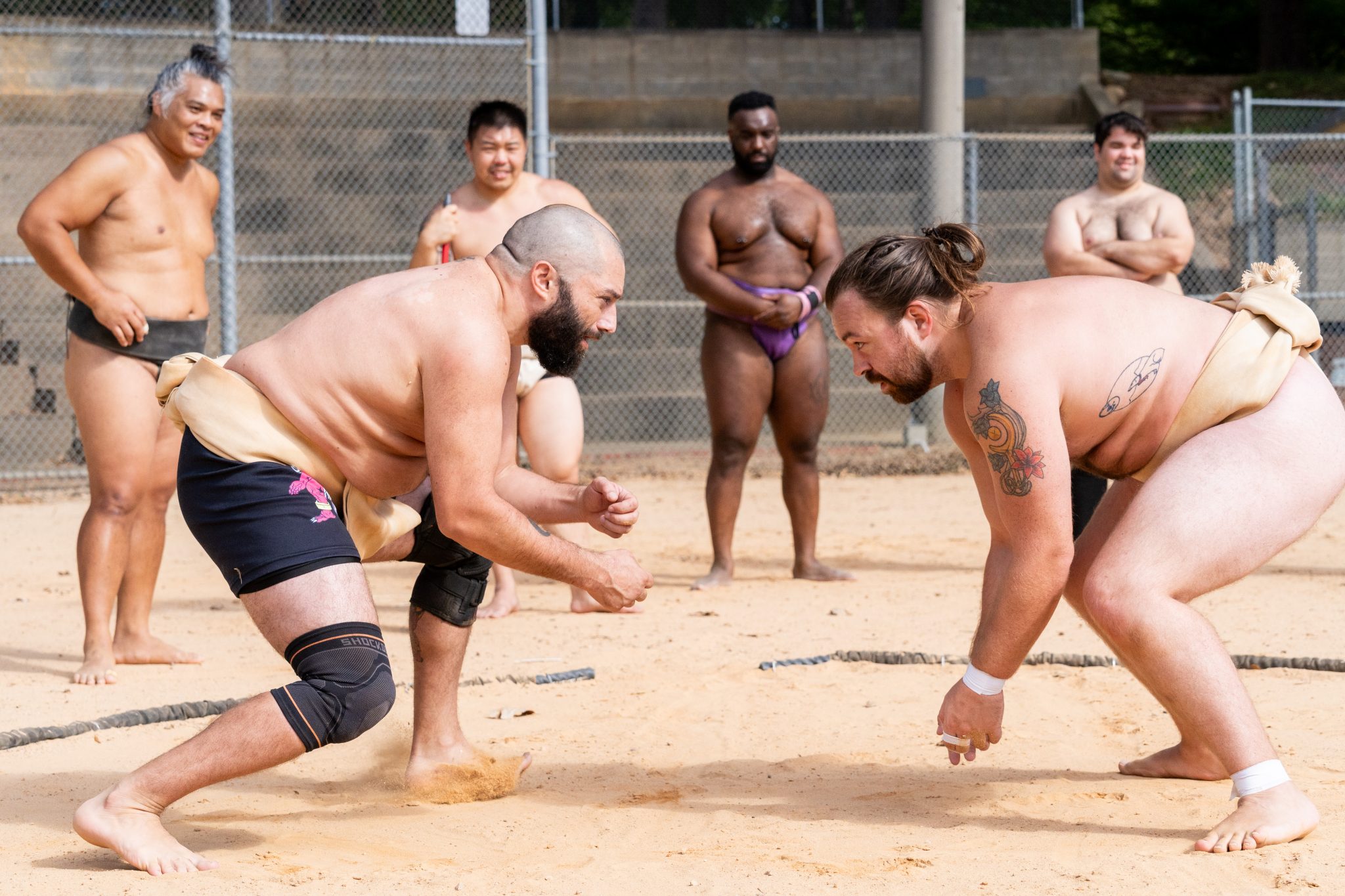
Sumo wrestling traditionally pits two competitors against one another in a raised ring called a dohyo. The objective is to push the opponent outside of the boundary or knock them off balance enough that any part of their body, other than the soles of their feet, touches the ground. Sumo is the national sport of Japan; countries like Russia, Mongolia and Ukraine have become global powers, but in the United States, most Sumo participants are hobbyists who find their way to the sport through other martial arts or pure curiosity.
Both Huynh and Faulk found Sumo during the pandemic while browsing online martial arts videos. A former high school wrestler, Huynh threw himself into the sport by registering for the 2020 US Sumo Open with no experience in the form. Faulk, a student at NC State at the time, was back home in Statesville for the lockdown period, where he built himself a DIY dohyo. He hoed up a section of his parents’ backyard, lined it with piping purchased at Lowes, and recruited his brother, a high schooler, to be his first opponent. Both Huynh and Faulk were immediately hooked, but they just needed a means to continue.
When NC State resumed in-person classes, Faulk returned to Raleigh and posted a query for training partners on the Reddit. Huynh, who was living in Wilmington at the time, responded. Huynh had 100 pounds on Faulk (though he’s bulked up since them), but they bonded immediately and began their one-on-one battles on the Miller Fields. By summer 2021, they added a third consistent member, Edobor Konyeha from Winston-Salem. Konyeha brought a fresh perspective, elite athleticism and a name idea for the group: Raijin Sumo Club, named for the god of storms in Japanese mythology and the Shinto religion. It stuck, and more people trickled in. Sunday practices were formalized and moved from Miller Fields to the dirt infield of the Pullen Park softball diamond, which more closely approximates the sand and clay surface of a traditional dohyo floor. Huynh moved up from Wilmington in order to be closer to the club.
But as the group began to grow, so did the need for actual instruction.
“It got to the point where we said, Whoa, we’re getting people that’s not just me and you anymore, Eric… We can’t just smash into each other,” says Faulk. “We can only teach them stuff if we know how the stuff works.”
So the two became students of the sport, watching films in their spare time and disseminating what they learned to the club. Today, teaching, collaboration and education are as much a part of the club’s ethos as brute force. Raijin is co-ed and has grown to over 20 members of all body types, ability levels and ambitions.
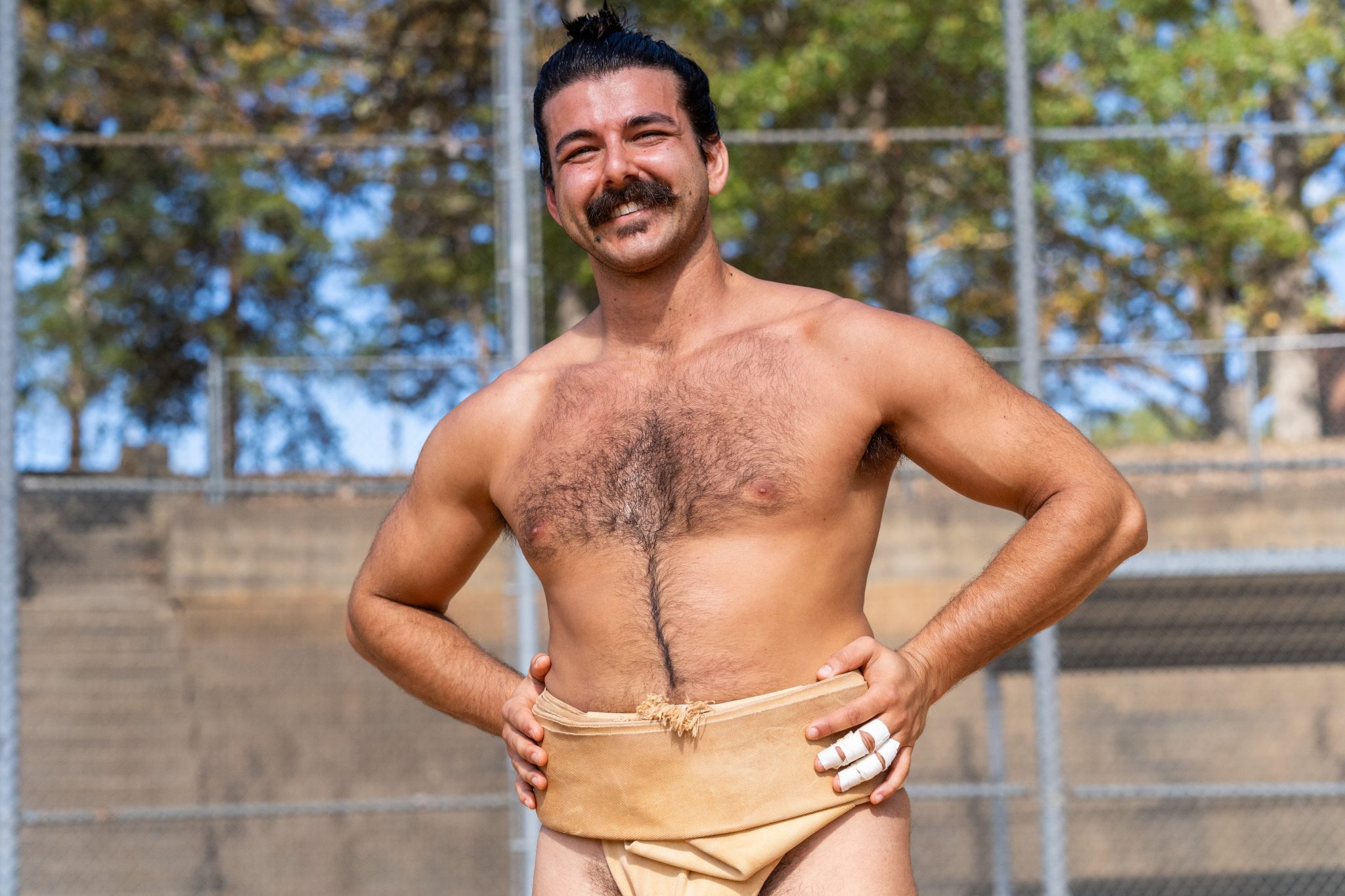
“We coach each other. We teach each other,” says Huynh. “It’s a community.”
In addition to the hobbyists, Raijin boasts some of the country’s top Sumo athletes. Huynh competed in the Sumo World Championships in Alabama in 2022 and Japan in 2023; Seth Adams went to Worlds in Poland 2024 and competed in Thailand in 2025, placing sixth. Konyeha, who has since moved to Texas, is a top lightweight in the world rankings, but is in a new club now. Faulk placed first in nationals in 2024 in the middleweight division, and several others compete in local and regional events.
As one member grows, so do the others. “Each new person that joins, you have to build them up, and as you build people up, you raise the level of the entire club,” says Faulk.
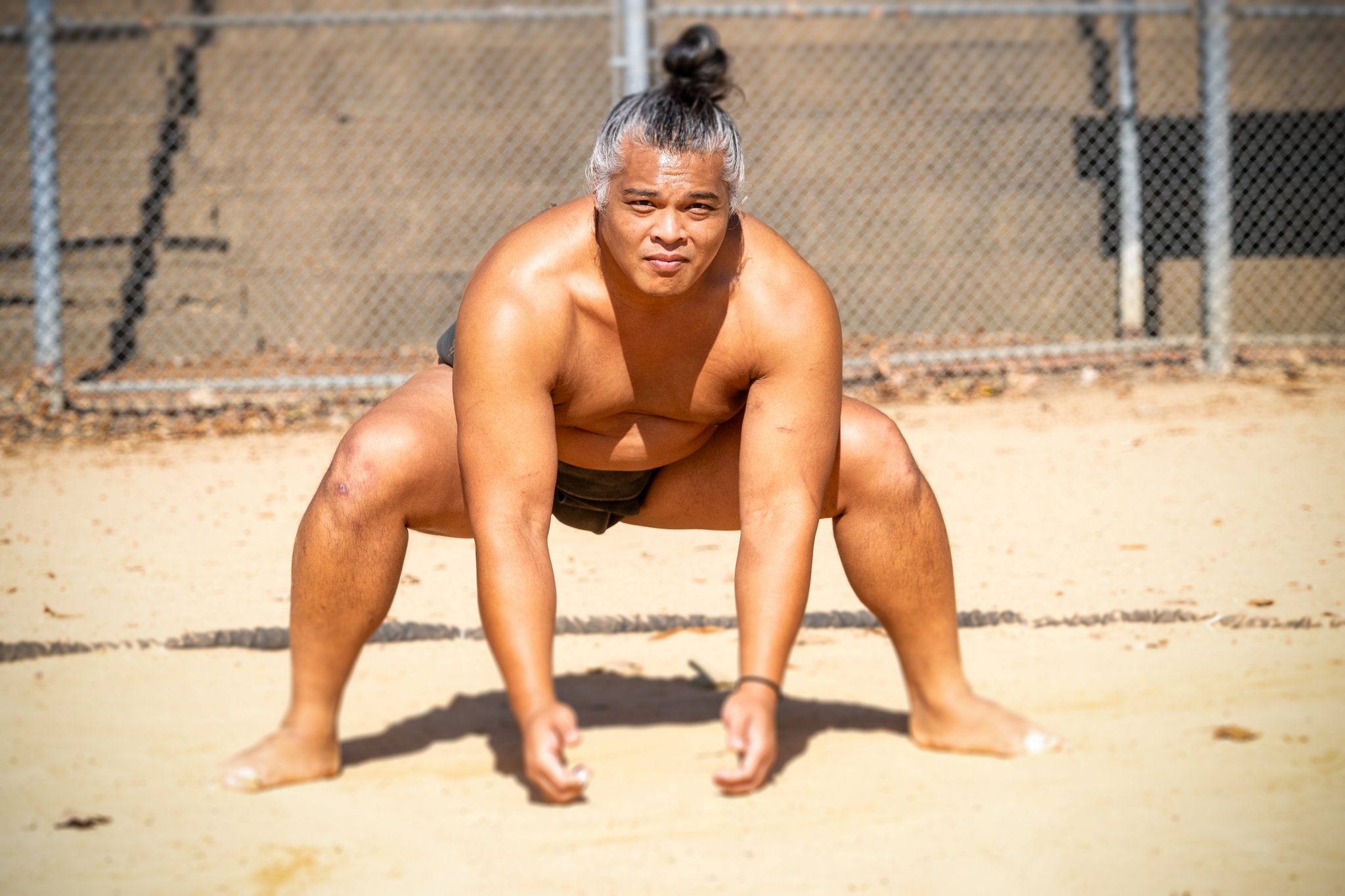
The Pullen Park baseball diamond doesn’t get as much foot traffic as Miller Fields, but passersby still stop and watch the Raijin athletes in action. Warmups consist of shikos, a sumo exercise of squatting, lifting a leg high in the air and stretching it as much as possible, returning it to the ground, squatting again and repeating with the other leg. Then the thunder begins. They typically wrestle for two hours.
After practice, exhausted and depleted, it’s time to eat. Buffet restaurants are a favorite landing spot, but on special occasions, like holidays, tournaments and a camp that the group recently hosted, Huynh and his wife make Chanko Nabe, a traditional Japanese Sumo meal of rich, fatty meat and lots of vegetables.
The post-practice calories are needed, but the real point of the meals is the fellowship. It’s a way to unwind after hours of adrenaline, exertion and “seeing red” in the ring. “It’s a good way to catch up, but it’s also a good way to assess if anybody has any issues or is feeling down, because when it comes down to it, we’re still a club,” says Huynh. “We’re community based.”
Raijin operates as a nonprofit organization and is thus far the only sumo club in North Carolina. It doesn’t yet have the exposure, size or resources of clubs in some states, specifically Texas, but it competes well for its size. Faulk says in addition to the immediate goal of gaining their own indoor practice facility, he wants Raijin to be in the vanguard as the sport grows domestically.
“I think the ultimate goal is just to raise the level of athletes in America and Raijin sumo,” he says. “We’re trying to lead that charge.”

This article originally appeared in the January 2026 issue of WALTER magazine.