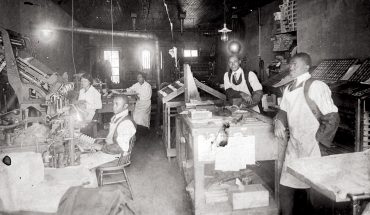
When the Old Boylan Bridge was deemed unsafe, locals stepped in to say goodbye to the 1987s aging steel truss structure
by Ian F.G. Dunn | photography from the State Archives of North Carolina
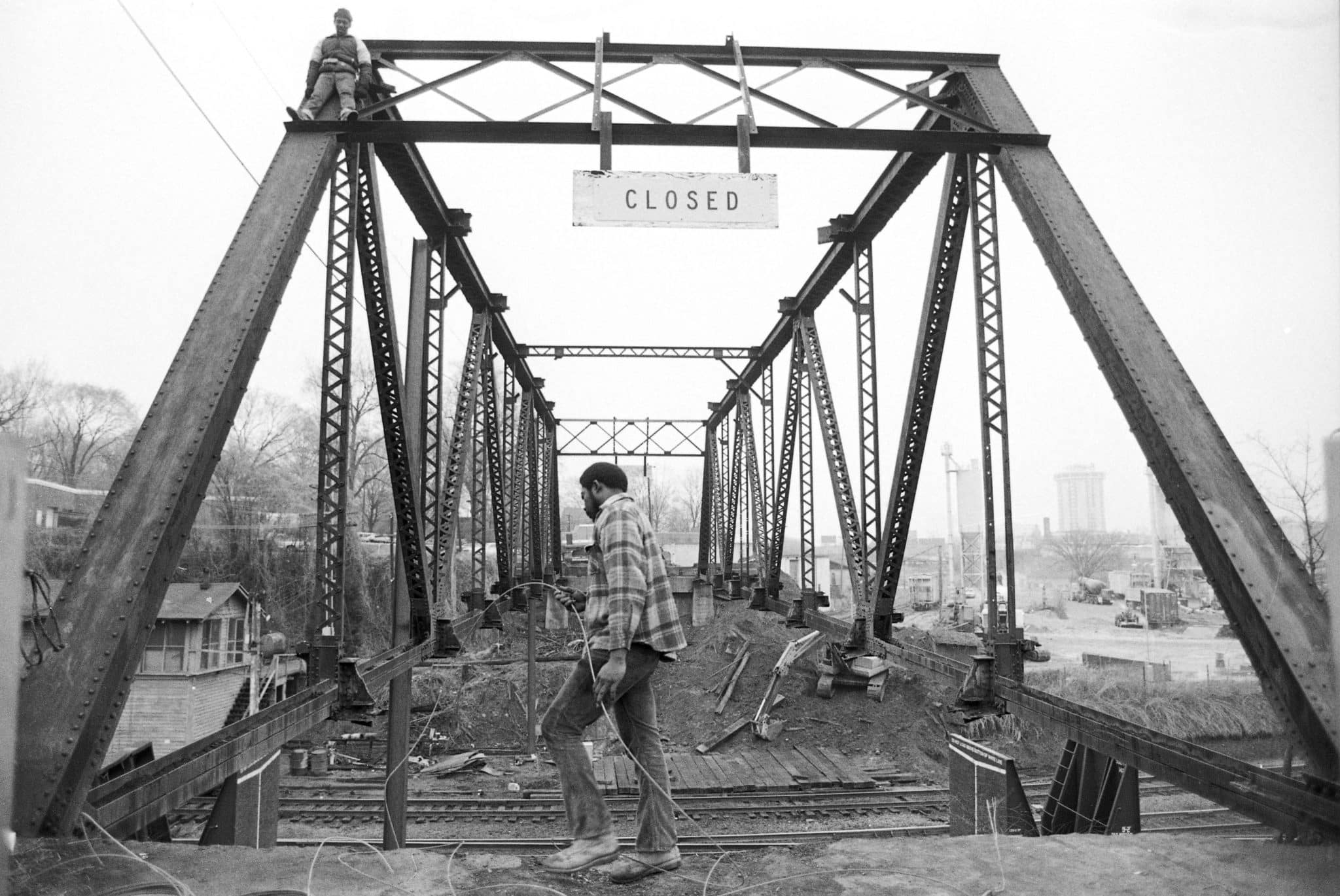
In 1978, the old Boylan Avenue bridge — an aging steel truss bridge that spanned the 150-foot railroad cut at the Boylan Wye — was permanently closed. An engineering assessment deemed the beloved structure unsafe, overloaded and deteriorating.
Constructed in 1913, it was the second bridge to span this railroad cut. Its predecessor was a wooden structure built around 1858, which provided access to the sprawling estate and mansion belonging to William Montfort Boylan. (The area later became Boylan Heights, one of Raleigh’s first planned subdivisions, and the mansion has been reimagined as the Heights House Hotel.)
In November of 1981 the fate of the Boylan Bridge was sealed. After a contentious fight by Raleigh residents to save the bridge, the North Carolina Department of Transportation ultimately prevailed and ordered its demolition. Humans have a peculiar practice of humanizing the non-human. Cars, boats and buildings are common objects to anthropomorphize, but in this case it was a steel truss bridge.
Upon hearing the news of its imminent demolition, Raleigh historian and native son Karl Larson sent postcard invitations to several friends to attend a ceremony honoring the landmark. Larson was a practicing Catholic, but he was also one part bohemian and two parts bon vivant. Each of the personality traits in this eccentric mix would play a role in creating an event never before seen in Raleigh: a last rites ceremony for a bridge.
What was initially intended as a performance art piece and personal observance involving a handful of friends evolved into a well-attended public event after word spread with both The News & Observer and WPTF-TV reporting on the story.
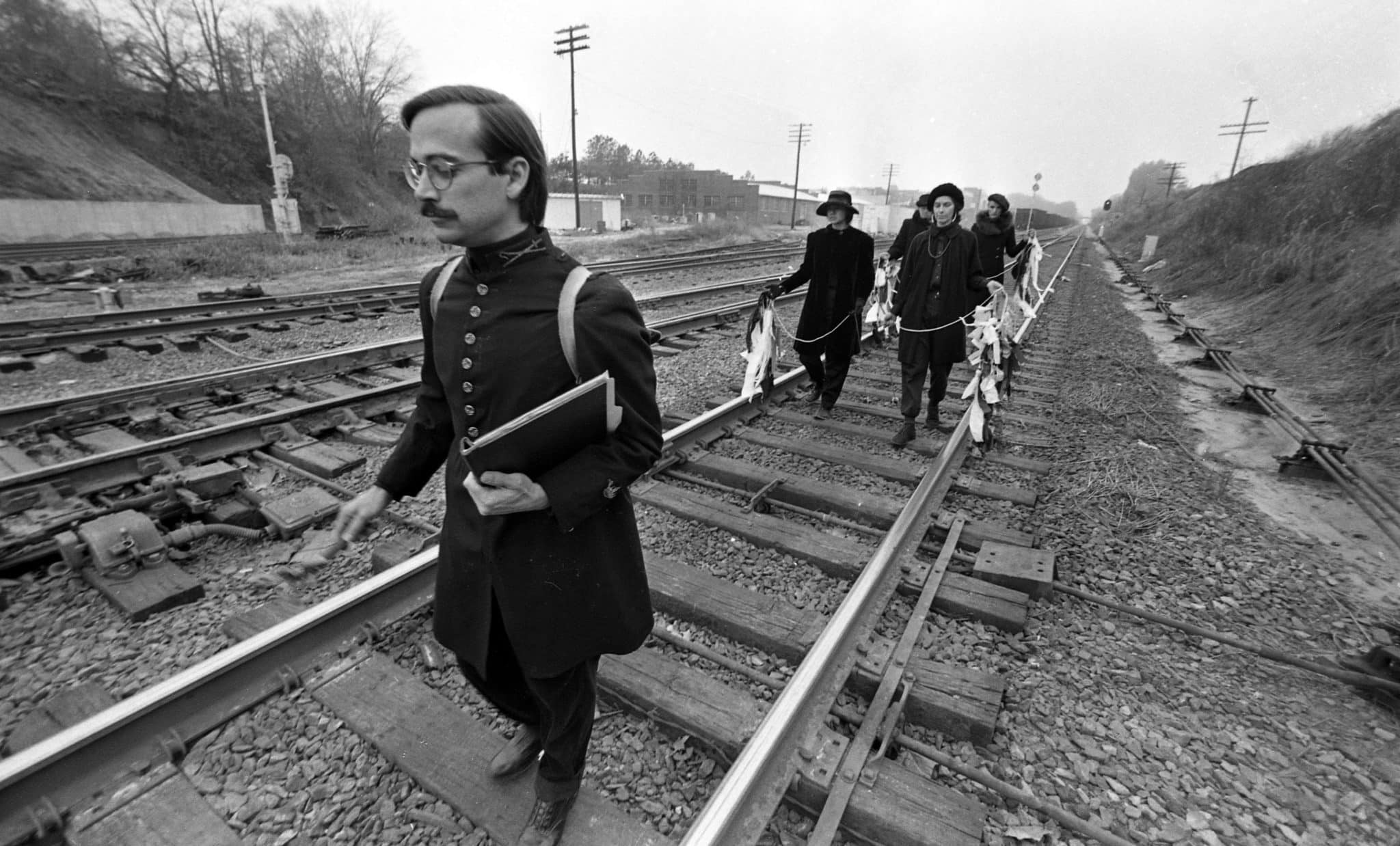
Larson and his entourage, each clad in black mourning garb, began the ceremony with a procession down the tracks approaching the bridge. In a personal letter from that year, held at the State Archive of NC, he described the event:
Our bridge traverses railroad tracks. We wanted to illustrate the relationship between the bridge and its function. Therefore, we began the performance with a procession down the tracks to the bridge. I led this procession ringing a hand bell followed by four women dressed in black. They dragged behind them towlines and streamers with railroad spikes attached. This made a wonderfully eerie and mournful clinking sound as we made our way to the bridge.
Meanwhile, on the bridge, another person in Larson’s group swept the road surface as a rite of purification prior to the ceremony. Once the procession climbed the stairs of the switch house and reached the bridge surface, Larson read the liturgy he’d written based on the funeral service found in the Episcopal Book of Common Prayer:
Almighty Bridge, unto whom all hearts are open, all desires known, and from whom no secrets are hid; cleanse the thoughts of our hearts by the inspiration of thy Holy Truss, that we may perfectly honour thee, and worthily magnify thy Name. Who, in the multitude of thy struts and girders, has encompassed us about with so great a cloud of witnesses that we may run with patience the race that is set before us, and together with them nay receive thy crowning glory that fadeth not ever away.
A “communion service” followed with Richards Wild Irish Rose wine and Nilla wafers as stand-ins for the real thing. The cheap wine was intended to be a respectful nod to the thousands of train-hoppers over the decades that made the underside of the bridge their temporary home.
Following communion, Larson uttered, “And now, with this act… I seal our pact.” He then took a second bottle of Wild Irish Rose and shattered it on the metal bridge. Another person in the party announced the response, “As it were in 1913, it is now and ever shall be.”
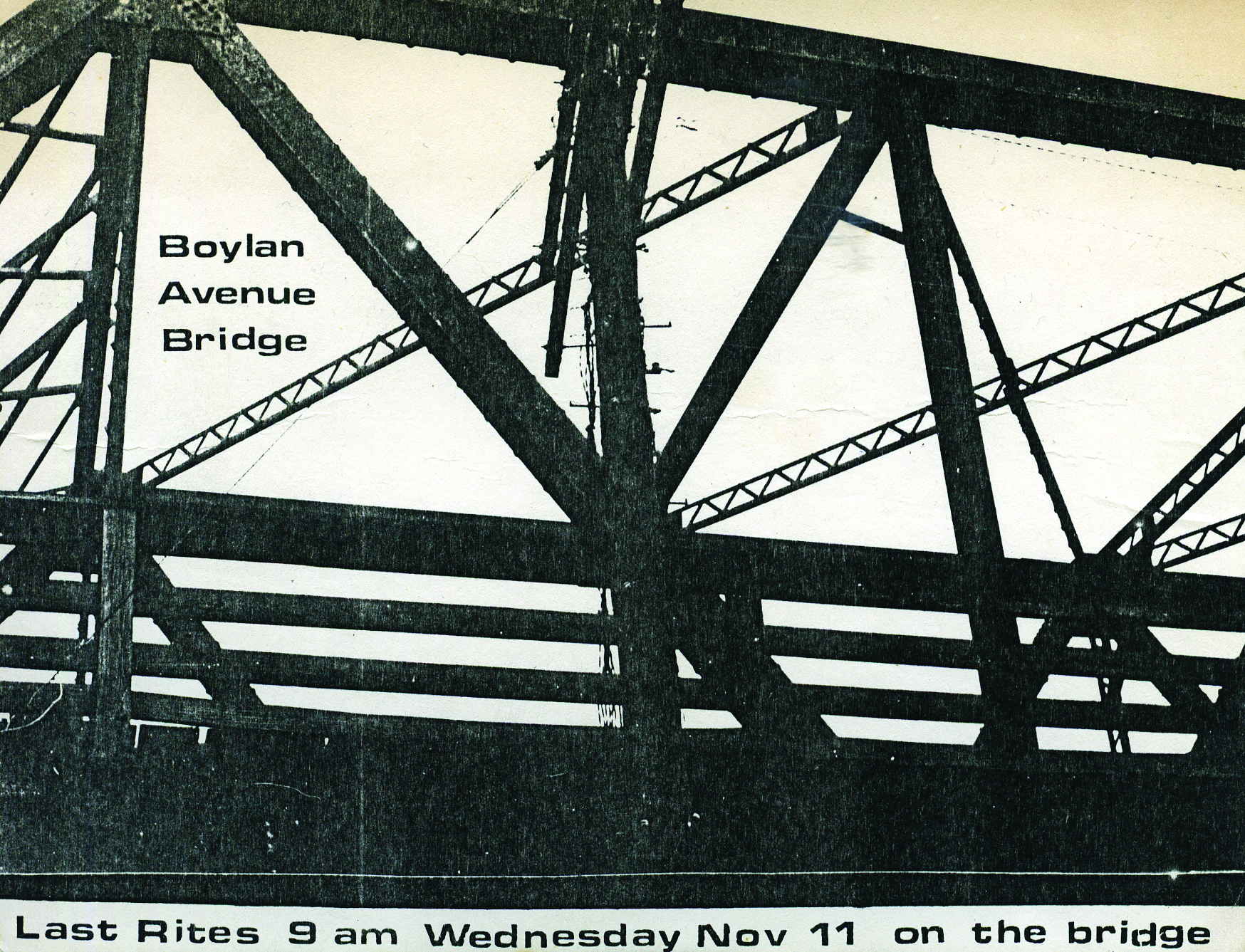
After the ceremony, the bridge remained for another month before demolition began. It wouldn’t be until late March of 1982 that the last metal girder was removed. Construction began immediately on the new concrete bridge, which opened to traffic 19 months later on Oct. 10, 1983. It remains there today, quietly performing the same duty as the old truss bridge, except now its work is silent and sanitary. Many enjoy its wide deck and sidewalks for easy travel and unobstructed, postcard views of our skyline. Still, others may not mind a girder or two getting in the way.

This article originally appeared in the May 2026 issue of WALTER magazine.