A growing community of people of all backgrounds come together to sing Christian hymns together — at the top of their lungs
by Susanna Klingenberg | photography by Taylor McDonald

Across the Triangle, a few times a month, an eclectic group gathers: religious believers of all stripes and spiritual seekers, tweedy professor types and tattooed 20-somethings. They duck into coffee shops or church basements, greet one another warmly, deliver their dishes to the break table, and gear up for what they’ve come to do: sing Christian hymns together. At this unlikely gathering, there are no instruments and no microphones. Just lungs, hearts and the powerful pull of music.
This is shape note singing, a raw, spirited singing tradition with a growing appeal to young people disenchanted with the AI-ification of our world. It offers an oasis of analog togetherness in an increasingly virtual world. Sometimes called fasola or Sacred Harp singing, shape notes have deep roots in early American history. Originating in rural New England in the late 18th and early 19th centuries, the tradition was designed as “a populist way to learn to sing together in church for people who didn’t have the money to be classically trained,” explains Celia Lechtman, a shape note singer who regularly goes to meetups at Durham Friends Meeting House, Pullen Baptist and St. Mark’s Chapel in Mordecai (and who happens to have operatic training, too).
Itinerant teachers would visit churches and teach the method, which quickly moved South and took hold in the Appalachians, where it remains popular today. But it’s also found a fanbase far from its rural origins across the nation at urban community centers, college campuses and innovation hubs like the Triangle.
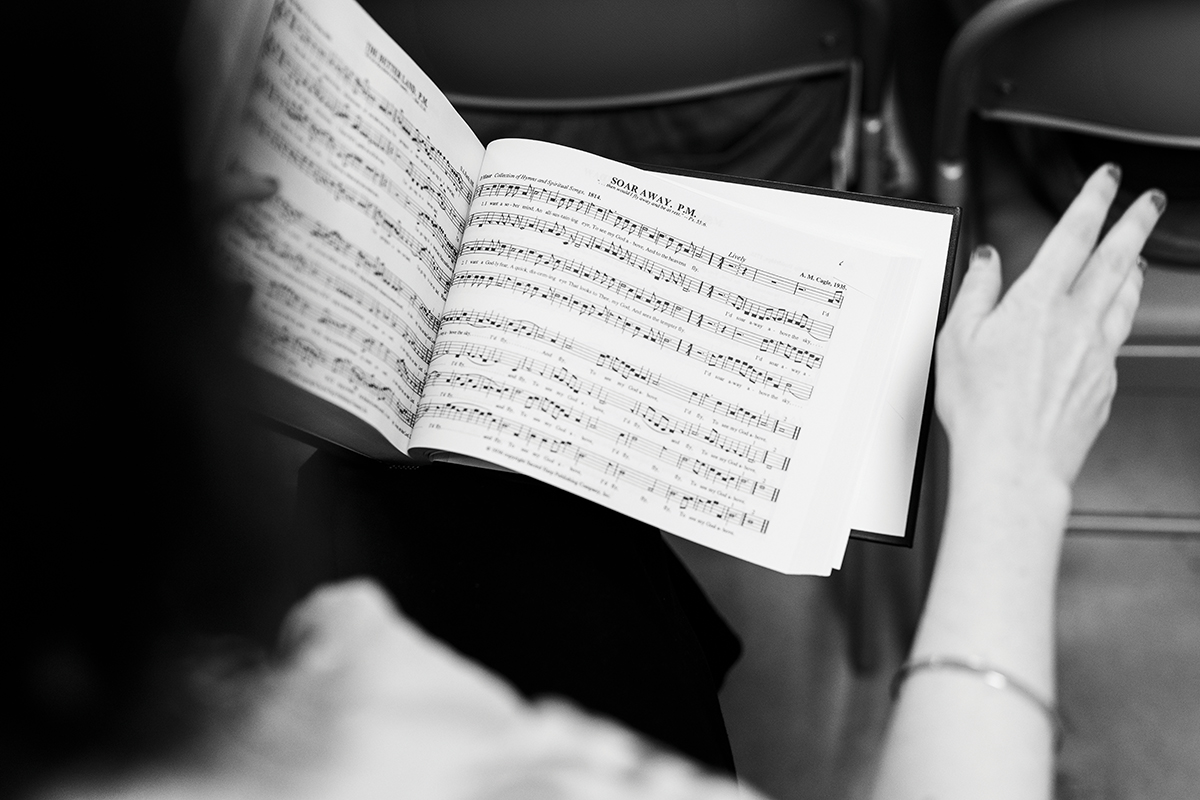
Instead of traditional notation, shape note music uses geometric shapes (triangle, square, oval, and diamond) to represent different pitches on the scale. The system was meant to democratize music. “I’ve never been in a space that’s as genuinely welcoming as shape note singing,” says Lechtman.
“But that’s not because it’s become more inclusive — it’s because it was built that way from the ground up.” Central to the local community is the Triangle Shape Note singers group, founded in the 1970s by Dr. Daniel Patterson, Kenan Professor Emeritus of English and Folklore at the University of North Carolina at Chapel Hill.
Patterson, now 97, was shelving books at an undergraduate work study when he happened upon a shape note songbook that included tunes his grandmother sang in the 1870s. He xeroxed a few and tried singing them with his friends, a group that quickly grew, gained support and eventually became the Triangle Shape Note singers. This community of Triangle musicians — some trained, many not — gather monthly to sing from several shared songbooks: The Shenandoah Harmony, The Valley Pocket Harmonist and, most famously, The Sacred Harp, a tune book first published in 1844. Its name is a reference to a singer’s voice.
And while the songbook titles might suggest a sound that’s delicate or even sentimental, the music is anything but. Loud, direct and energetic, shape note singing was (and still is) meant to be in full voice, with singers arranged in a hollow square, one part on each side, each voice carrying its own weight. “A good voice in shape note singing is one that can hit the notes and sing loud,” says Lechtman. “That perspective is so freeing, so bucket-filling. Singing is a thing we’re doing together, like an organism that I get to become part of.”

The sound of shape note singing might surprise you, not only because it’s loud (very loud) when sung in big groups, but also because the harmonies are not those we typically hear in Western music. Instead of thirds, it leans on fourths and fifths, with the tenor (rather than the soprano) carrying the melody.
“To my ears there’s a beautiful dissonance to the sound that makes it one of the truest representations of the human voice out there,” says David Brower, executive director of PineCone, the Piedmont Council of Traditional Music, which helps facilitate shape note singing in the Triangle. “We’re all surrounded by autotuned recordings and bombarded by AI-generated music. This is the exact opposite.”
For devotees, shape note singing isn’t about performance. It’s about participation. “We’re not a choir. There’s nothing performative about it,” says singer Kyle Johnston, associate director of the Moravian Music Foundation and committed shape note singer. “If you believe in God, then that’s your only audience. But many singers don’t, and for them, it’s about singing for one another, making music in community.”
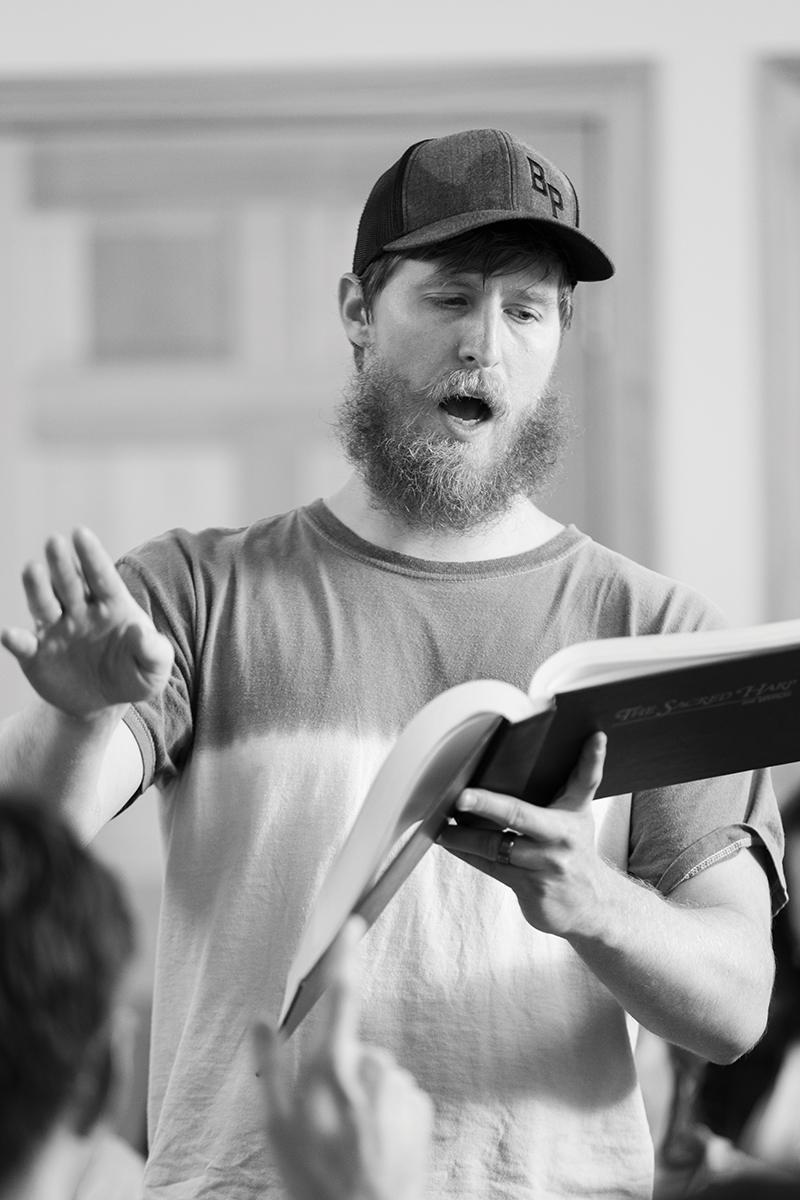
What draws people in 2025 to a singing style founded in the 1800s? Many singers appreciate that shape note singing frees them up to explore spiritual questions without the trappings of a church or religious tradition. “There’s a different kind of reverence here,” says Michael DeVito, a regular at Durham sings. “It has nothing to do with a 50-foot tall stained glass or a giant pipe organ and everything to do with being present together and singing.”
For others, the draw is the lyrics. “They explore the whole breadth of human experience: friendship, work, troubles and dying,” says Lechtman. “There’s a lot of we. It’s about passing through the world together.”
Sometimes these groups of friends gather for conferences, such as the National Folk Conference, or for all-day sings, which draw enthusiasts from across the country. These gatherings often include a covered-dish dinner before people depart for smaller “house sings” in living rooms and backyards — a musical afterparty of sorts.
But across the board, people are drawn to the authentic community of shape note singing. Says DeVito, “As much as it’s a way to poke around at some kind of spiritual yearning or whatever, it’s also just fun to sing super loud and potluck with your friends.”

This article originally appeared in the October 2025 issue of WALTER magazine.