Across Raleigh, skaters find community in various avenues, from skate parks and roller rinks to derbies and hip-hop skate classes.
By Lori D. R. Wiggins | Photography by Bryan Regan
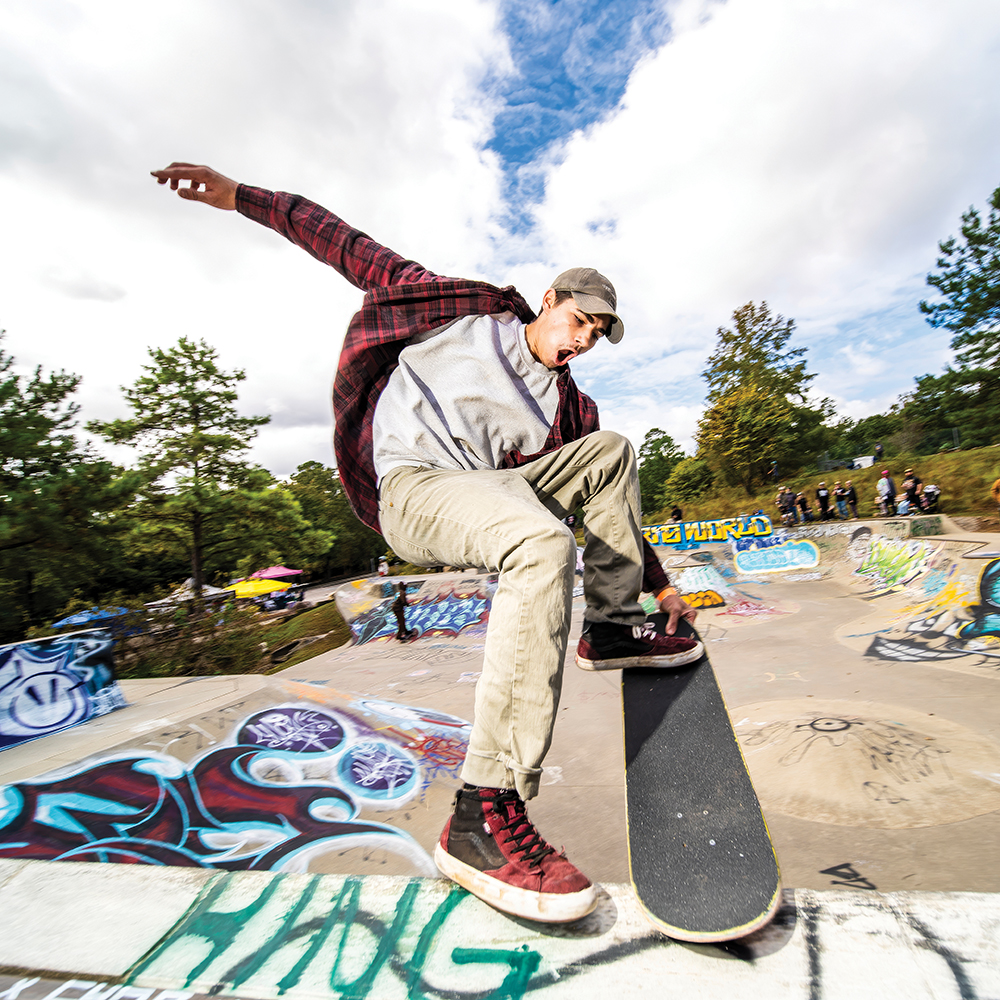
You often hear the skaters before you see them: the grind of wheels on concrete, the scratch of tightening wristguards, the clacks of sticks on pavement. Across the Triangle, people lace up in parking decks, public parks, hockey rinks, tennis courts and pretty much wherever else the pavement is smooth. While Raleigh may not be known as a skating city like Venice Beach, New York or Detroit, the skate community is expanding.
Parking decks become skate rinks. Empty warehouses become practice arenas. Community center basketball courts become classrooms, dance floors and gathering places. “There’s creativity in the craft — and resiliency,” says Cody Charland, co-founder and executive director of Skate Raleigh, a nonprofit organization that advocates for expanding safe, welcoming places for skateboarding and other wheeled sports. “People skate, just not only at skate parks.” “We’re all just trying to skate,” says Nate Jones, who began roller skating in Detroit before moving to Raleigh in 2020. “People think skateboarding is different from roller skating or inline skating, but what I love is seeing all those cultures cross-pollinate.”
A Scene Without a Stage
Like the wheels they use — whether on boots, boards or blades — the skating culture in Raleigh is “people-powered,” says Charland. For decades, the skating scene has been shaped by people determined to create opportunities where hardly none existed. Among them, few names come up more often than Reggie Barnes, a professional skateboarder and founder of Endless Grind, a longtime Peace Street skateboard shop that recently announced its closing, perhaps temporarily, to make way for development. For more than 40 years, Endless Grind was a place where skateboarders gathered, created and honed the craft. Some became the store’s gear-sponsored riders. “It was a cool place to be a part of,” says Coley Martin, an Endless Grind-sponsored skater who’s been a regular since he was a kid. “Everybody in here could be a part of the scene because we helped create board graphics, T-shirts, hoodies.” Agrees Charland: “Without Reggie Barnes, the skate scene would be non-existent.”
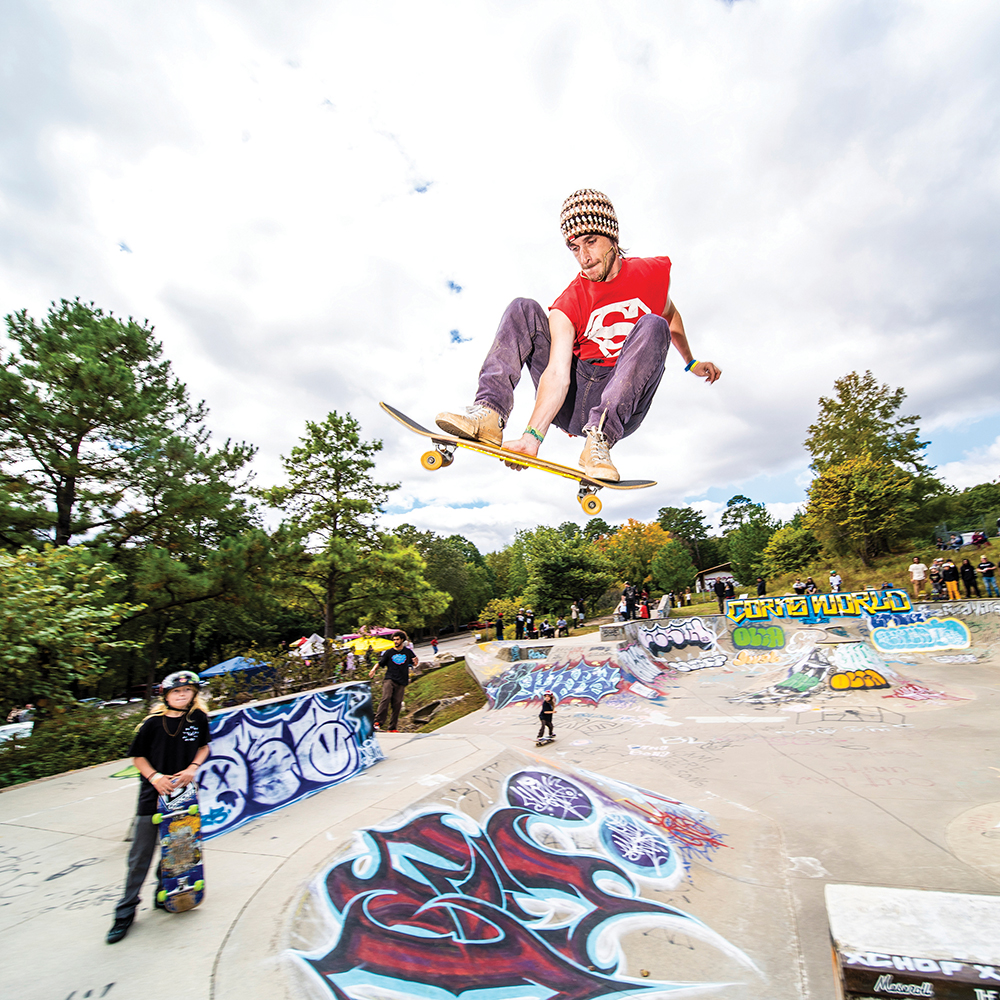
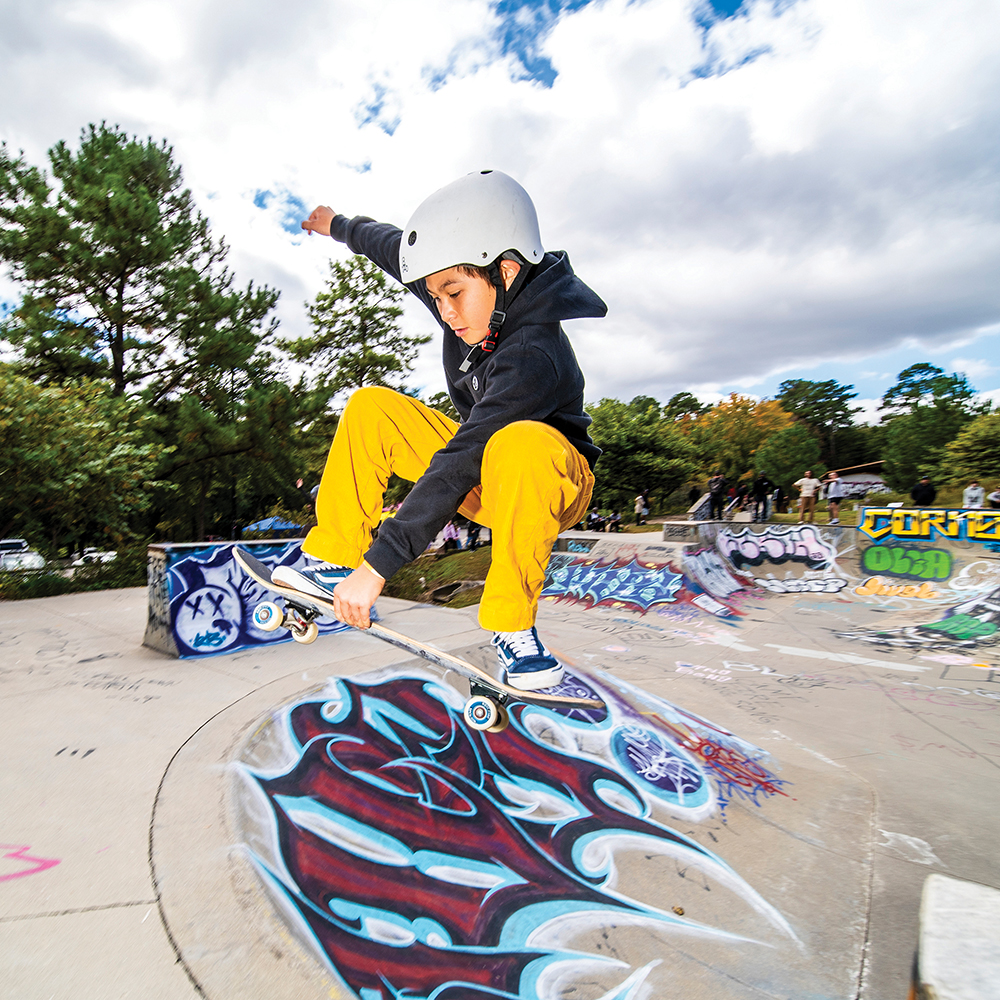
Charland and others have spent years advocating for permanent skateable public spaces. The Conlon Family Skatepark, a 2.5-acre concrete slab that sits along Capital Boulevard, reflects that advocacy. Featuring 11,000 square feet of street-style terrain, including a flat bar, grind ledge, down rail, slappy curb, banks, stairs and grind pads, Conlon welcomes skateboarders, BMX riders and roller skaters of all skill levels. In just 10 months, through a conditional use agreement with the City of Raleigh, Skate Raleigh and other community organizers helped raise roughly $300,000 in private money and in-kind donations to help foot the bill for design and engineering, construction, asphalt resurfacing, contractor services, materials, labor and other site improvements, including shade structures designed by students at N.C. State University. Named in recognition of entrepreneur Mike Conlon’s $100,000 gift, Skate Raleigh helped build Conlon and now manages it.
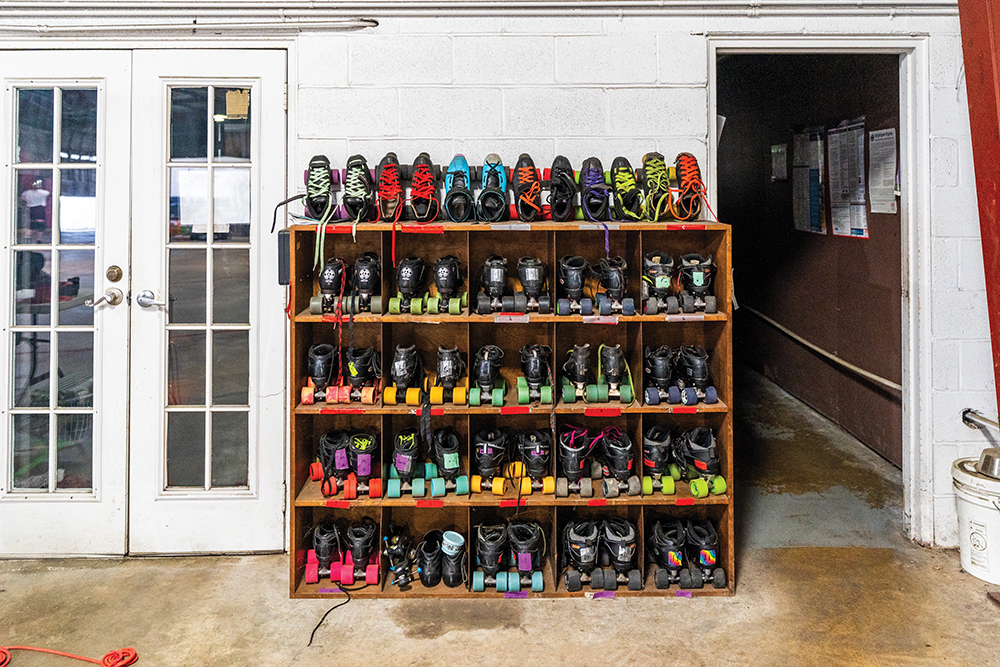
Still, there’s demand for more. “The community is suffering without appropriate facilities — professionally designed, safe facilities,” Charland says. Both quad and inline roller skaters search for smooth surfaces in parking decks after work and at places like the North Carolina Museum of Art on weekends. Derby leagues practice in borrowed warehouse space and at rinks during hours no one else wants. Solo skaters join classes and open skate sessions at community recreation centers for a few hours each week. For years, skateboarders have argued that Raleigh has lagged behind neighboring cities when it comes to permanent public skate facilities.
“There are places, but there’s a gap in the middle,” says Bryan Ulma, a longtime skateboarder who grew up skating in Cary and now manages Delicious Skateboard Shop off Falls of Neuse Road. Raleigh skaters have to make their way to Cary or Apex, or drive 30 to 45 minutes to roll in parks in Durham, Chapel Hill, Hillsborough or Pittsboro, to find robust public facilities. “We see pickleball courts popping up everywhere, and that’s great. We’d love to see skateboarding get that same kind of investment,” Ulma says. “I mean, it’s already in the Olympics now.”
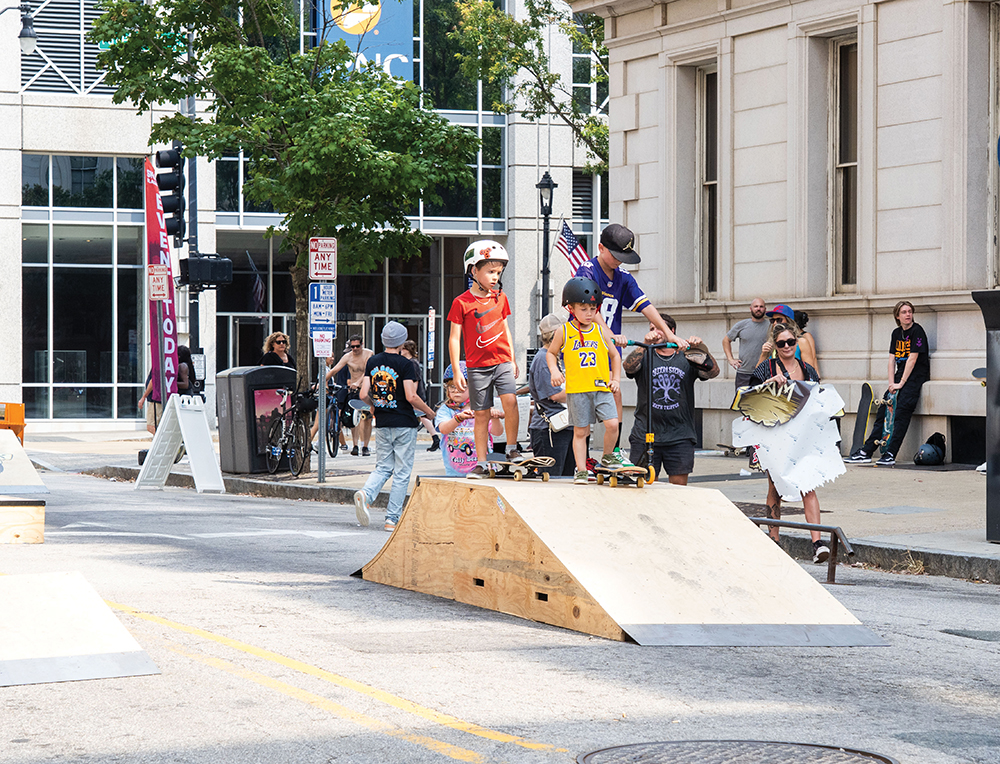
Raleigh is indeed responding. “We want our community to be healthy and active,” says David Aubut, the city’s recreation supervisor. “The more we can work with the skate community — and all communities — the more opportunities we can create for people to feel like they belong.” Quarterly, the city hosts Skate Moore Square, a free, all-ages pop-up skatepark that features ramps, rails and obstacles for skateboards, quad and inline roller skates, scooters and BMX — plus music, vendors and demonstrations. It also offers a mobile pump-track, a course of rolling terrain for wheeled sports, classes and Open Skate hours at city park community centers. And it’s moving forward with a skater-proposed DIY skate facility that skaters will build themselves at Jaycee Park. There’s also great anticipation simmering around the planned Smoky Hollow Park, a 14-acre urban park near Capital Boulevard and Peace Street that city leaders plan as a signature public space, featuring trails, gathering plazas, and a dedicated skate spot. Currently, Conlon is its temporary place holder.
“The goal extends beyond constructing spaces to skate,” says Aubut. “When people feel a sense of belonging and have ownership of a space, they take care of it. It becomes theirs, too. That’s what we want.” Skaters applaud the inroads and the momentum. Still, they say, Raleigh needs to catch up. “If the city’s not going to move quick enough, we’re just going to make it ourselves,” Jones says.
“It’s just fun.”
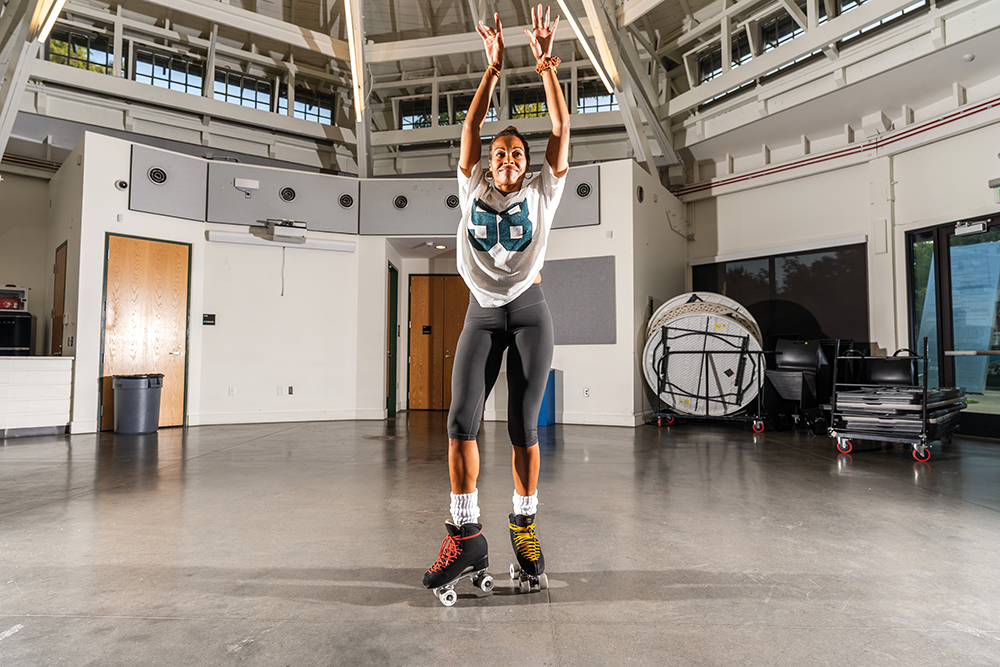
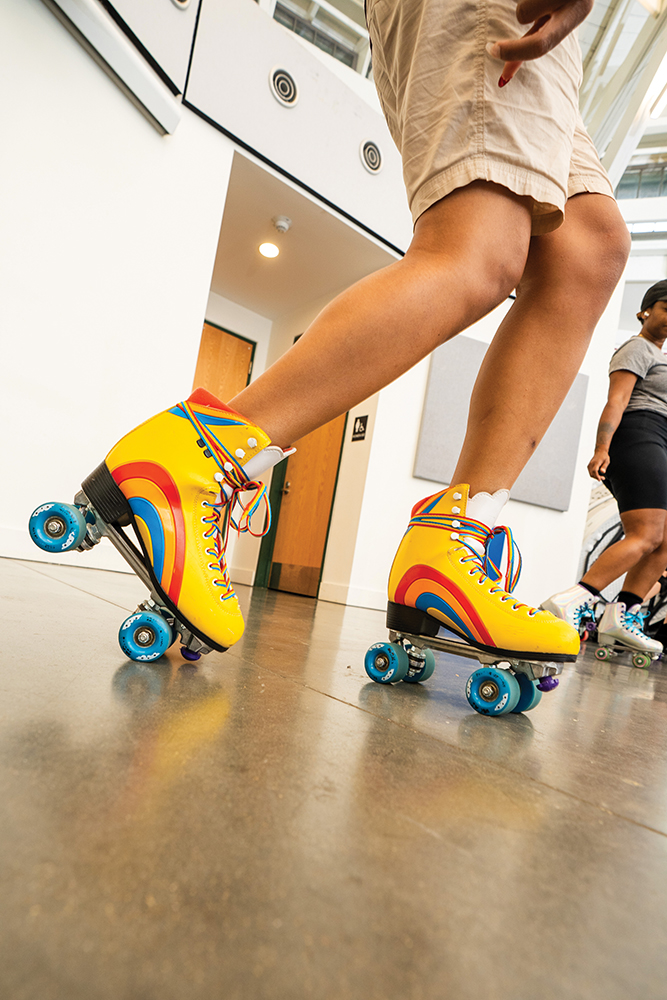
Ask almost anyone in Raleigh why they lace up traditional, four wheeled roller skates — affectionately known as “quads” — and personal achievement tops the list. Fitness through rhythm and music rolls in next, followed by community and the peace of release.
Dawn Kifalme, who grew up in New York, could skate before she could ride a bike. She returned to the sport as a pandemic fitness goal after having twins. Plus, she wanted to learn to skate backwards. “Skating is a full-body workout,” she says. “It’s growing in popularity outside of the rink.”
Kifalme is now the skate coach that she and others couldn’t find for themselves. She teaches beginner roller skating classes and roller dance at John Chavis Memorial Park through Raleigh Parks and Recreation, helping newcomers overcome what she calls the biggest hurdle: fear. “People feel intimidated going to the rink, because nobody wants to look like a beginner,” she says. “But it’s a solo journey. Everybody’s body is different.”
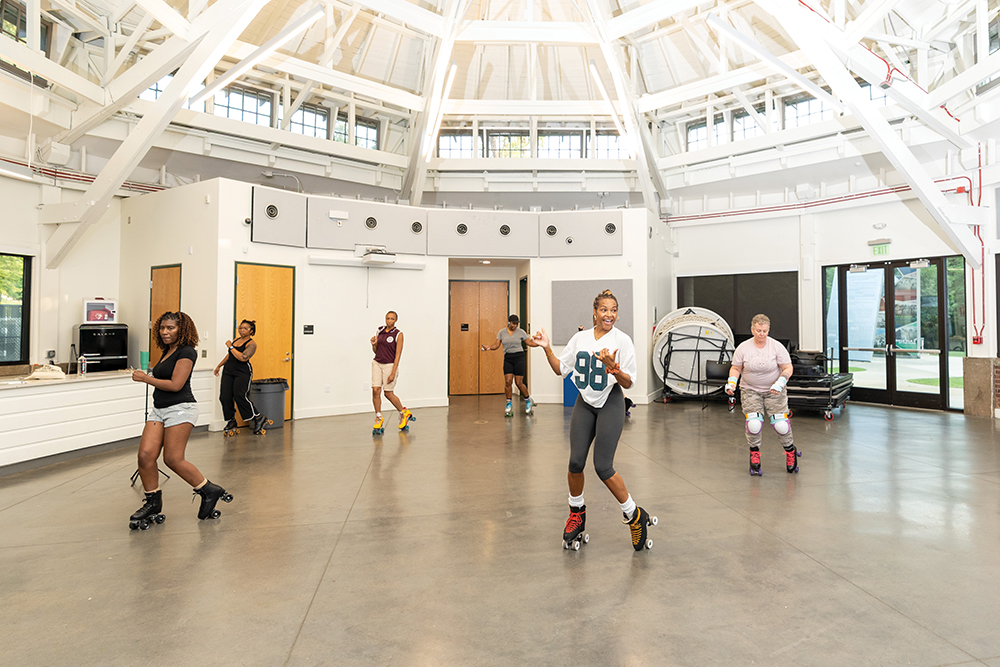
Like Kifalme and many others, Debra Ireland returned to skating during the pandemic. Growing up in Miami, skating had been second nature, but two decades of adulthood halted the pastime.
Now that she’s 40, she realizes there’s more than exercise under her wheels. “I need some joy in life,” says Ireland, who enjoys Open Skate hours at Tarboro Road Community Center (and occasionally in a parking garage) to catch that joy. “It helps my mental health. It’s kind of a creative outlet. I enjoy the social aspect and the physical and cognitive challenges. It’s just fun.”
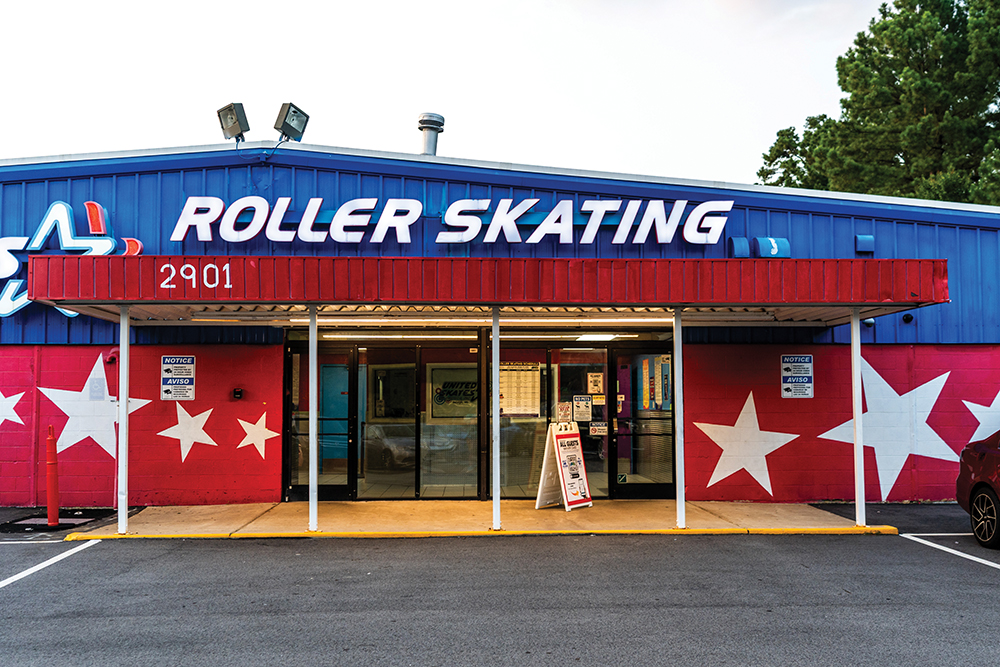
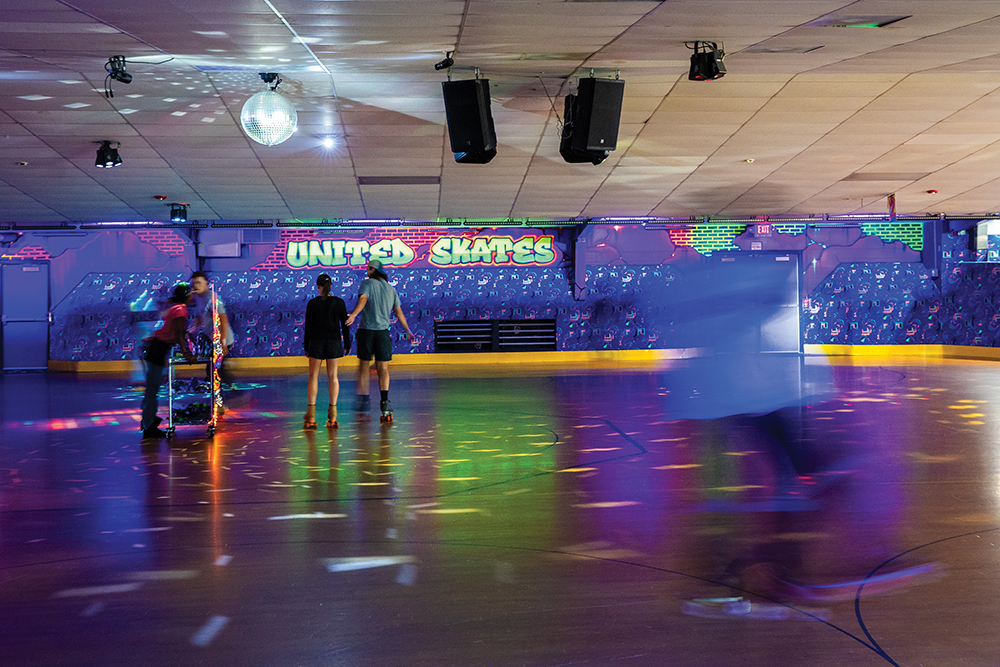
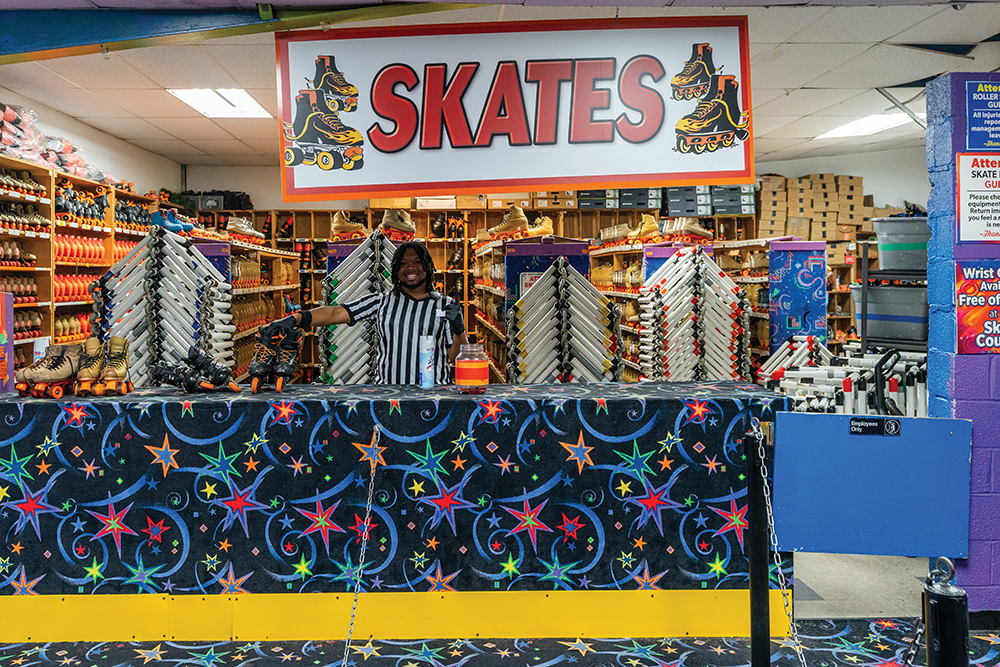
Avia Smith, a Raleigh native who grew up skating with her mom at the still-popular United Skates of America on Trawick Road, rediscovered skating during the pandemic. At first, it was a path to personal reflection. Now, she’s learning to shake off shyness and skate confidently with others at skating classes at the Tarboro Road Community Center. “My lens was narrow,” says Smith. “This has opened me to being part of the skate family.”
Wheeled Power
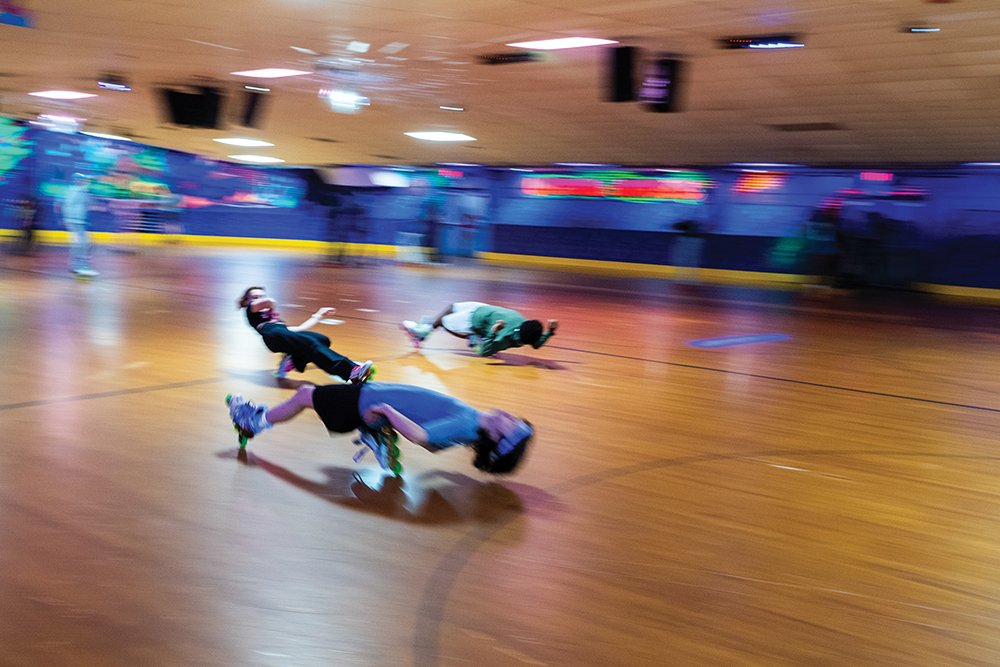
Since 2020, a local explosion of skate culture has been fueled by TikTok videos, Instagram reels, pandemic-era outdoor gatherings and even an Usher performance on quads that went viral, Smith says.
But the trailblazers and stalwarts of the skate scene insist the movement didn’t begin there. “It never really went away,” says Eddie Watson, who has skated for more than three decades and now teaches others and showcases his own skill on the local skate scene. “It’s just that the pandemic slowed everybody down enough to actually watch and want to learn and be a part of what they saw.”
Watson’s classes at Tarboro Road Community Center introduce beginners to safety, including how to fall properly, and intermediate skaters to rhythm skating, a style deeply rooted in Black culture and generations of rink traditions.
“When hip-hop music and skating came together, it became a creative art,” he says. That heritage is visible at events across the region, where DJs, dance routines and a portfolio of skate styles blend trends from Chicago to Miami.
For Marcelle Parker, skating reaches beyond recreation. As one of six children who grew up as a regular at a military base skating rink, it is a legacy she passed down to her children and grandchildren. Granddaughter Riley Walker rolled alongside her at Skate Moore Square in April; more recently, her nephews visiting from Maryland joined her for Open Skate at John Chavis Memorial Park.
“When I’ve had a bad day or a bad week, skating is an emotional release,” says Parker. “I’d rather skate than go to therapy.”
Plus, she says, she’s lost 30 pounds since returning to skating. Now that she’s retired, she teaches choreography while organizing community events.
“It’s mind, body and soul,” she says.
Joy Wilburn’s image is the second-tallest on the mural outside Wheels, the Durham skating rink that recently reopened. Wilburn, a lifelong skater from Chicago who returned to skating with her children, never expected it to become a defining part of her life well after her children reached adulthood.
“I take my skates everywhere,” Wilburn says. For her, roller skating has become a source of freedom. “It’s something just for me,” she says, describing skating as a dopamine rush that’s different from going to the gym. At the same time, it’s also a gateway to one of the area’s tightest-knit communities.
“We have a secret Whatsapp group,” Wilburn whispers. “Everywhere I go, I find a skate community. It’s like the new Meetup.”
Grassroots Grit
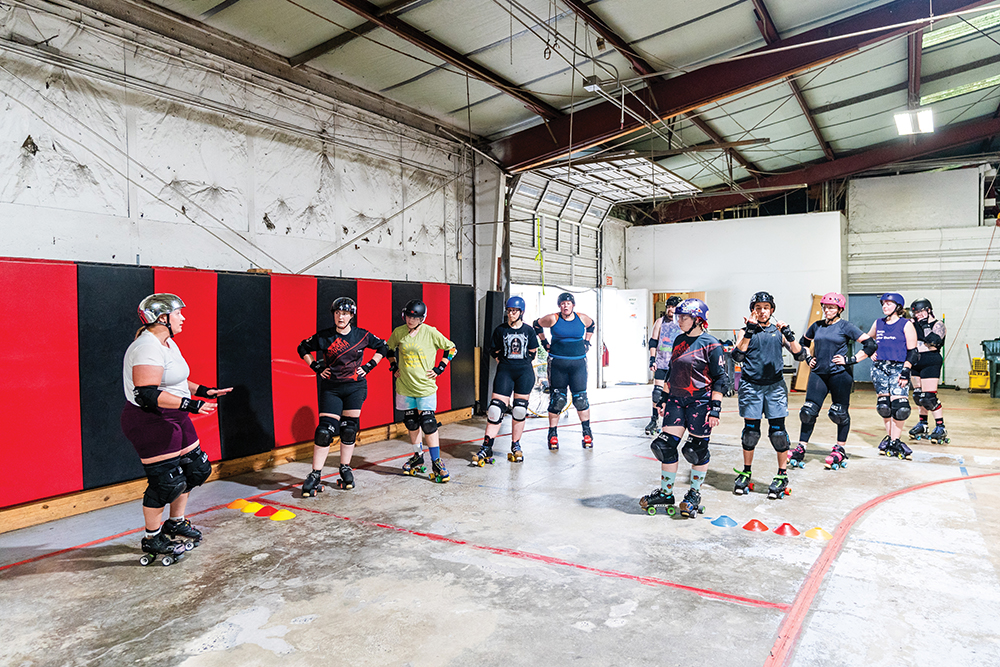
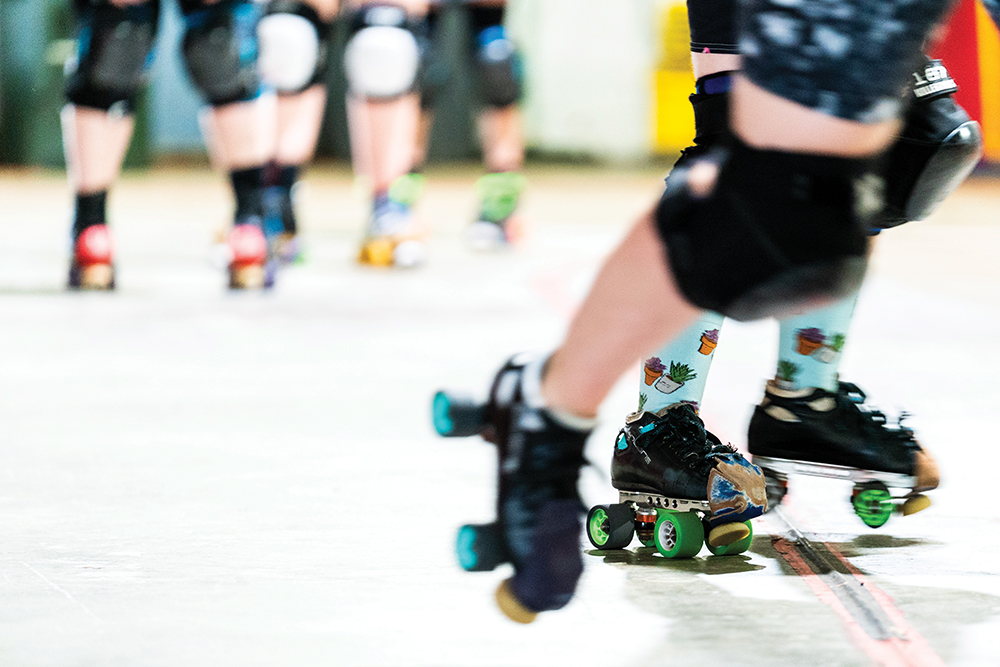
Perhaps no skating group better embodies the area’s can-do spirit more than Raleigh’s Carolina Roller Derby, a pioneer of modern flat-track roller derby, showcasing the fast-paced contact sport where skaters race and block opponents on a flat, oval track. The league is a founding member of the Women’s Flat Track Derby Association (WFTDA), which was formed in 2004. Its home is an un-air-conditioned auto warehouse in Apex. Before every practice, volunteers lay out an official-sized track using rope and tape.
“We go wherever we can afford,” says league president Natasha Young.
The nonprofit, player-run league has about 60 active skaters and another dozen officials and referees. Members pay dues, volunteer, travel across the Southeast to compete and rely on ingenuity when it’s their turn to host, bouncing between venues because few buildings can accommodate an 8,000-square-foot flat track. The league has a history of playing at the J.S. Dorton Arena and the Holshouser Building at the State Fairgrounds, with hopes to return in 2027. They currently host at Sofive Sports Center in Apex and Wheels Skating Rink in Durham.
“At the end of the day, people in skate communities have to be creative,” Young says. “We’re grassroots. We’re a nonprofit that’s volunteer-run, trying to play a sport we really love.”
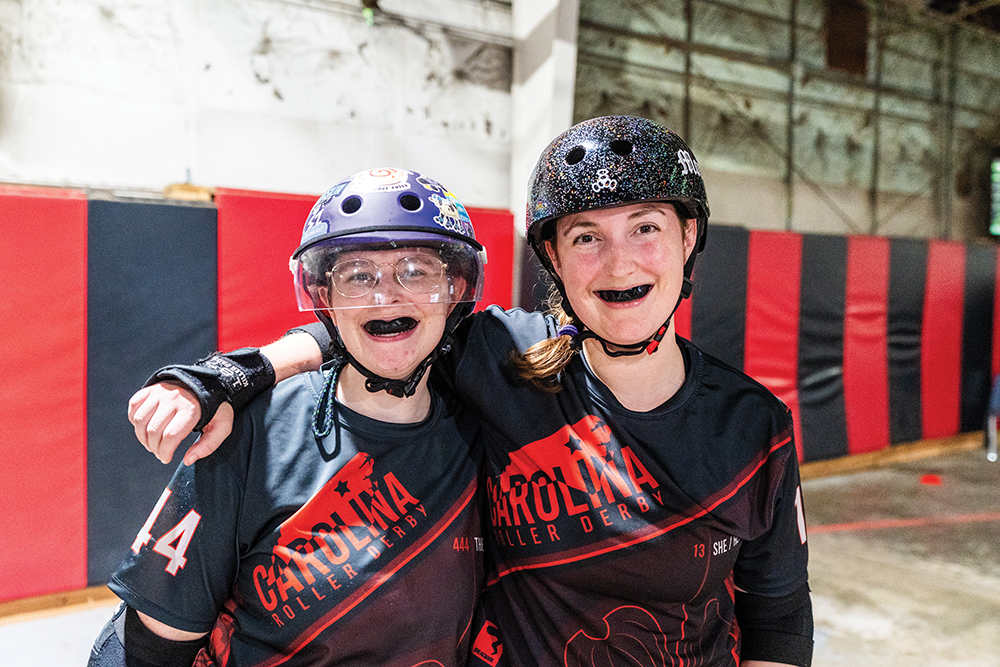
The Raleigh Junior Rollers, an associated league of Carolina Roller Derby for all genders ages 8 to 18, often adjust practice times to hours United Skates is closed. Despite challenges to both practice and host bouts, derby continues to attract newcomers. The pandemic pushed many of them to the Carolina Roller Derby.
They found more than sport. “For us, roller derby is definitely seen, nationwide and across the globe, as a space that’s inclusive and welcoming of people across gender identity, gender presentation and sexual orientation,” Young said. “It has absolutely become a safe space for LGBTQ+ people to be themselves and find community.”
An equal point of pride: “Our league also recognizes we can do better,” she said, noting lack of representation of other marginalized groups. “We’re building and establishing good things, but we always want to improve. We want to constantly learn and educate ourselves so we can become even more inclusive of the Triangle community that we serve and represent.”
As they strive to be positive role models, the individuals in this league are also committed to shaping the awareness of roller derby as a “high-level competitive sport that folks should take seriously,” says Young.
Young never imagined she’d suit up to play a contact sport. “I did ballet growing up,” she says. “I never thought I’d be able to hip-check somebody.”
Rolling Forward
Skating is about far more than recreation.
“The appeal is different for everybody,” Charland says. “It’s individual and it’s community.”
That’s why entrepreneurs like Laini Jarrett of Apex launched Peak Skates, a mobile skate shop that brings equipment and rentals to parks, schools or wherever skaters want to skate and learn. She hopes to expand opportunities for everyone, including creating sensory-friendly events for neurodivergent skaters and people with autism. It’s also why Kelly Wright, who noticed aging facilities at birthday skate parties when she moved here from Virginia, created The Wright Wheelhouse, organizing group-skate meetups as she pursues opening her own indoor rink. It’s why volunteers continue lobbying for more public facilities, more classes and more places where anyone can roll.
“The barrier is so low, but the ceiling’s so high,” Charland says. “The sky’s the limit!”
Stretching beyond any single rink or skate park, the Raleigh skating community — whether on boards, quads, inlines or derby boots — is connected by the thrill of the glide and the ingenuity that keeps them on a roll.

This article was originally published in the September 2026 issue of WALTER Magazine.