After longing for a pickup truck year after year, this columnist learns to ask for the things that matter this holiday season
by Jim Dodson | illustration by Gerry O’Neill
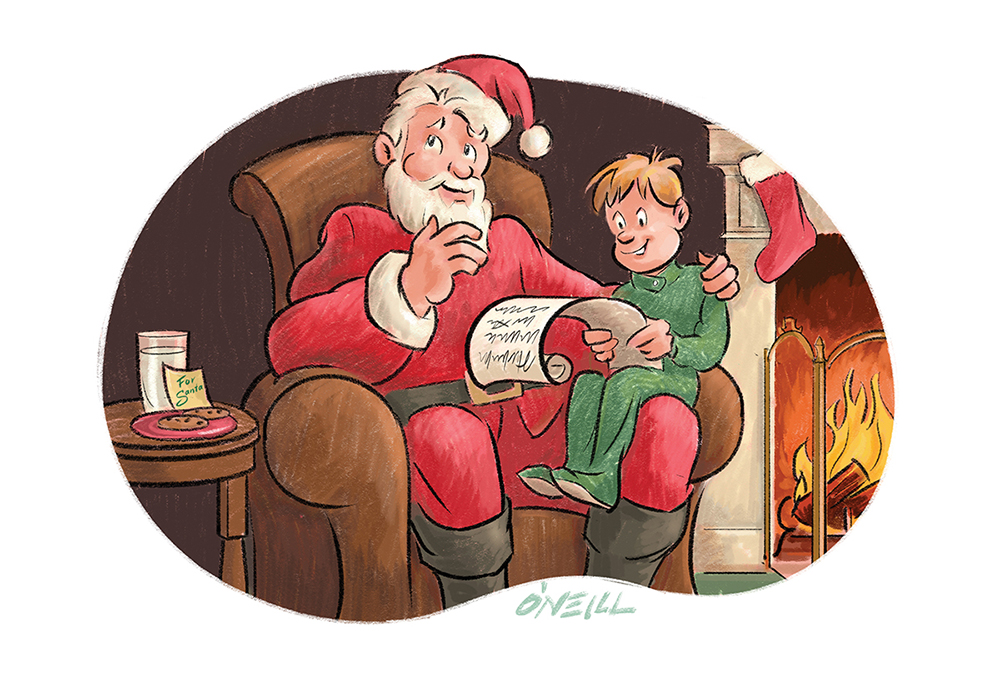
Twenty years ago, as part of our move to North Carolina from Maine, I gave my beloved Chevy truck to a local kid who thought Christmas had come early. “Old Blue,” as I called her, was getting on in years and prone to stalling out from time to time. But, oh, how I loved that truck. She gave our tribe many fine memories, including carrying me, my 7-year-old daughter, Maggie, and our dog, Amos, through a 6,000-mile camping-and-fly-fishing trip across the golden West that became the premise for a book.
Last Christmas, some of you may recall, I jokingly wished that Santa would bring me a shiny new Chevy pickup truck. To help the old fella out, I even began scouting local Chevy dealers, hoping to find a deal on a nice new or used pickup truck that had my name on it. Unfortunately, the trucks I liked had eye-popping price tags — bad news for Santa.
On one level, I’m glad my truck wish failed to come true. On another, everywhere I went in the city over the following year, I seemed to see fancy pickup trucks with old white dudes like me behind the wheel, an unnaturally cruel sight for a fellow quietly suffering from years of truck lust.
So, I asked myself: What the heck does someone like me, who lives and gardens in a quiet suburban neighborhood, really need with a shiny new pickup truck?
The answer is nothing. Or pretty much nothing.
On the other hand, if Santa had indeed brought me the shiny new pickup I’d wished for, this year I could have impressed my neighbors by hauling home the largest Christmas tree ever in the back of my truck, a Currier and Ives scene for the age of consumer excess.
Instead, as usual, we purchased a lovely little fir tree at the roadside lot where we’ve found the perfect holiday tree for many years and drove it home on the roof of my elderly Outback. It looked sensational with its tiny lights glowing from our den’s picture window on a deep December night.
Still, old wishes die hard.
During an afternoon trip to the grocery store the other day, just when I thought my truck lust was finally a thing of the past, a white-haired fellow about my age parked beside me and climbed out of a beautiful, cobalt-blue Sierra Denali 1500. It was a real beauty, and for a crazy, covetous moment, I wished I had one just like it.
“How do you like your rig?” I cordially asked.

He beamed. “It’s absolutely fantastic. Gave it to myself when I retired last year. One of the new self-driving models with four-wheel drive and a crew cab that’s perfect for hauling our four grandkids around town.” He added that it had all the latest high-technology toys, plus real leather seats and a super sound system.
“Feel free to take a seat in it, if you’d like,” he graciously offered.
I thanked him, but declined the offer. I wished him happy grandkid-hauling, then went on my way, realizing that I evidently hadn’t quite gotten my yen for a shiny new pickup truck completely out of my system.
Fortunately, my next stop was Lowe’s Home Improvement, which brought me back to earth. As I loaded 10 bags of mulch, a hundred pounds of organic garden soil and several bags of dried manure into my trusty old Outback “garden car,” I realized some things are simply never meant to be.
Besides, suddenly I spotted something by the store’s front doors that I truly wanted — and needed — more than a fancy new pickup truck.
A row of shiny new wheelbarrows.
The act of making wishes is as old as the invention of the wheel.
In ancient European folklore, wishing wells were places where any spoken wish — often accompanied by a coin tossed into the water — was thought to be magically granted. The ritual itself was a means of connecting with the divine and requesting blessings or favors. Wishing wells, in fact, exist in the lore of almost every world culture and still have a place in modern society, often found in spiritual and historic gardens, and even used in contemporary fundraising campaigns. And don’t forget, as Jiminy Cricket pointed out, when you wish upon a star, your dreams may come true.
In the modern context, however, the word “wish” simply means “a desire or hope for something to happen,” which makes me hear my late papa’s voice on the subject.
He was something of an armchair philosopher. One of his favorite expressions was “whatever is worth wishing for, son, is worth working for.”
Probably because I was such a wishful kid, I heard this pithy bit of armchair wisdom dozens of times while growing up.
As a kid who was happiest in nature, in a garden or on a golf course, I wished to someday be either a forest ranger or someone who built beautiful gardens for a living, maybe even a golf course designer. As an early reader of adventure books, I hoped to follow in the footsteps of my favorite writers, like Jules Verne.
None of these wishes came true.
Or did they? Fueled by such youthful desires, I grew up to become a newspaper reporter like my father and found that I was even more drawn to stories about real people, history, nature, poets and things that make dreamers wish for a better world. Along the way, I’ve also built five landscape gardens and even designed a popular golf course.
In short, I’ve lived long enough to know the old man was right — that if we wish for anything, including a better world, we all must work hard to make it happen.
So, whether by starlight or ancient wishing well, this Christmas I’m wishing for a couple very special things: More goodwill and kindness to each other in our troubled human family, and a safe and happy delivery for my daughter’s baby girl, due to arrive on Christmas Eve.
As a new grandpa, I can’t wait to haul my first grandchild around in my shiny new wheelbarrow.

This article originally appeared in the December 2025 issue of WALTER magazine.