The Raleigh creative has earned a reputation for whimsical, large-scale works — especially inflatables — that bring joy to public spaces
by Colony Little | photography by Joshua Steadman | special thanks for Marbles Kids Museum
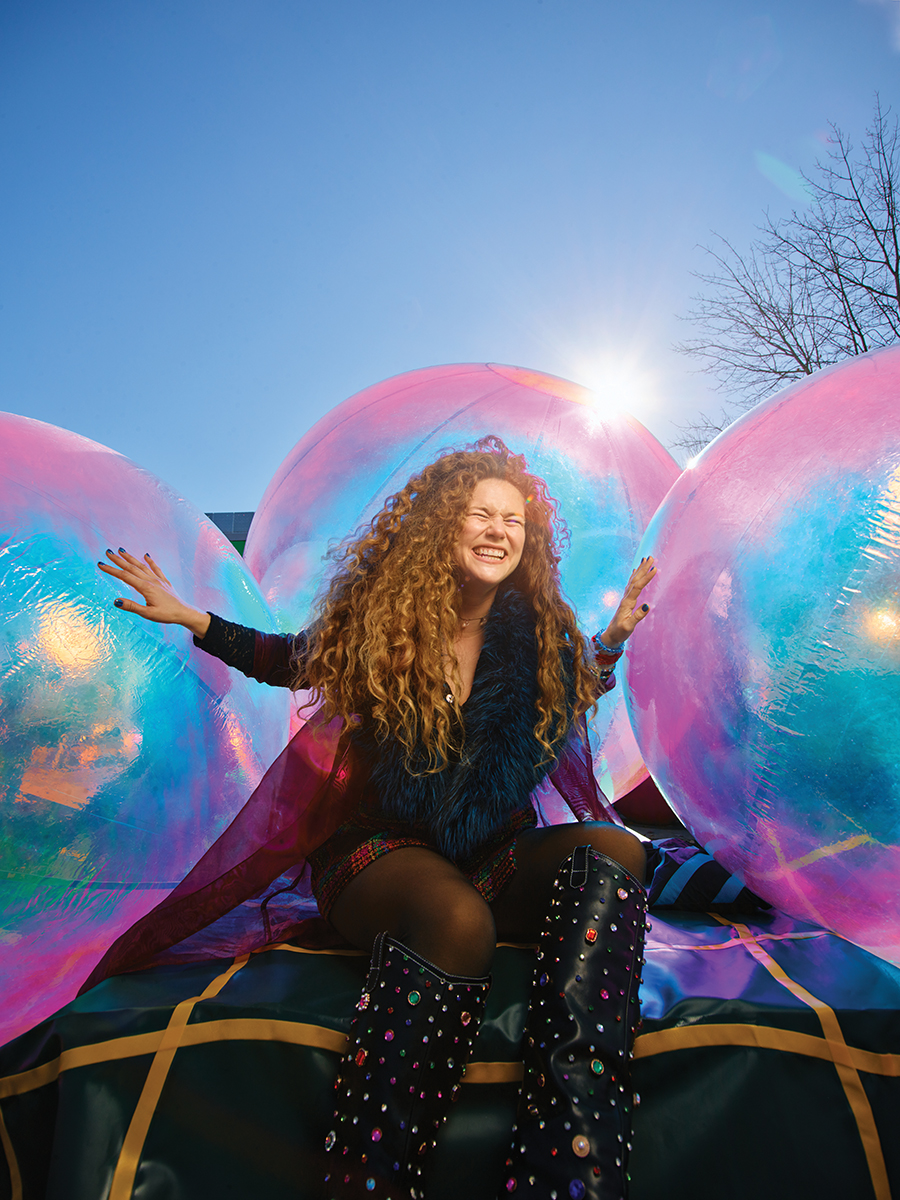
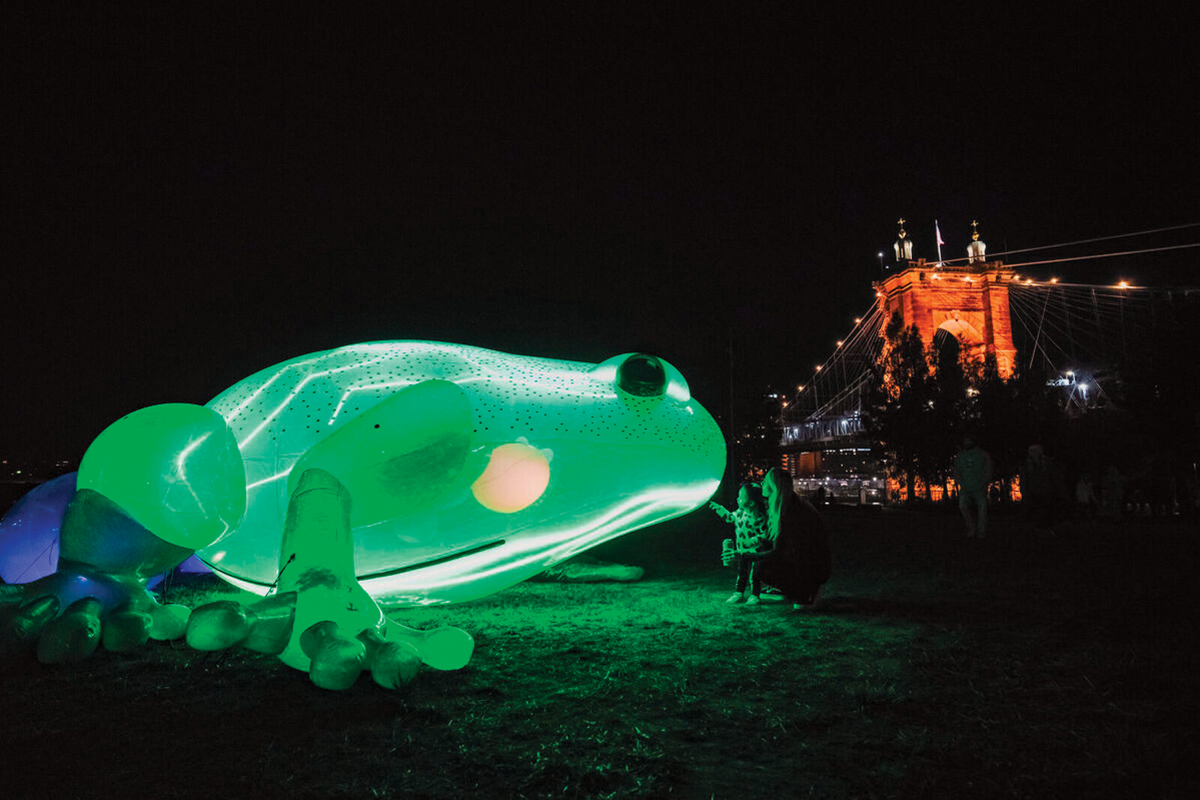
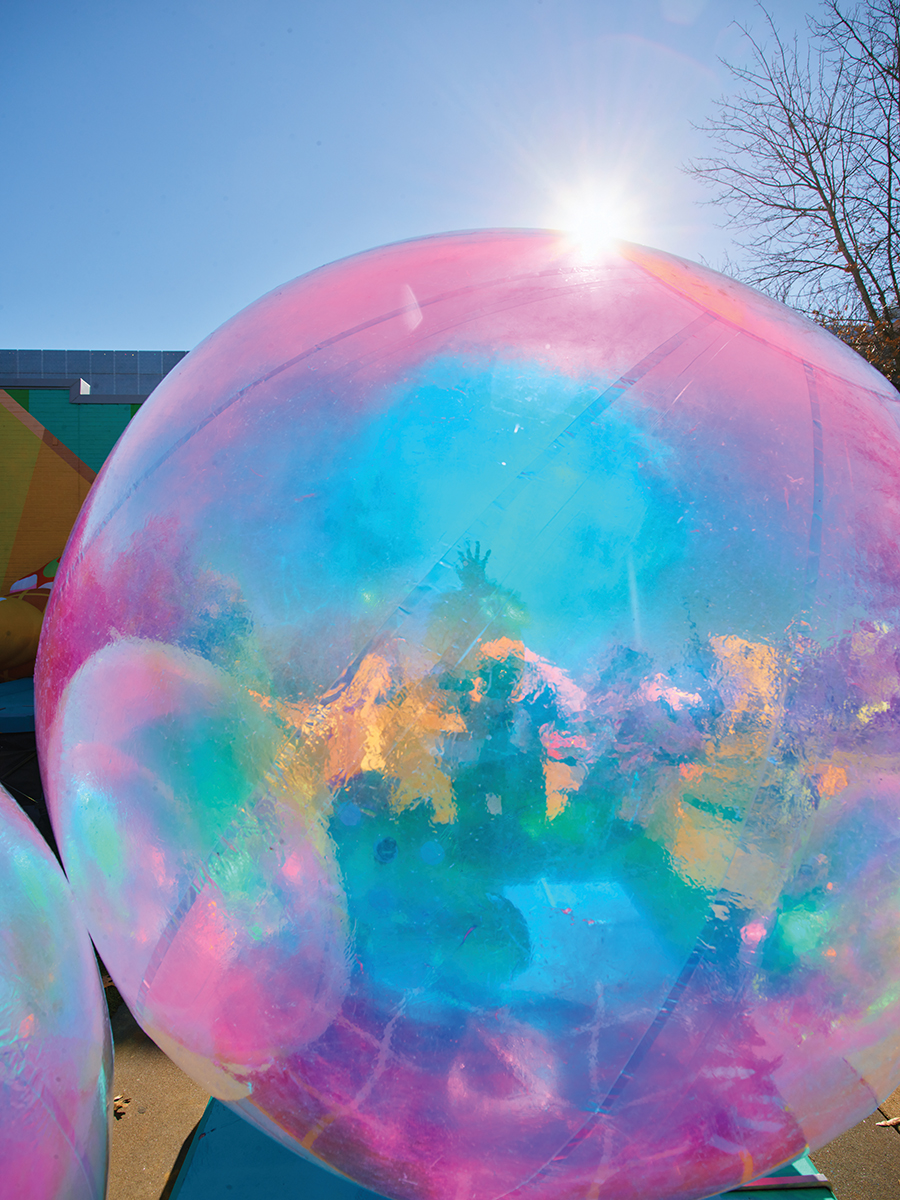
You’ll rarely spot Katie Stewart’s work indoors. Her oversized inflatable sculptures and exuberant installations are most often found in places that invite accidental, more casual interactions with her craft — parks, festivals and the odd roller skating rink, to name a few. Quirky and subversive, Stewart’s work challenges us to expand our parameters around art spaces, like the traditional white-walled gallery, and by extension, our definitions of art and who makes it. “I don’t know why we’re stuck in this very constrained view of what an artist is,” says Stewart. One piece, Oopsie Daisy, is a character with a daisy for a face doing a handstand, with lanky, striped legs that kick in the air. Another, Heart of Glass, is a giant, translucent frog with visible organs, including an illuminated pink heart. Stewart has made iridescent orbs and airbrushed Cuban snails, XPS foam scrap mushrooms and polyfill clouds. Each of these pieces provides unexpected moments of whimsy.
These larger-than-life works of art make it hard to imagine that Stewart, who grew up outside of Charlotte, once considered herself as an introvert. “I was always a weird art kid with a very small circle of friends,” says Stewart. When she enrolled in North Carolina State University’s College of Design in the mid-2000s, she found her creative tribe, relishing in the program’s talented staff and interdisciplinary curriculum. But it was her side job that coaxed her out of her shell. “I definitely bloomed as a young adult,” she says. “I was a barista in college; that’s how I unlocked the fact that I was an extrovert to the nth degree. I get energy around people.”
While Stewart’s work sparks curiosity and joy, it also comes from a place that’s not always so saccharine. She says her art is a byproduct of her own mental health journey, where she has relied on her creativity and ingenuity to lead herself out of dark times and uncertainty. “I’m
a highly emotional person with anxiety, depression and ADHD,” she says. “I love being very clear about self-disclosure and bursting taboos.”
While at NC State, she struggled to choose a major, switching from art and design into graphic design; the sense of doubt followed her after graduation. She worked locally in graphic design while building a freelance portfolio, questioning her decisions and motivations while grappling with other people’s expectations of where her degree should lead.
“I was very lost. The definition of success was going to the West or East Coast, working in Manhattan, Brooklyn, San Francisco or Portland,” she says. “Watching my peers get these incredible jobs at legendary firms, the comparison was stifling. I really took a hit to my ego because at the time, I didn’t know what I wanted to do.”
While suffering from burnout as an in-house graphic designer for five years, Stewart turned to therapy. “I have a psychiatrist and a therapist that I treasure; they’re my counsel,” she says. She parted ways with her employer in 2015 to launch a solo career, providing art direction, photography and design services to commercial ventures in Raleigh, including the former boutique design store Port of Raleigh and fashion and gift retailer Edge of Urge.
From her studio at Anchorlight, her practice became a series of creative experiments in material, printing and photography. After receiving a small business grant from custom fabric printer Spoonflower in 2019, she created an installation in the center of a roller rink that was installed in late 2020 for a burst of social-distanced fun. Using the fabrics she designed, she made a small photo studio backdrop for skaters to roll up and take portraits. Later that year, Stewart was tapped to create an installation for Raleigh’s first Illuminate Art Walk, an outdoor exhibit to bring people downtown. She filled the windows of a vacant storefront with an art installation titled Rainglow, using hand-dyed fabrics to provide the backdrop for large polyfill clouds brightened by ribbons of rainbow LED and cascading raindrop lights.

Through that project, Stewart saw the creative potential in engaging underutilized real estate. “We need to have more spaces for joy, enrichment and highlighting the different, beautiful parts of the community and culture,” she says. “We just need platforms for it. If you have a vacant storefront for a month, make it an Illuminate style window display… Activate it! Trust artists.”
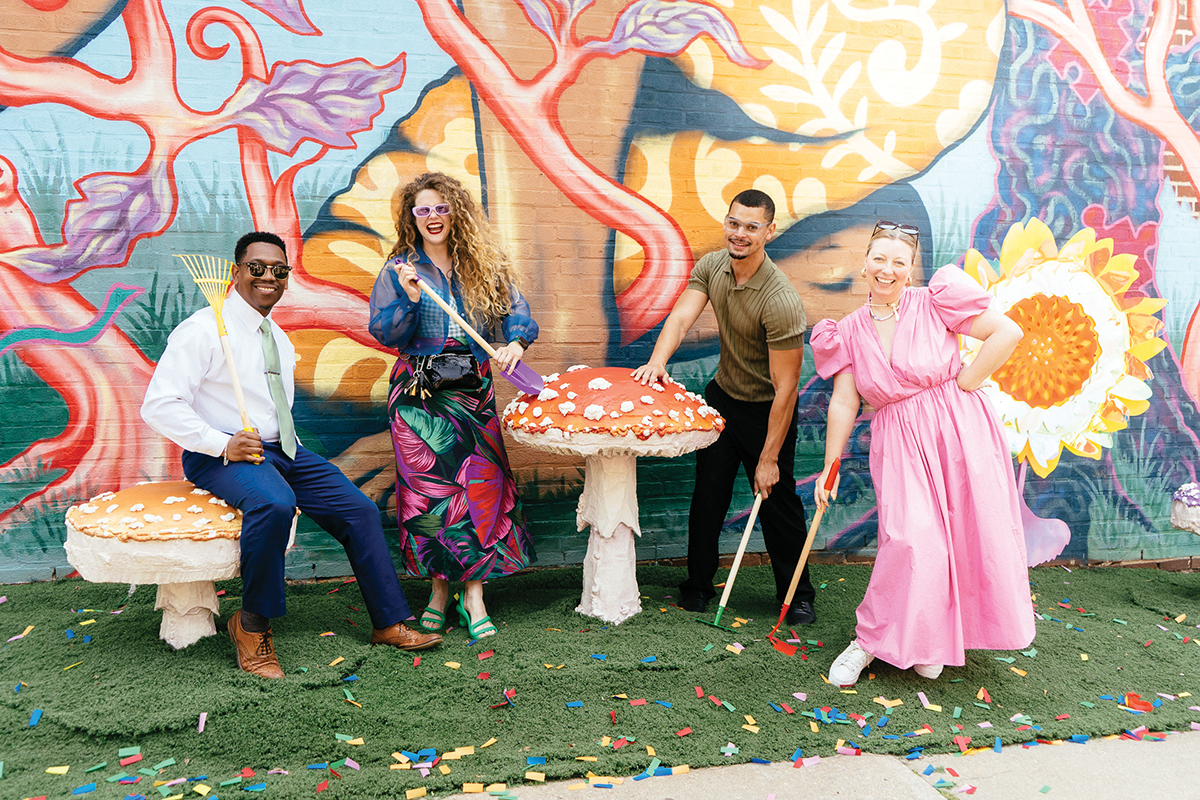
In 2023, Stewart was approached by Artsplosure program director Cameron Laws to create Raleigh’s Smallest Park on the corner of Hillsborough and West Streets. Located in front of a mural titled Parks for the People by artist Gabe Eng-Goetz, the streetside installation uses reclaimed synthetic turf and a collection of whimsical red toadstool mushrooms, floral pinwheels and colorfully painted benches to create a fantastical pocket park.
Stewart continued to build upon these projects, fusing her technical skills with resourcefulness to create visual experiences. Thinking about how large-scale art installations can serve as memorable event guideposts and landmarks for visitors, Stewart had an idea to create a large-scale sculpture reminiscent of the iconic Bonnaroo arch for events here in Raleigh. “They’re like postcards or a vignette scene that say, we’re here! It’s where you take your cute festival picture, so I call it a virtual postcard,” she says. She approached the organizers of the 2023 Hopscotch Music Festival with her idea. “I pitched this zany inflatable installation and they approved it,” she says. “I was excited, but then thought, how the hell am I going to make this happen? At that point, I never had an activation.”
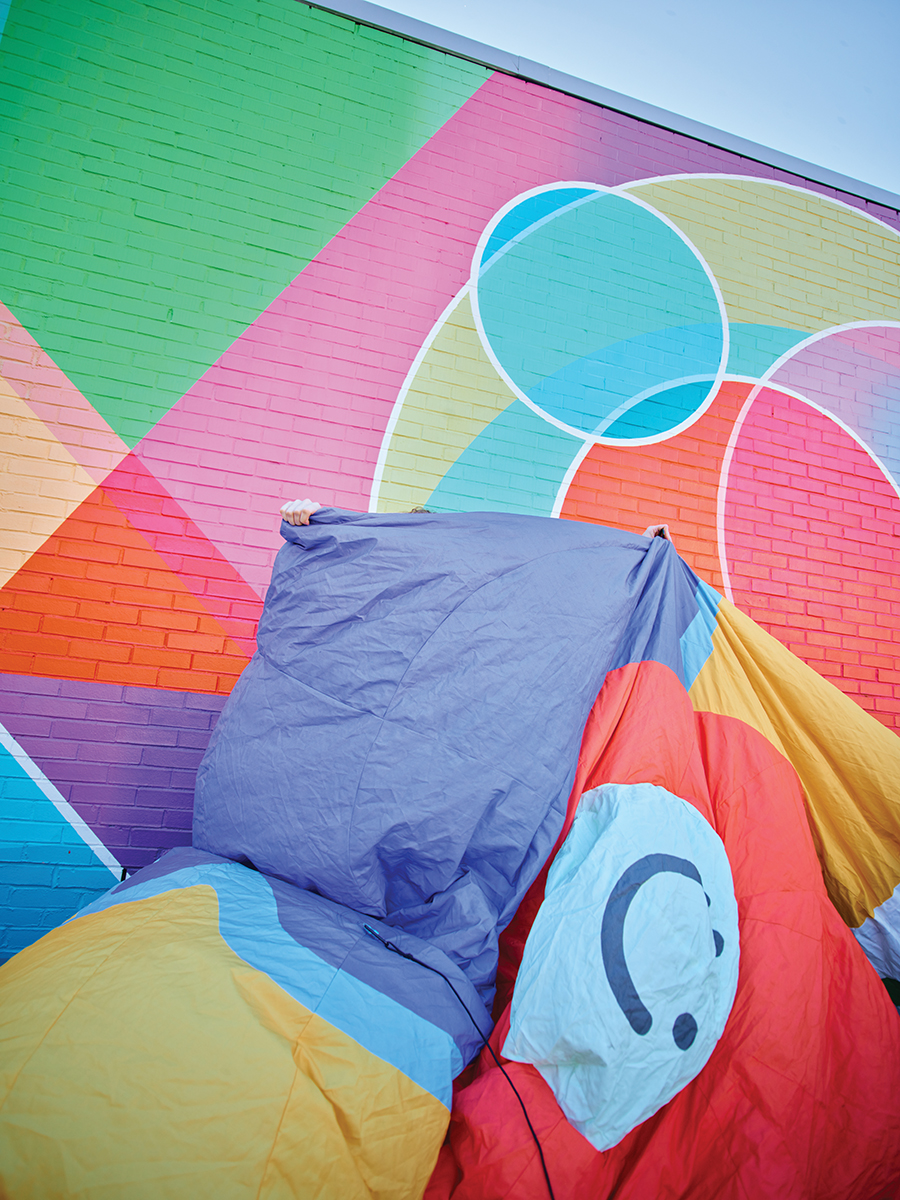
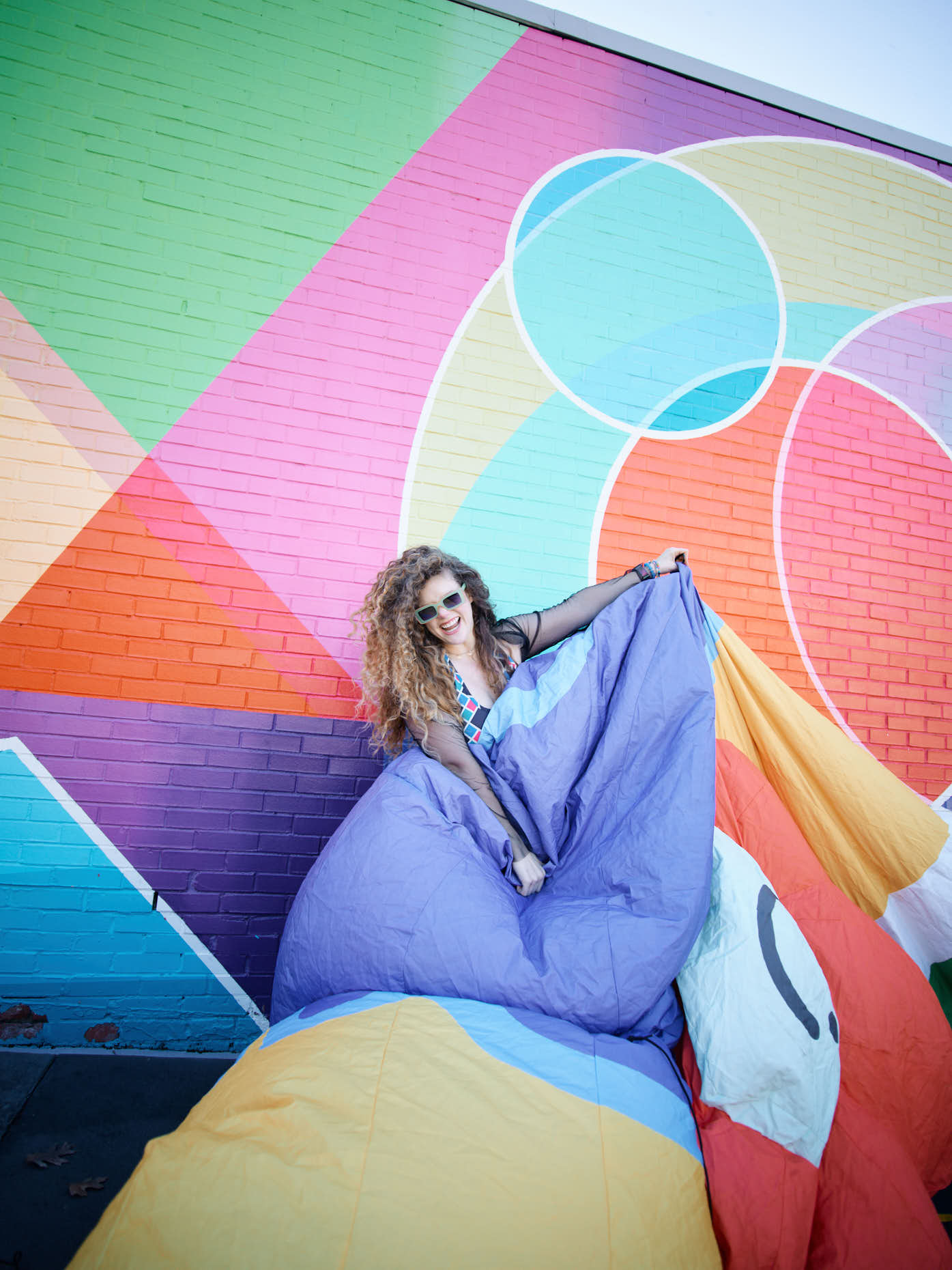
The design process included lots of sketches, photoshopping, 3D software modeling and numerous calls to vendors for material and fabrication. She outsourced the sewing of her ripstop nylon design to a fabricator while she tested fans and blowers and figured out the right cabling technique to secure her work. The first piece of the installation was Oopsie Daisy, her lanky-legged daisy. When it came time for setup, the physical labor was unlike any other project she experienced, but she received much- needed help from her circle. “I had an incredible crew of friends; we drove my Subaru onto Moore Square, unloaded everything, and made it happen with this incredible team of volunteers, which I’m so appreciative for,” she says.
Since then, she’s continued to experiment with inflatables, modeling various surface design techniques for the fabrics she used, while maintaining meticulous records around the installation logistics — from tethering to sandbagging to voltage requirements — for each piece. “There’s an incredible, beautiful, shiny, lovely aspirational product that happens with installational design, but it is also arduous — heavy schlepping,” she notes. “I joke that at the end of each install I have ‘installation legs’ or ‘festival legs’ because they are beaten, battered, bruised. I am a mess, but the product looks amazing.” She’s continued to scale her works both in size and marketability since discovering her knack for inflatables.
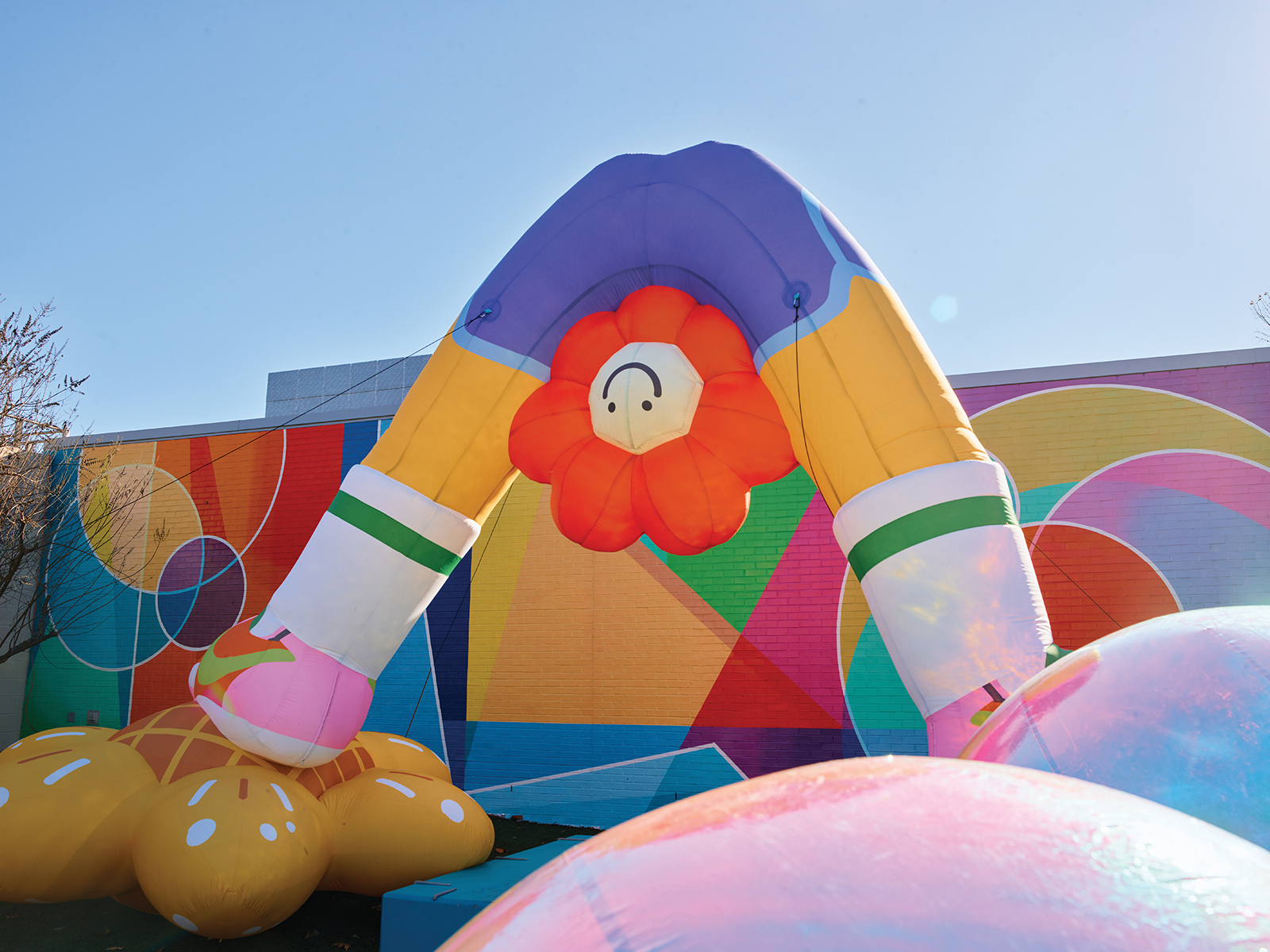
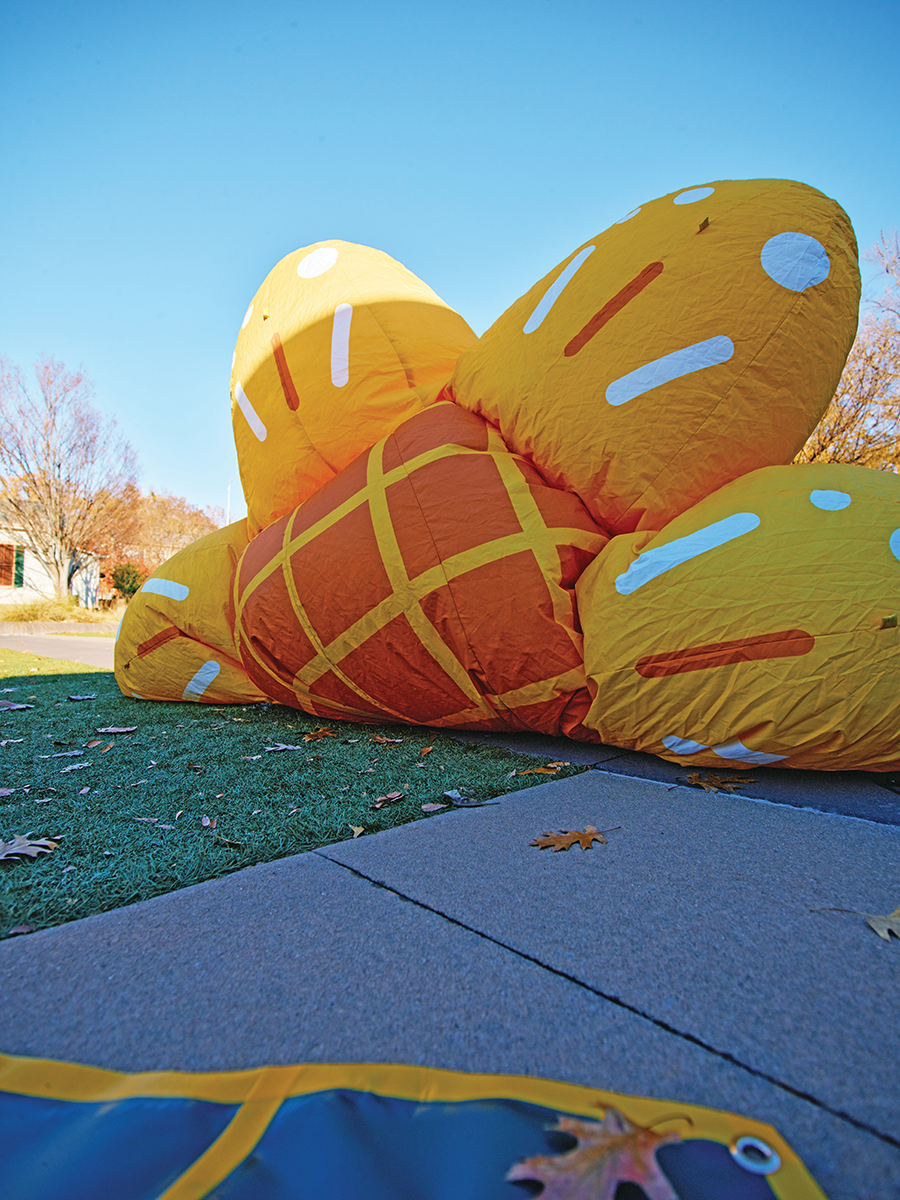
In 2024, she secured her first brand project, with Nike, for an activation around the Dreamville Music Festival: a new daisy-faced character, this one doing a backbend in colorful sneakers while standing on two massive inflated sunflowers. That same year, she created Heart of Glass, her inflatable frog, and a giant cicada nymph for Brood Awakening, an immersive art walk though Walnut Creek Wetland Park that celebrated its ecological and cultural history. She says she has always drawn inspiration from nature. “It’s one of my pillars,” she says. “I grew up climbing trees, playing with tadpoles in the pond, or seeing quartz rocks and Carolina clay, and playing with moss and making little fairy habitats.”
These creations are projections of her colorful personality and infectious energy — they also represent her personal and artistic journey. For a recent talk at speaker series CreativeMornings RDU, which happened to be on Halloween, Stewart wore a DIY moth costume, complete with wings and feathered antennae. It was both a nod to famed storytelling show The Moth Radio Hour and the theme of her presentation, Softness. In her talk, she discussed how periods of vulnerability invite growth, much like in the transformation of moths and butterflies. “‘Soft’ does not mean fragile,” she said to the group, pointing to the inflatable cicada nymph behind her. “Critters with exoskeletons must shed their hard shells in order to grow; they have to get soft in order to survive.” CreativeMornings RDU host Joel Pominville was pleased that she chose to share her story: “Katie exemplifies everything we stand for: creativity, community, passion and joy.”
While daunting at first, Stewart has found that these creative ventures unfold like puzzles as she finds the keys to solve them — not unlike life’s challenges. “It’s about knowing that you can succeed. It’s terrifying, scary and exhausting, but you’ve got to punch through to the next level,” she says. She looks back on her past triumphs as foundational lessons for future artistic endeavors. “In 2023 I figured out I could, and in 2024 I figured out I could succeed.”
Stewart is currently a Wayfinding Artist in Residence with the City of Raleigh Department of Transportation, collaborating with their design department to upcycle discarded DOT materials to create signage connecting downtown attractions. (Expect to see it this spring!) And in the meantime, she’s dreaming up new, exciting ideas and exploring new locales to bring them to life. (Right now, she’s got an eye on the vacant Circus Family restaurant site on Wake Forest Road. “I want to make a little skating rink,” she says.)
And day-to-day, she’s chasing glimmers of wonder and finding ways to capture it in her work. She currently lives near the wetlands, which offer a constant source of inspiration. “I’ll see dew drops just blobbling around on a hosta, or come upon an oyster mushroom in the woods, and think, that’s the most beautiful thing I’ve ever seen,” she says. “I want to bring that to light to others.”

This article originally appeared in the February 2026 issue of WALTER magazine.