Textile artist Shelley Smith weaves together her personal practice and the generative force of leadership
By Colony Little | Photography by Joshua Steadman
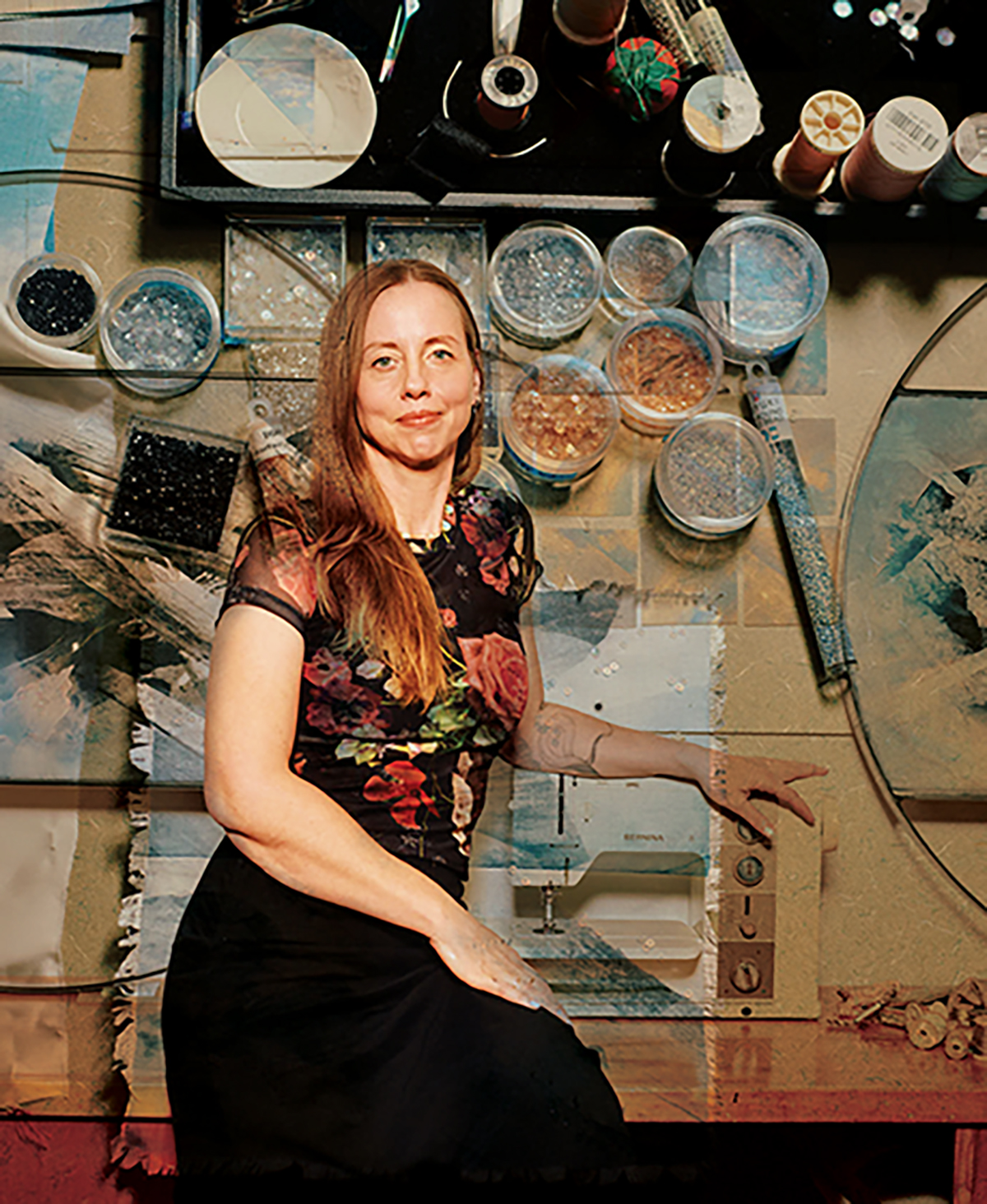
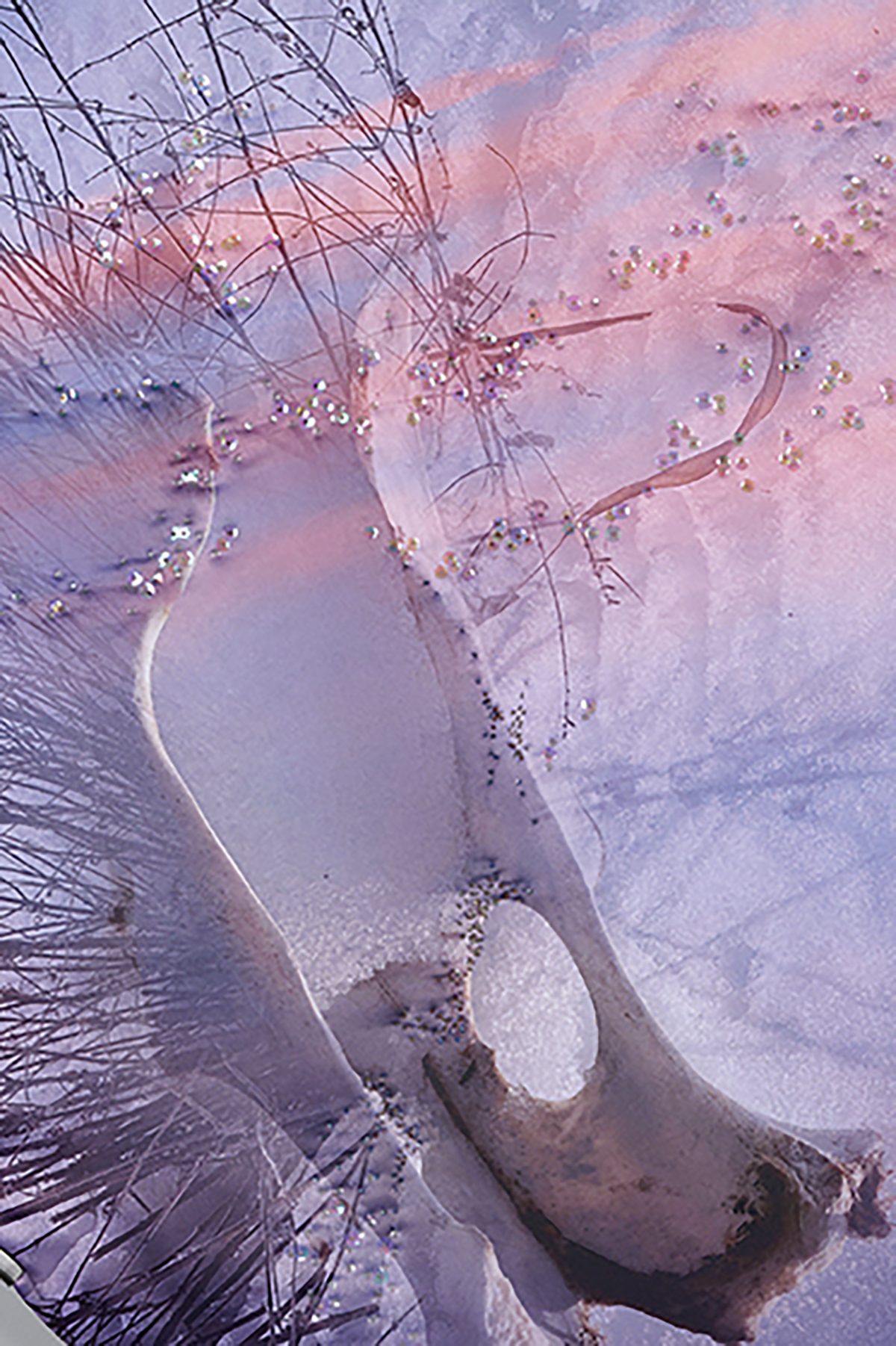
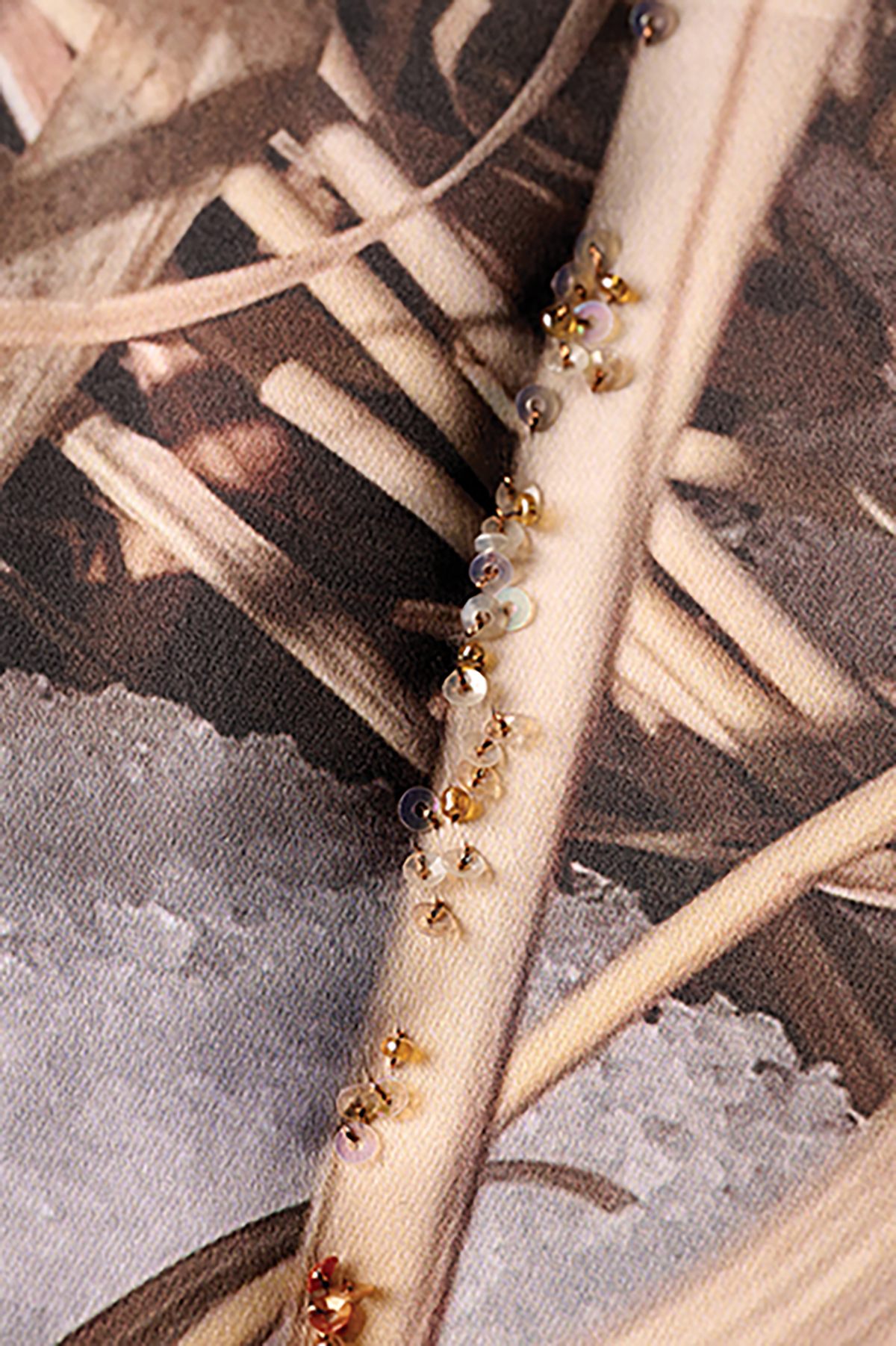
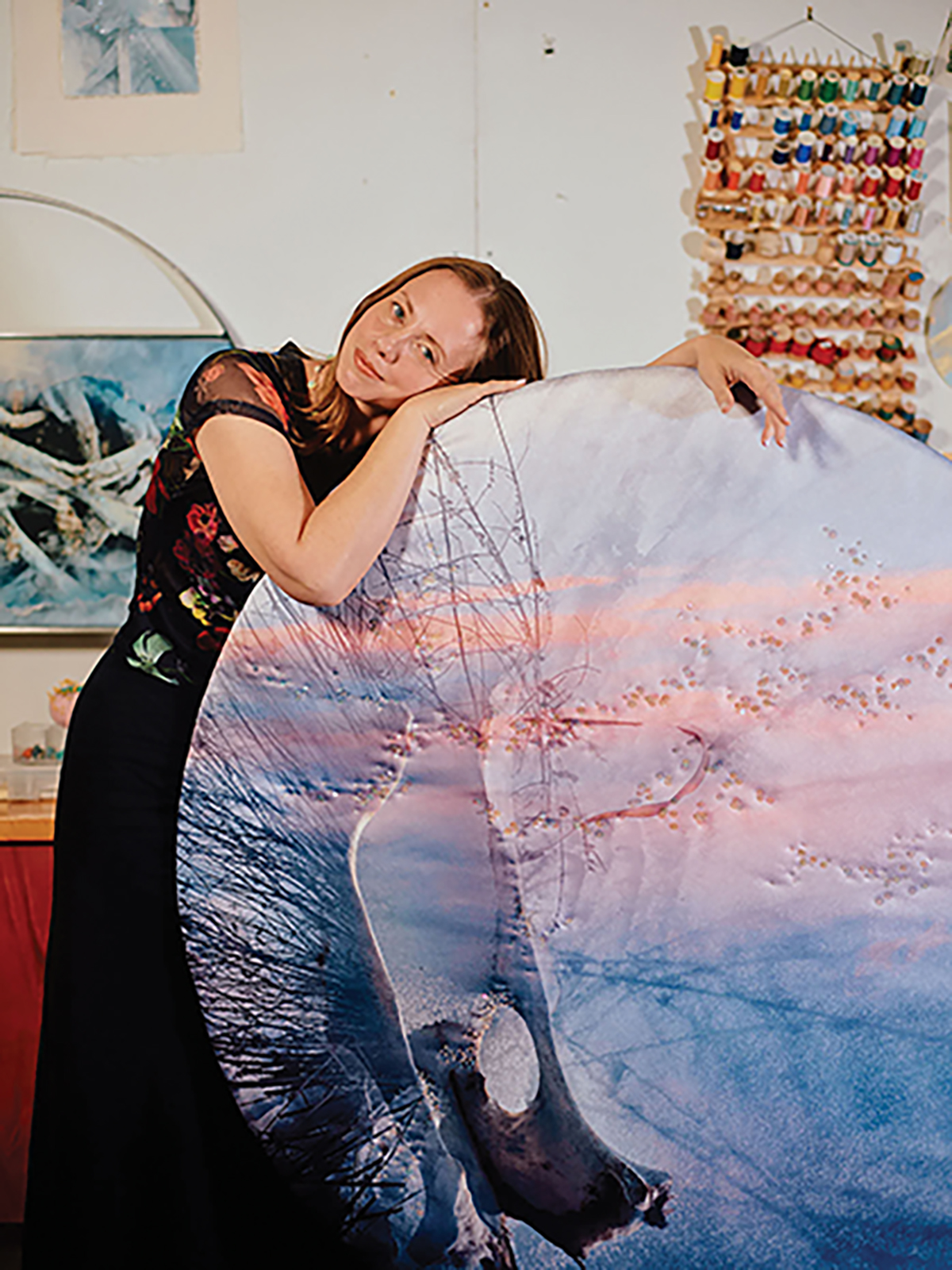
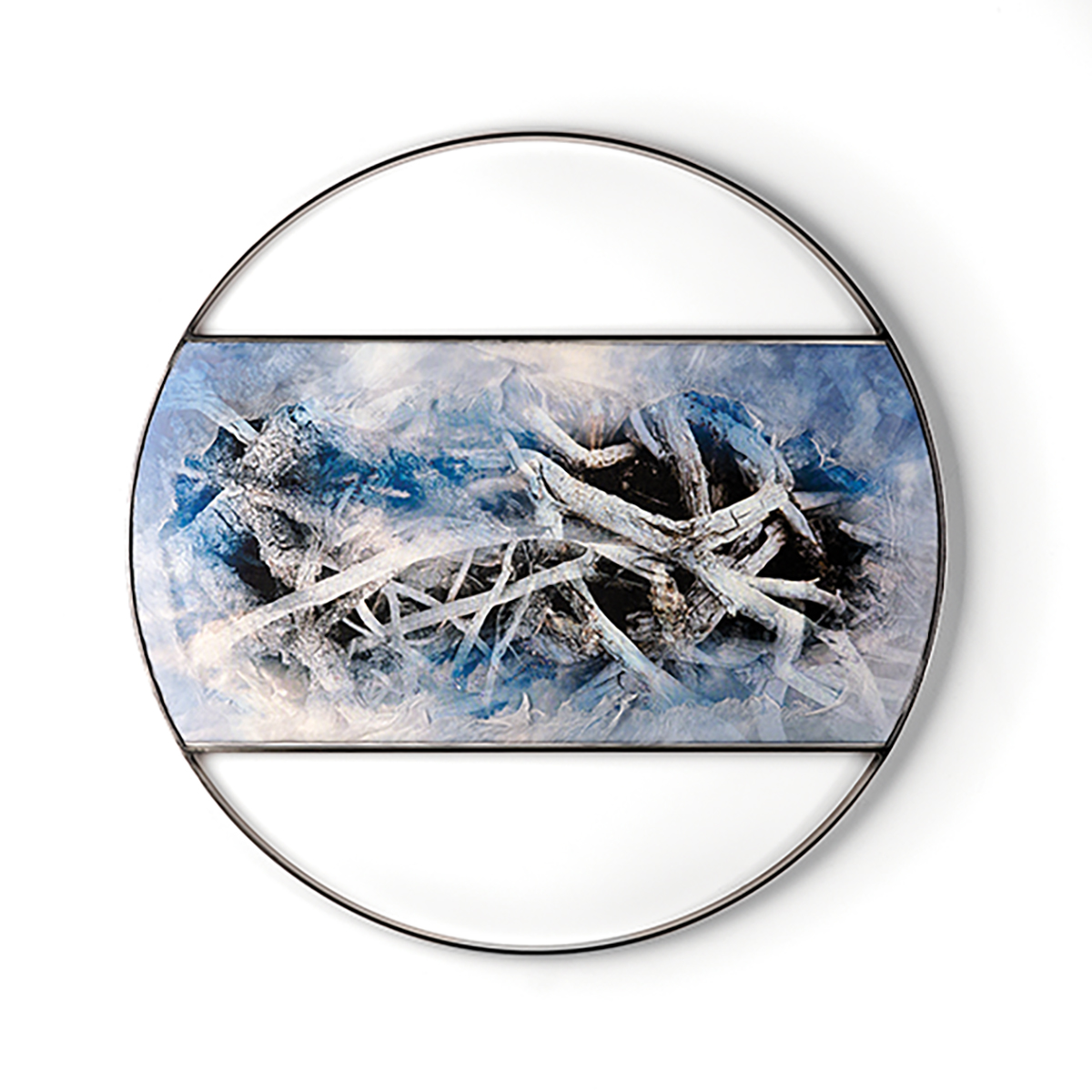
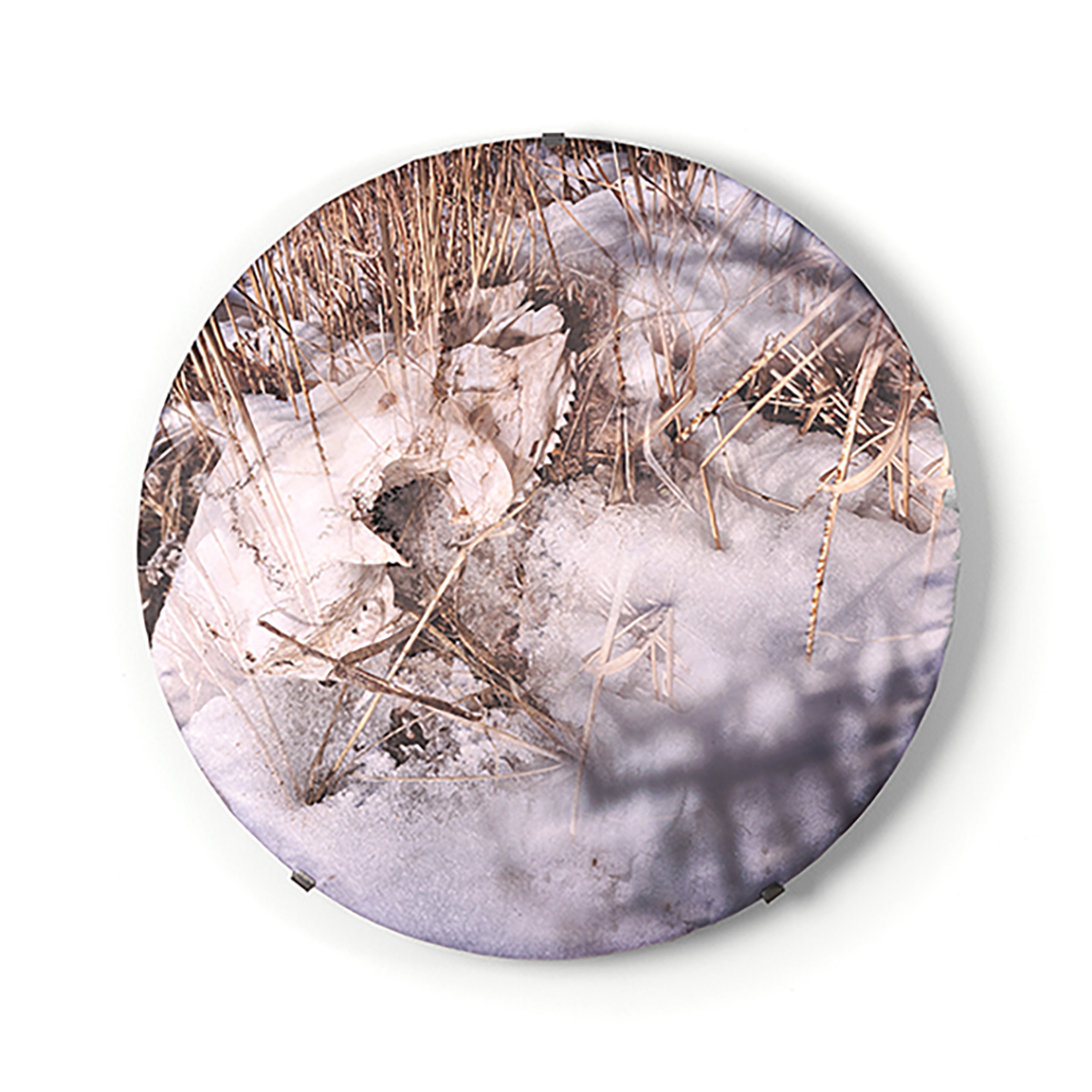
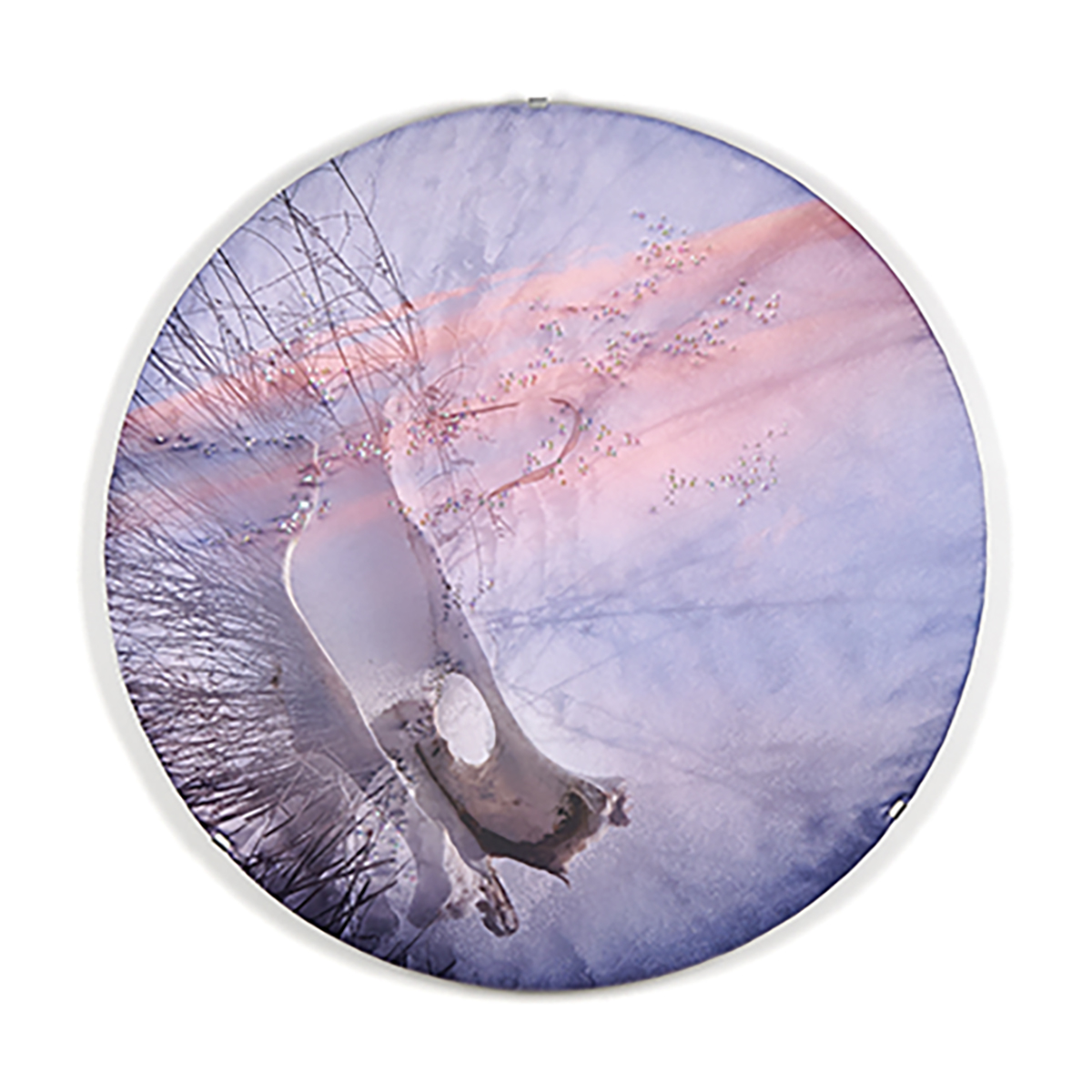
Circles play a prominent role in Shelley Smith’s multimedia paintings, images and textiles. The natural world is also a wellspring of inspiration, from the fractals of a snowflake to dewdrops on a leaf. In some works, metal frames hold digital prints of trees and flowers whose branches and petals glimmer in metallic satin fabric; in others, she fills embroidery loops with linen or muslin, on which she hand-stitches a menagerie of seed shapes or glimmering beads arranged into celestial clusters. Or you might find an image painted or printed onto sheer silk that’s layered over other fabrics, with details highlighted through stitches in gold thread.
“Things like this are the reward for the careful viewer,” Smith says. “That is what I hope that my art does: I want you to continue to look and then be rewarded.”
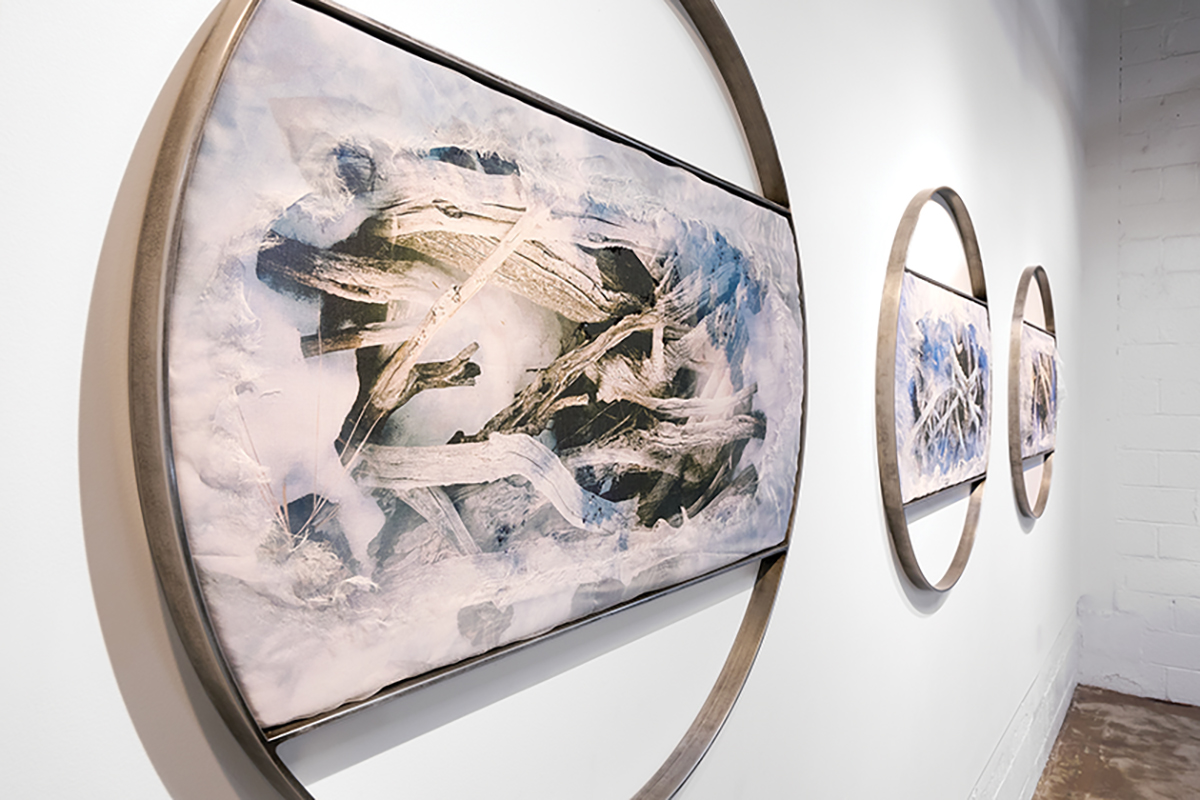
Her careful viewers also tend to be return buyers of her art. They’re the collectors who are drawn to the hidden details in work that combines traditional textiles with contemporary aesthetics using photography, metalworking, papermaking and other techniques. During a 2025 exhibition at Raleigh’s Rebus Works, Smith presented nature photographs printed onto large, round aluminum disks. Titled Give Me Something Endless, the show was emblematic of her process of taking something old and creating something new.
Smith’s resourcefulness is not limited to her art — it’s a skill she’s nurtured through her work directing Anchorlight and its Brightwork Fellowship.
Smith began honing her creative pursuits at an early age. In the late 1990s, she attended the North Carolina School of the Arts in Winston-Salem, completing a two-year program that prepares high school students for art school. While there, she built a broad portfolio of work in multiple mediums, from painting to sculpture. She enrolled into the School of the Art Institute of Chicago, but dropped out and moved to New York City at age 19, where she faced a series of setbacks. She fell into a spiral of substance abuse and addiction that stymied her creative pursuits. “It got really dark for a while,” she says. “It was a really wild and dangerous time.”
By 2003, she had made the decision to return to North Carolina to heal and pursue sobriety, and at 28, she went back to school, albeit with some initial trepidation. “When I decided to go back to school, I thought I was so old — but it was the right time for me to go to college,” she says. “I was excited to be there, I was focused. I knew what I wanted and took advantage of every opportunity.” She enrolled into the former Anni Albers Scholars Program at North Carolina State University, a dual-degree program in art and design and textile technology, where she studied under distinguished artists and educators including Susan Brandeis, Vita Plume and Jan-Ru Wan. “That program and their expertise, along with their dedication to fiber as a craft and as a fine art, really changed the direction of my studio practice forever,” she says.
Returning to art became an important milestone in her journey through sobriety. “I’d stopped making art when I started drinking and doing drugs. Addiction stole that from me — it took several years to put the pieces back together and become more of a whole person again,” Smith says. “One of the signals of true healing and recovery was when I started making art again.”
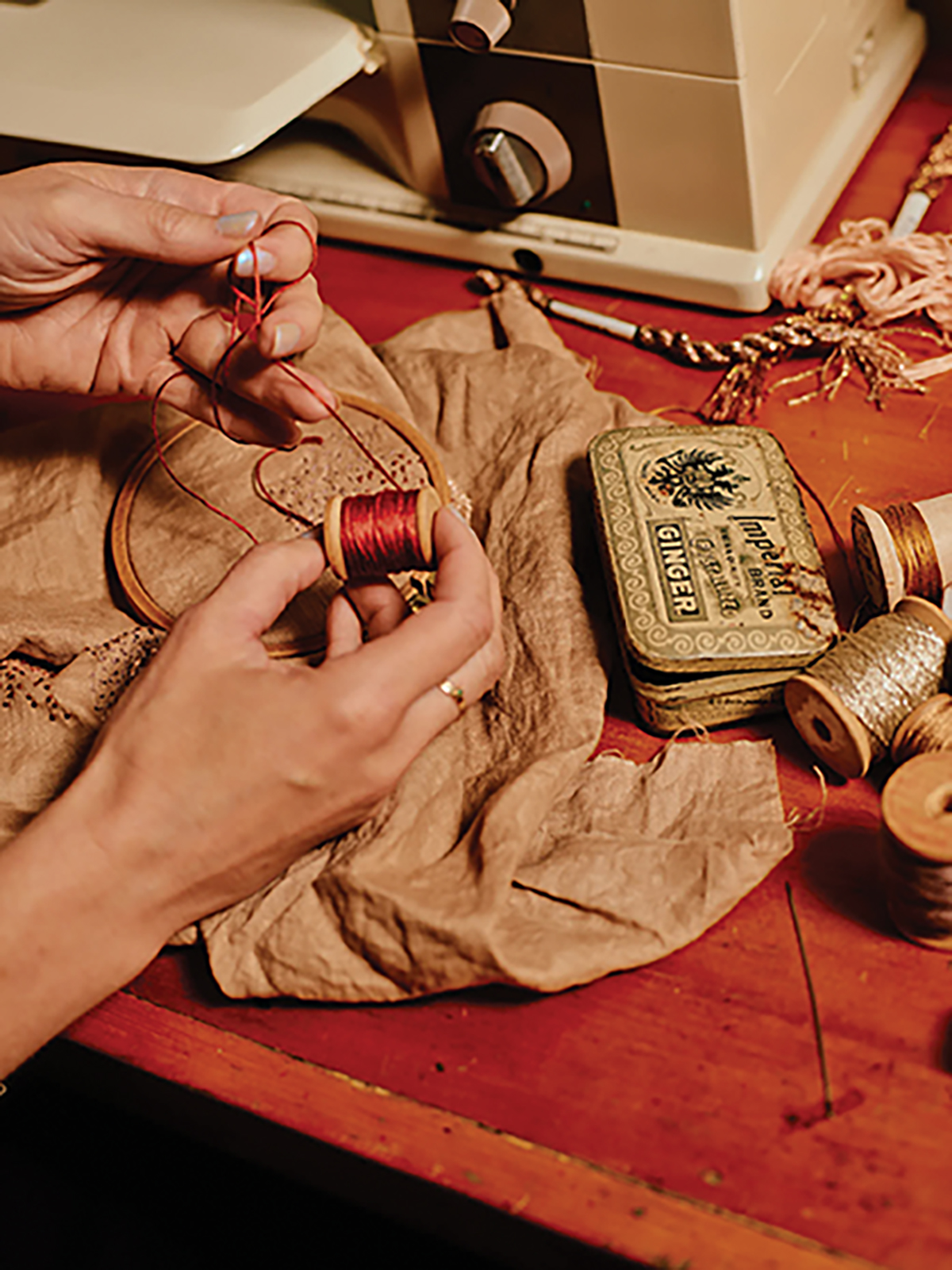
By 2015, Smith was waiting tables at Poole’s Diner and preparing to wrap up graduate school, but struggled to find venues to exhibit her thesis, a series of works combining personal, archival photographs she printed onto sheer fabrics and embellished with embroidery thread. “The galleries in town were booked far in advance, and they also took a commission of 50%, which I couldn’t afford to pay,” she says. At the urging of a fellow artist, Smith approached real-estate developer James A. Goodnight, a Poole’s regular who had previously supported emerging artists by commissioning work and displaying their art in his commercial properties. (Painter Luke Buchanan, then a bartender at Poole’s, was among the artists he hired for mural projects around town.) Smith explained the show she was planning — and to her surprise, Goodnight had available space and was immediately on board.
The two met up the next day at a property on E. Davie Street, a few blocks from Artspace. “He said, I’ve been trying to rent this building for a year — nobody wants it,” recalls Smith. Rather than leaving the property vacant, he told Smith she could use it for a year if she could cover the utilities. “To this day, I don’t know why he offered that to me, but it was too good of an opportunity to pass up,” she says. Smith enlisted a few of her NC State cohorts to share studio space and activate the property through events and short-term residencies. Soon, the space and the collective was known as the Pink Building Project. “We did 11 exhibitions in 12 months,” Smith says.
This temporary experiment became a proof of concept: Once that year was up, Smith and Goodnight partnered to open Anchorlight, which now leases 26 studio spaces, a project space and a gallery located on S. Bloodworth Street in downtown Raleigh’s South Park neighborhood. Their mission is to foster a community of artists representing varying stages of their career by providing residencies, community building and mentorship opportunities among one another.
Photographer Sally Van Gorder was one of the first studio artists at Anchorlight. “Shelley was very thoughtful as she progressed in the development of Anchorlight,” Van Gorder says. “She had conversations with all of us about what our needs were as artists, and how we could use the opportunity in a way that was beneficial to more than just ourselves.”
Anchorlight offered short-term artist residencies and exhibitions through a fellowship program from its inception into 2020. After a hiatus, the program was relaunched in 2022 as the Brightwork Fellowship, a yearlong residency that provides studio space, a solo exhibition and a $50,000 stipend. This year, artist Robert Choe Henderson, who works in handmade Korean papermaking, is in residence; former fellows include Isys Hennigar, Steven Cozart, Saba Taj and Precious Lovell. In late 2025, Smith and Goodnight established the Brightwork Foundation as a 501(c)(3) organization.
Smith admits that in the early years of Anchorlight, she prioritized the demands of the organization over her studio practice. “It took the majority of my creative energy to figure it out, to build it and to see what worked,” she says. “For a long time, I saw that as my studio practice suffering — then I realized at some point that I needed to stop thinking about my creativity as a finite resource and think about it as generative.”
Smith credits her fellow studio mates, in part, for inspiring that revelation. “I can see all of the different ways that my practice has benefited from me being around and working with all these other artists, getting to really understand their practice on a deep level,” she says. Smith has also learned to be deliberate about making time and space to create independently, often by traveling or spending time at her home in upstate New York, where the environment inspires her art.
In 2027, Smith will launch a community fiber studio through the Brightwork Foundation, using a decommissioned loom she acquired from NC State. “I realized that there was an opportunity to have an educational arm of Brightwork and that we could fill a small gap that was left from the closing of the Anni Albers Scholars Program,” Smith says. During the winter Anchorlight Open House (Dec. 5), Smith plans to host weaving demonstrations, with a pilot program of weaving workshops to follow next spring.
And if you visit her studio during that open house, you will likely see a series of quilted North Stars lining the walls, which Smith created with swatches from earlier projects. “In between conceptually heavy fine-art bodies of work, I’ll often craft,” she says. Much like her repeated use of the circle motif, the North Star metaphorically marks a return to Smith’s early studies. “Textiles are always the foundation. Textile language is often appropriated to describe the human experience: our lives are woven together, the fabric of life… this language that we use so fluently to describe what it means to be human is derived from textile terms,” says Smith. “Being able to work with material and techniques that are so old, but in a contemporary way, helps me feel like part of that continuum of humanity.”

This article originally appeared in the December 2026 issue of WALTER magazine.