In the midst of the Jim Crow era, the Orgen Printing Company created a space to cover news that was relevant to Raleigh’s Black community
By Ian F. G. Dunn
Photography from the State Archives of North Carolina
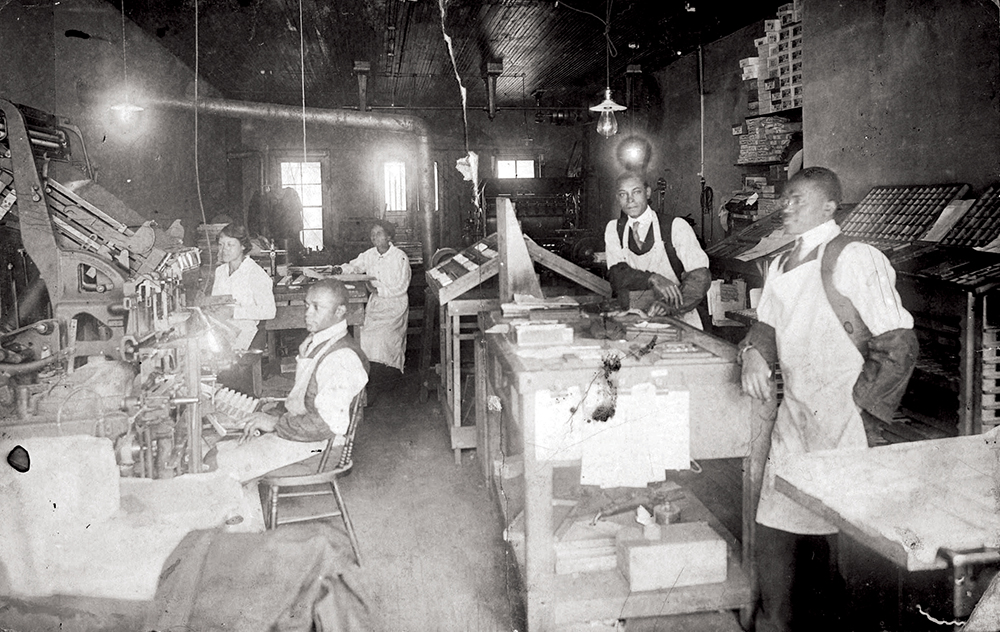
A photo taken around 1917 shows the inside of the Orgen Printing Company at 115 E. Hargett Street, where a handful of workers operated several large presses.
By the time of the photograph, Jim Crow laws had transformed Raleigh’s cultural, residential and commercial landscapes. Black-owned businesses that once intermingled with white-owned businesses in location and clientele were now much more clearly separated. The result was a concentration of Black-owned businesses along E. Hargett Street. The Orgen Printing Company was among these businesses.
In 1916, Lawrence Macauga Cheek, seen here on the far right, established the printing company in a small storefront on the ground floor of the Grand United Order of Odd Fellows Building, the present-day location of Arrow Haircuts.
Born in Warren County in 1886, Cheek came to Raleigh around 1910 to attend Shaw University, where he graduated magna cum laude. Shortly after graduating, Cheek moved to Houston, Texas, to accept a position teaching Greek at Houston College. Only a few years later, he moved back to Raleigh to establish Orgen Printing Company and ultimately, The Raleigh Independent newspaper. The name of the company — “negro” spelled backwards — reflected his commitment to publishing news that was relevant to the Black community.
More and more, citizens of different races shared a world, but didn’t share a lens in which to view it. African-American newspapers had been in existence in many larger northern cities since before emancipation, but it took longer for them to appear in smaller towns further south like Raleigh.
The first newspaper published and written by Black people appeared in New York City in 1827. The inaugural issue of Freedom’s Journal, co-edited by Samuel Cornish and John Russwurm, opened with a message to its readers. Its second paragraph began, “We wish to plead our own cause. Too long have others spoken for us. Too long has the publick [sic] been deceived by misrepresentations, in things which concern us dearly…”
In 1917, Raleigh had eleven sources of print media. The Raleigh Times, The News and Observer, The Union Herald, The Progressive Farmer — these were all white-run newspapers reporting on a world that largely wasn’t open or relevant to the Black community. The Raleigh Independent was the only Black-owned paper.
The slogan printed atop every issue read, “INDEPENDENT IN ALL THINGS. NEUTRAL IN NOTHING.” Apart from its primary goal of turning a profit, the paper’s existence was further legitimized by the crucial void it filled.
In 1919, Cheek ran for Raleigh City Council along with Manassa T. Pope and Calvin Lightner. All three knew they wouldn’t win, as the gerrymandering of voting districts nearly guaranteed the outcome of any election. According to Lightner, their main objective was to “wake our people up politically.”
At the time, the Black community’s vim and confidence had been debased by disfranchisement and ever-hardening Jim Crow laws. The Raleigh Independent aimed to inform and empower by publishing relevant and helpful content. The stories ranged from corruption and oppression exposés to features on successful Black citizens. The Dec. 18, 1920, issue, for example, included enthusiastic reportage of a mortgage burning ceremony for Tupper Memorial Baptist Church and a lengthy column announcing plans for Raleigh’s Emancipation Day celebration on Jan. 1, 1921.
Sadly, Cheek died in 1921 at the age of 34 from kidney disease. After The Raleigh Independent folded in early 1922, the Orgen Printing Company continued to operate at 115 E. Hargett until 1929, when it moved across the street.
In 1932, Orgen Printing Company was absorbed by the Carolina Tribune, the paper that, in 1940, would become The Carolinian. Eighty-six years later, The Carolinian continues to print two issues weekly.

This article was originally published in the September 2026 issue of WALTER Magazine.