A family photo archive reveals the 1926 World Series “playograph” outside The News & Observer and the site of Raleigh’s first telephone call.
By Matthew Busch
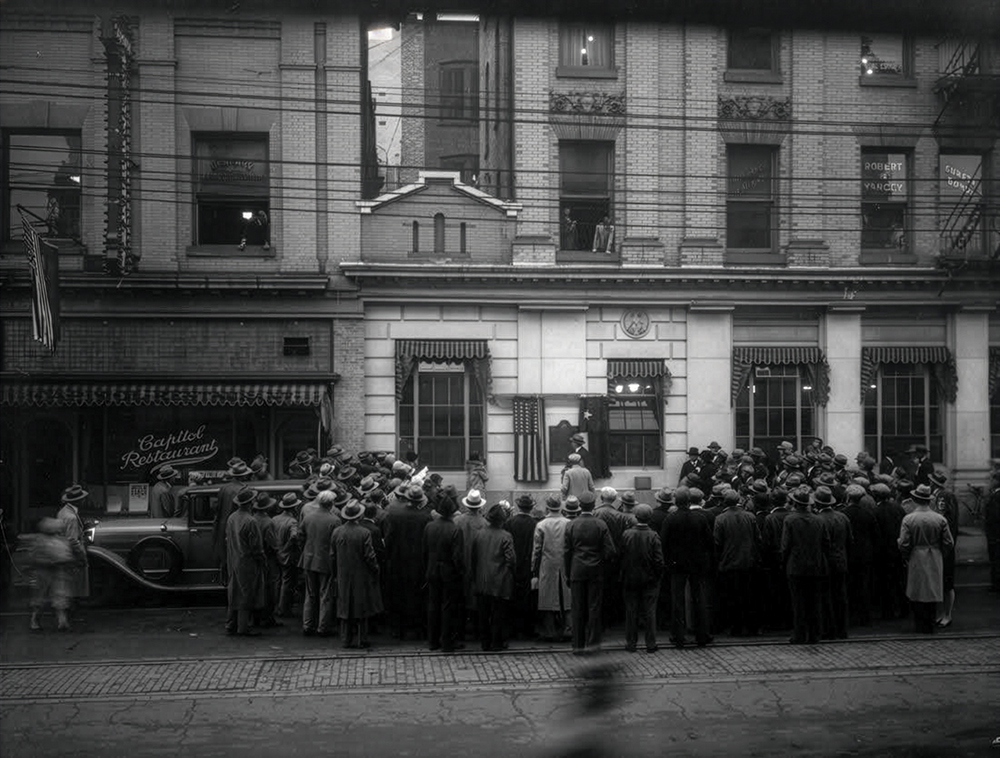
My grandfather, Robert Bruce Cauthen (known as “Bruce” — Pop-pop, to me), once told me a story from the late 1920s. During the World Series, when the workday was winding down, Raleighites would gather outside the building that housed The News & Observer. They’d park their bicycles, bring chairs or sit on makeshift wooden boxes. My grandfather would spot his father, Grover Cleveland Cauthen, in the crowd, hunched over a radio, adjusting dials.
Through the fuzz of static and the rising pitch of frequency, a voice would burst through a bullhorn. An announcer called out plays for the baseball game in real-time, perfectly in sync with a massive diagram of a ballfield erected in front of the building. Shaped like a ballfield, it was lit by bulbs that tracked runs, hits and bases — an electric echo of the game unfolding miles away.
That story captivated me as a teenager, but after my grandfather passed, I started to question my memory. Was it the N&O building or the Raleigh Times building? A one-time deal or regular occurrence?
I began crawling under beds at my parents’ house, pulling out bags stuffed with my grandfather’s archives of old newspaper clippings, telegrams and photos.
Among them, I found a blurb from a September 29, 1926, N&O article: “News & Observer To Conduct Matinees for Fans of World Series.” The crowd had gathered at the former McDowell Street location. The game was the 1926 World Series, a turning point in baseball history, with the St. Louis Cardinals winning their first championship against a powerhouse New York Yankees team. The game ended dramatically, with Babe Ruth getting caught stealing a base in Game 7 — all depicted on a “playograph” board, much to the locals’ excitement. My grandfather would’ve been 12.
Coincidentally, that same year, 1926, marked a milestone: the 50th anniversary of the invention of the telephone. Among the clippings I’d found were a stack of photos. On their backs were glued scraps of paper, typewritten with bold captions claiming they showed the site of Raleigh’s first telephone calls. Silver pencil lines framed the photos as if they were destined for publication. But where?
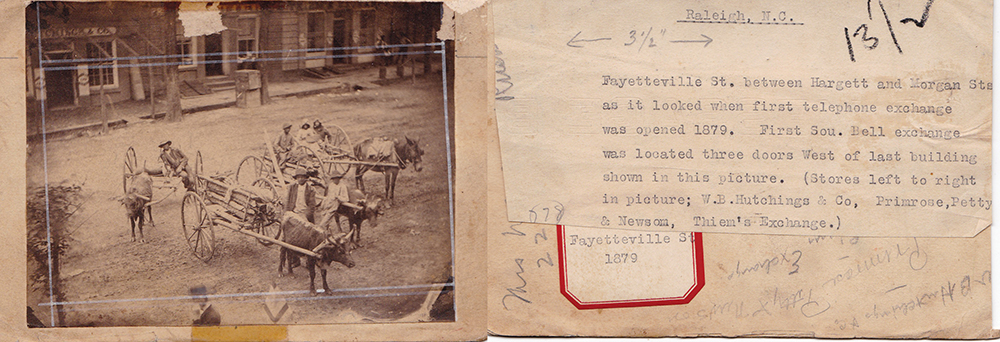
Back in 1879, a central telephone office was established on Fayetteville Street, operated by Western Union. Three years later, the first telephone call in North Carolina was made from that very spot: Gov. Zebulon B. Vance called Wilmington and was serenaded by a choir on the receiver’s end.
As district manager of Southern Bell — the company that eventually beat out Western Union in the telephone race — my great-grandfather Grover understood that his company should capitalize on the hype of this anniversary. He threw a giant birthday bash for the telephone, setting up for an unforgettable night in July at the Sir Walter Hotel on Fayetteville Street.
The Sir Walter Hotel at the time was like Raleigh’s Ritz-Carlton: grand and new, full of crystal chandeliers shining outward onto the street. An N&O article described the event as “one of the happiest occasions in Raleigh’s history,” going on to describe the “softly lit banquet room,” tables topped with flowers and candles set in silver holders. Some of the telephone’s earliest subscribers were invited to speak, recalling its early days, “when voices over wires were a curiosity, and compared it to the modern world of instant, long-distance connection.”
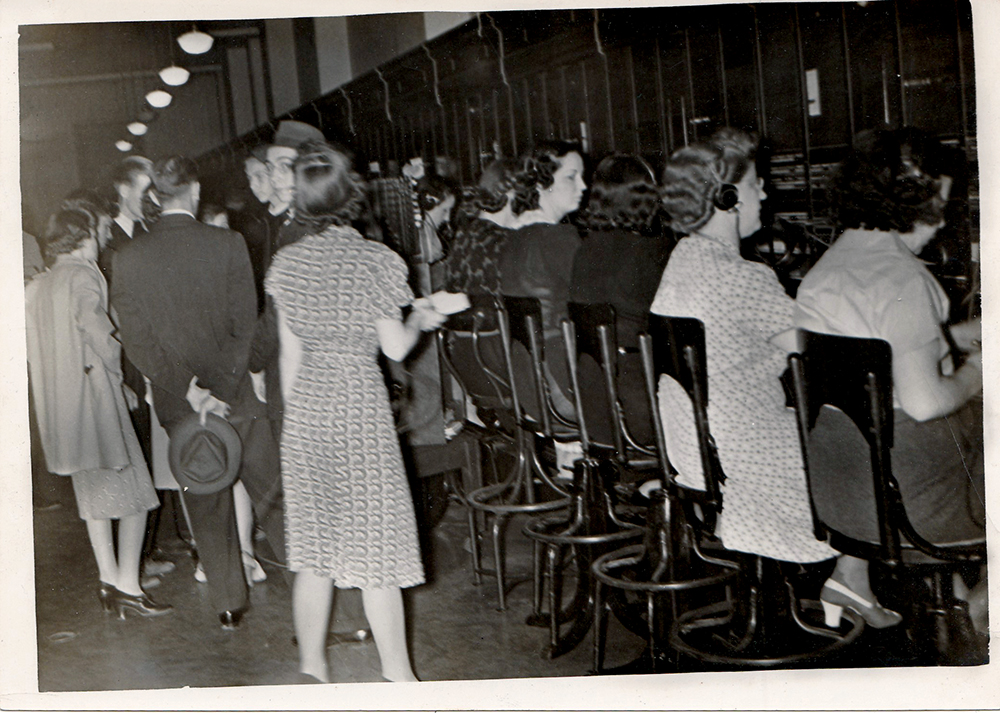
Among the photos was one of a bronze plaque with a giant telephone bell on it. Another photo depicted a huge crowd gathered around it, in what I assumed was an unveiling ceremony. But I had lived in Raleigh my whole life and never seen this plaque.
I reached out to Ian F.G. Dunn, an archivist at the State Archives of North Carolina. He recognized the plaque right away: it once hung on Fayetteville Street, he said, before being relocated inside a building lobby just off the street.
I tracked down the owner of the building, Greg Hatem. It turns out that since its removal, he’s been quietly working on restoring the lobby and honoring Raleigh’s role in telephone history — he’d even tracked down the original program from the 1926 Sir Walter Hotel event. Hatem had commissioned a tile artist to recreate its cover design, an ornate illustration of telephone lines wrapped around a spinning earth, to decorate the floor of the lobby.
A few weeks later, Hatem’s office sent me a digital copy of the 1926 program. There was my great-grandfather listed as the host, with his photo printed on the page. The program included the same photos I’d found under my parents’ bed, outlined in silver.
The 1926 N&O article describing the party included this line: “As stories were shared and laughter moved across the room, the event became more than a dinner — it was a moment where Raleigh of 1926 quite literally ‘spoke’ to Raleigh of 1879.”
One hundred and fifty years after the invention of the telephone, I carry in my pocket the ability to get in touch with the world in an instant. But it was the human connection — a collective interest in history, a willingness to share what we’ve found and learned — that we inherit from the Raleigh of 1926.

This article first appeared in the August 2026 issue of WALTER Magazine.