The Mahler building on Fayetteville Street in downtown Raleigh traces its roots to the city’s early immigrants.
By Ian F. G. Dunn | Photography from the State Archives of North Carolina
Gerhard Henry Mahler was born in Osnabrück, Kingdom of Hanover, in 1832 and immigrated to the United States around age 20. It may have been at this time that he chose to drop his first name and use his more American-sounding middle name.
Henry arrived in Raleigh around 1853 to join his brother Frederick, who had come to America several years prior and established himself as a merchant.
Frederick’s store had opened in 1851 opposite the Raleigh and Gaston Railroad depot but soon after moved to Fayetteville Street. It seemed to sell anything that would leave the shelves: one advertisement from 1854 boasted offerings including cigars, fruit, groceries, knives, children’s toys, and even ammunition. Upon his younger brother Henry’s arrival, Frederick allowed him to set up a small jewelry shop and workspace in an unused corner of his store.
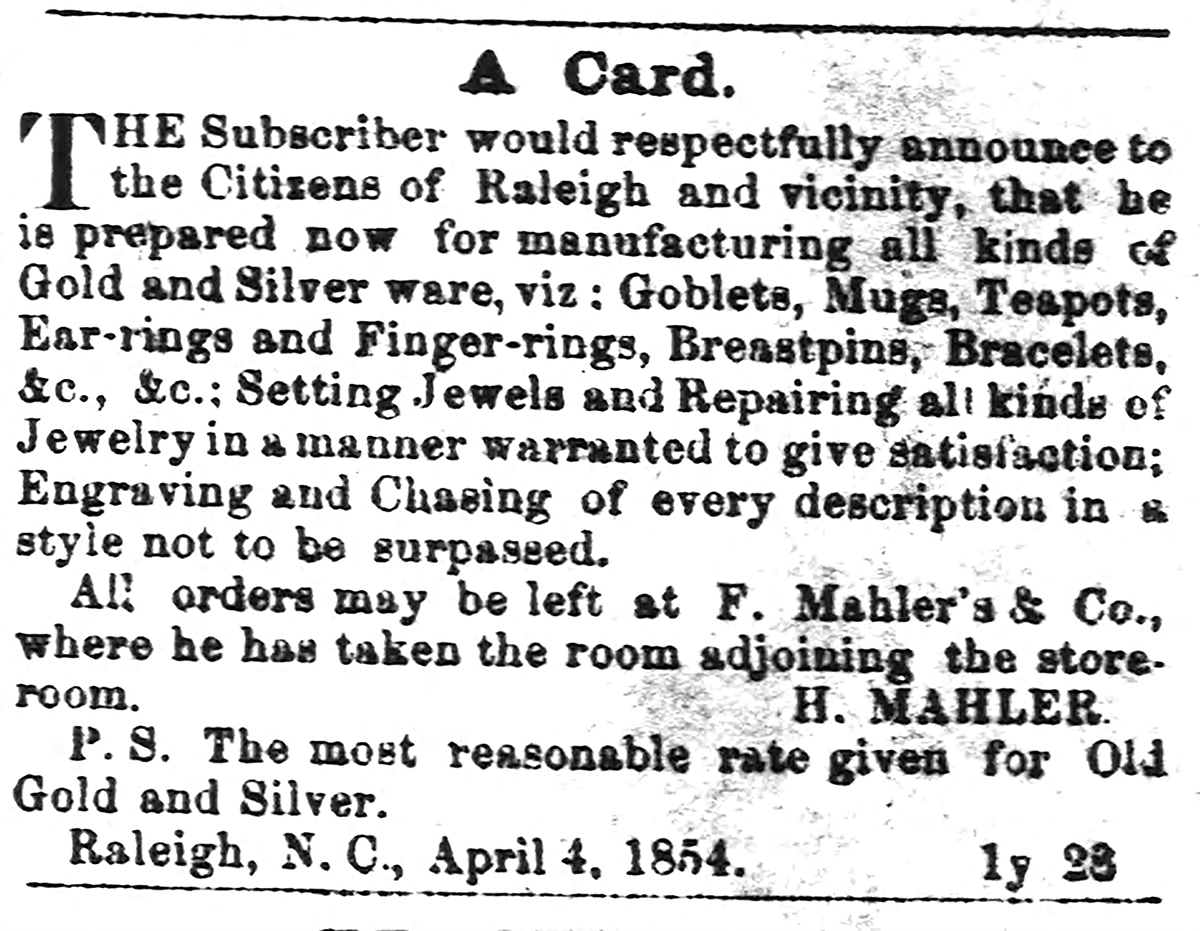
Having completed a silversmith apprenticeship in Germany, Henry was eager to begin his trade in Raleigh. In April 1854, he advertised his services in the Raleigh Register for the first time:
“The subscriber would respectfully announce to the citizens of Raleigh and the vicinity that he is prepared now for manufacturing all kinds of gold and silver ware, viz.: goblets, mugs, teapots, earrings and finger-rings, breastpins, bracelets, &c., &c.…”
Although Raleigh’s population in the mid-1850s was only around 5,000 people, there was room enough for two jewelers. John C. Palmer, an experienced silversmith, had established himself in Raleigh in 1840 and employed Mahler for a short time just after his arrival in Raleigh. (In 1845, Palmer had also added the service of daguerreotype photography to his business, making him one of Raleigh’s earliest photographers. This was likely done to supplement the modest income from watch repair and jewelry sales.)
The two jewelers coexisted well into the 1880s, with Palmer’s store on the east side of the 100 block of Fayetteville Street and Mahler farther down on the west side of the street.
By the end of the 1850s, Mahler had experienced two dissolved partnerships, the first with Philip Thiem and later with Louis Holst. Following the Civil War, Mahler set out on his own and constructed the small wooden store building that stood where the present-day Mahler Building at 228 Fayetteville Street now stands. In October 1865, he advertised the reopening of his store. The advertisement boasted of his good stock, ability to repair and manufacture jewelry, and the services of Mr. Cilleken, a watchmaker.
Despite the difficult years of Reconstruction and a global economic crisis sparked by the Panic of 1873, Mahler’s business not only survived but also flourished. His success allowed him to purchase an interest in both the Mikelbo and Thomasberg Vineyards, located just south of Raleigh, the latter well-known across the state for its fine grapes.
In addition to his horticultural exploits, in 1876 Henry constructed a new building on Fayetteville Street for his business. This three-story Renaissance Revival-style brick building featured cast-iron façade details and a 12-foot-deep cellar, built especially for the storage of wines manufactured at Mahler’s vineyard.
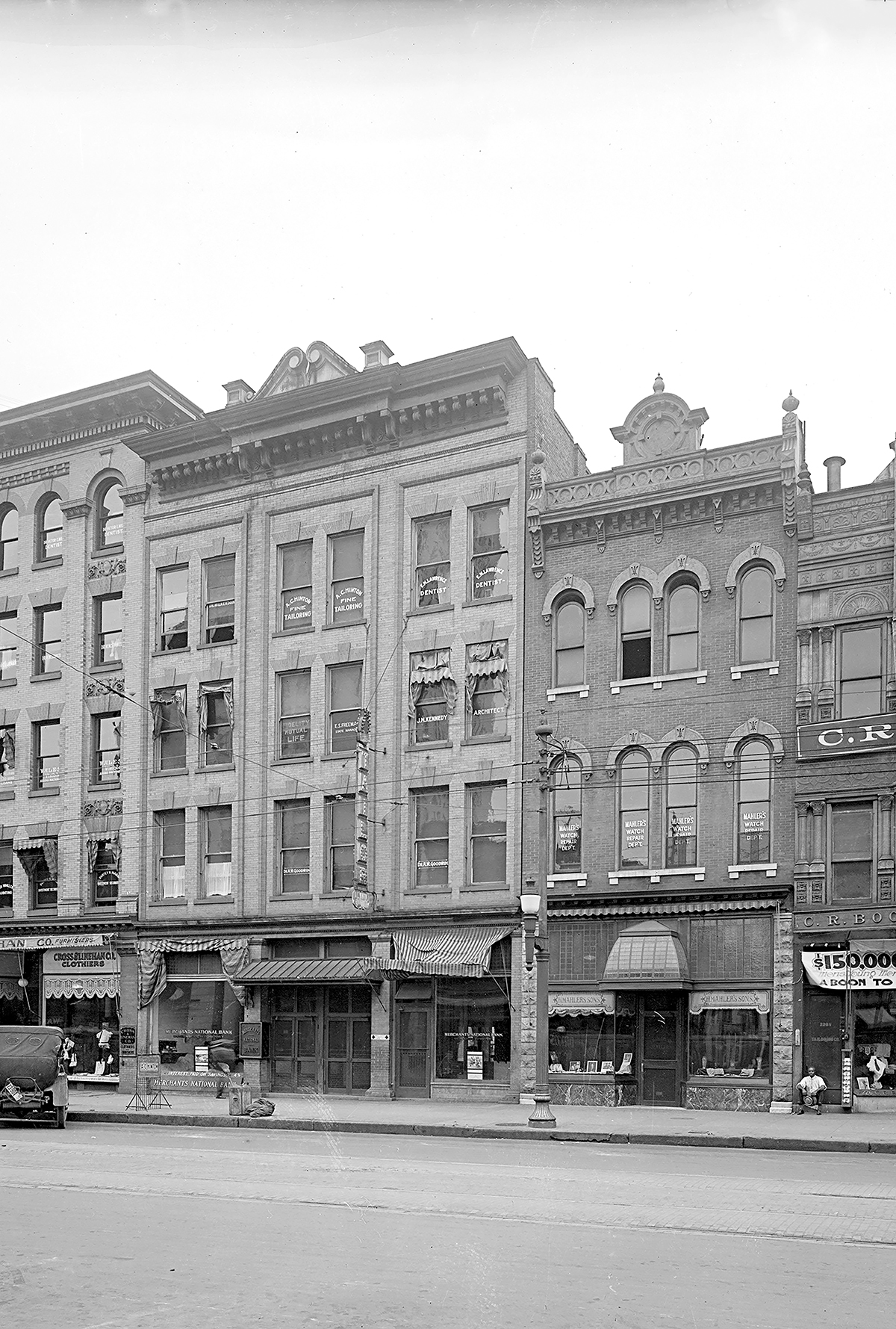
Construction on the new building began in May 1876 after his old wooden store was moved to a site near the State School for the Negro, Deaf, Dumb, and Blind, near Shaw University. During construction, Mahler carried out business in the nearby Holleman Building, but that situation was short-lived as construction on his new building was complete after only six months.
Mahler spent the remainder of his career in the building, renting out the upper floors and running his jewelry store on the ground level. Mahler died in 1895 and passed his beloved business to two of his sons, Frederick and Louis.
The brothers, operating under the new name H. Mahler’s Sons, continued Henry’s success, growing the business and bringing it into the 20th century. But despite many successful years, the firm closed in 1932 as a result of the Great Depression.
After auctioning their remaining inventory and selling the building, the Mahler brothers insisted the store would reopen in another location. Those plans never materialized. Raleigh’s longest-running jewelry store—described in some newspapers as “the Southern Tiffany”—was gone for good.
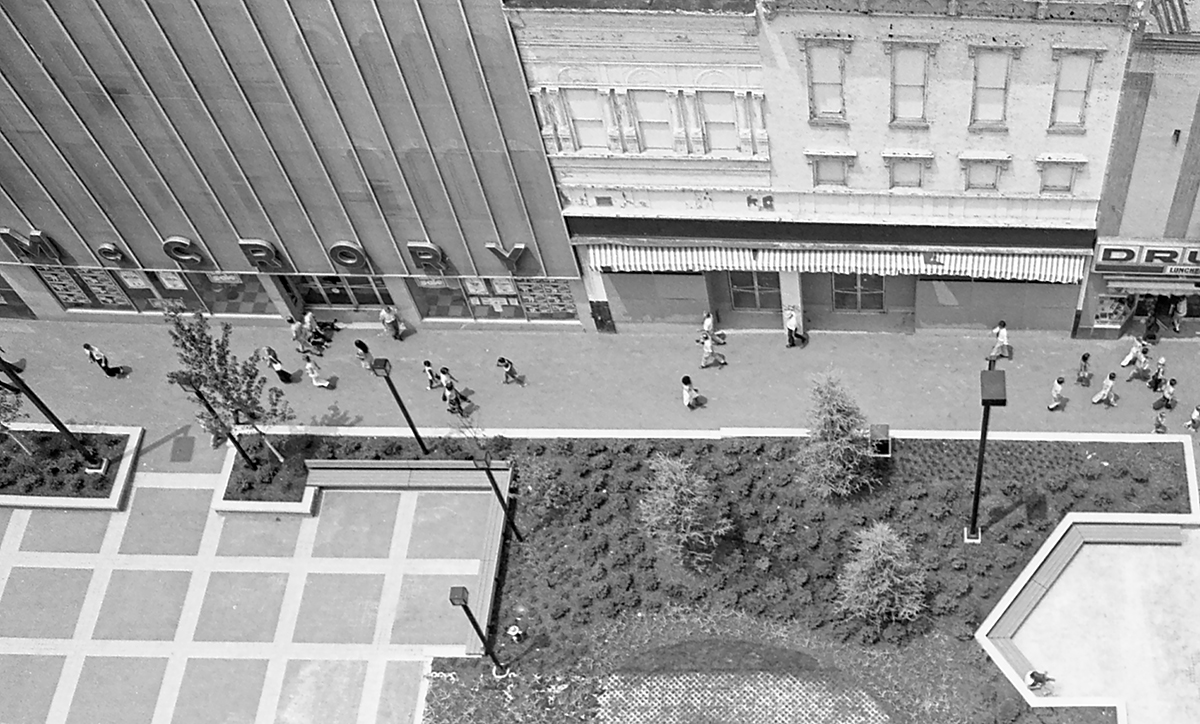
After serving as an extension of McLellan’s dime store and later McCrory’s variety store for many years, a modern façade was applied to the exterior of the building in 1971, a treatment suffered by many 19th- and early-20th-century buildings during this time period.
In 1998, the Mahler Building was sold for the first time in almost 50 years. A careful restoration carried out by Greg Paul Builders took place over the following nine years. This included removal of the modernist façade, replicating and replacing its long-gone cornice, and restoring the interior. In 2001, it was designated a Raleigh Historic Landmark along with its southern neighbor, the Carolina Trust Building. Today, the building houses office space on the upper floors and The Newsagent’s, a bookstore and coffee bar, on the ground level.

This article originally appeared in the November 2026 issue of WALTER Magazine.