A deep dive into Raleigh’s changing accent, tracing how migration, culture and time have shaped speech in North Carolina
by Hampton Williams Hofer | illustration by Canain Stanley
Recently, amid a crowd in Zürich, Switzerland, I heard notes of a North Carolina accent. I sniffed it out until I found a man from Chowan County in a Carolina toboggan (though we were certainly the only ones there who would have referred to it as such) who spoke with long vowels that sounded like home. The coincidence was wild as all get-out, as we like to say, but our accents, though so distinct in that foreign crowd, are only diluted versions of the ones that preceded us. Somehow I just know that his grandparents would have referred to my hometown as
Rawlee, same as mine did.
An accent, perhaps the first signal of where someone comes from, may have a person blending in with hometown crowds or standing out in faraway cities — but is, regardless, integral to identity, a direct link to where we came from. But these dialects shift naturally as humans adapt for better communication, experience more exposure and learn integration, with younger generations typically leading the charge. And the old Raleigh accent, like that of all regions across the state, is fading.
For most people in the area, “well” is just one syllable now, and there’s no pronounced “t” in “Wilson.” The way we speak the words has evolved along with the phrases themselves, but you can still butter my butt and call me a biscuit if I hear my kids forgetting their “ma’ams” and “sirs.” And sometimes, letters be damned, there just is a correct way to say things around here, and your car’s GPS is saying them wrong: Blount Street (blunt, don’t you dare make it rhyme with mount), Fayetteville Street (FAY-et-vul) and Mordecai (MOR-duh-kee, absolutely not kye) are just a few.
It’s not just me who sees the change. I connected with Dr. Robin Dodsworth, a professor at North Carolina State University who has analyzed spoken-language data in Raleigh for nearly 20 years. His research shows that in the Triangle area, a significant decline in Southern drawl began in 1959 with the opening of Research Triangle Park and the influx of non-Southern speakers. “It’s clear that traditionally Southern pronunciations here have become weaker or less frequent,” Dodsworth says. “The same is true in other Southern cities such as Charlotte, Winston-Salem and Atlanta.”
Indeed, urban areas like Raleigh have seen the most significant linguistic shift. In the western part of North Carolina, plenty of people may still commonly reckon, holler and head over yonder, while in the eastern part of the state, they may mash the button to cut off the lights or just piddle around the house. It’s not only the drawn-out sounds of the words themselves that fall away with the generations, but the colloquialisms, too.
Sociolinguistic research at NC State’s Language and Life Project, a nonprofit outreach education endeavor to document and celebrate dialects, languages and cultures across the United States, has revealed five distinct dialects across our state: Southern Appalachian Highlands, Virginia Piedmont, North Carolina Piedmont, Coastal Plains and Pamlico Sound. Not all North Carolina accents are as famous as Ocracoke’s unique “Hoi Toider” dialect, but many did develop in some isolation. Like a map of our state’s history, each dialect is woven through with threads of Native American languages, speech patterns of European settlers and enslaved people from Africa, and pepperings of pirate slang.
Like many North Carolinians, I have learned to code switch. I remember reading in front of my class at New York University, knowing the word “five” was coming, and willing myself to say the “i” hard and fast, instead of my normal faave, as if the lazy vowel might betray some lesser intelligence. Dodsworth’s research at NC State has shown that the elongated vowels are the first thing to fade across races, age groups and parts of town in the area, especially sounds like the “i” in typically Southern pronunciations of words like “high” or “time.”
From the Blue Ridge Mountains to the Outer Banks, locals will be speaking some ever-evolving variation of the North Carolina vernacular that brims with nostalgia, intrigue and sometimes a dash of the ridiculous. For previous generations, a child was darlin’, a Coke meant any soft drink, and ugly had nothing to do with physical appearance and everything to do with how a person was acting. If someone was being ugly, bless his heart.
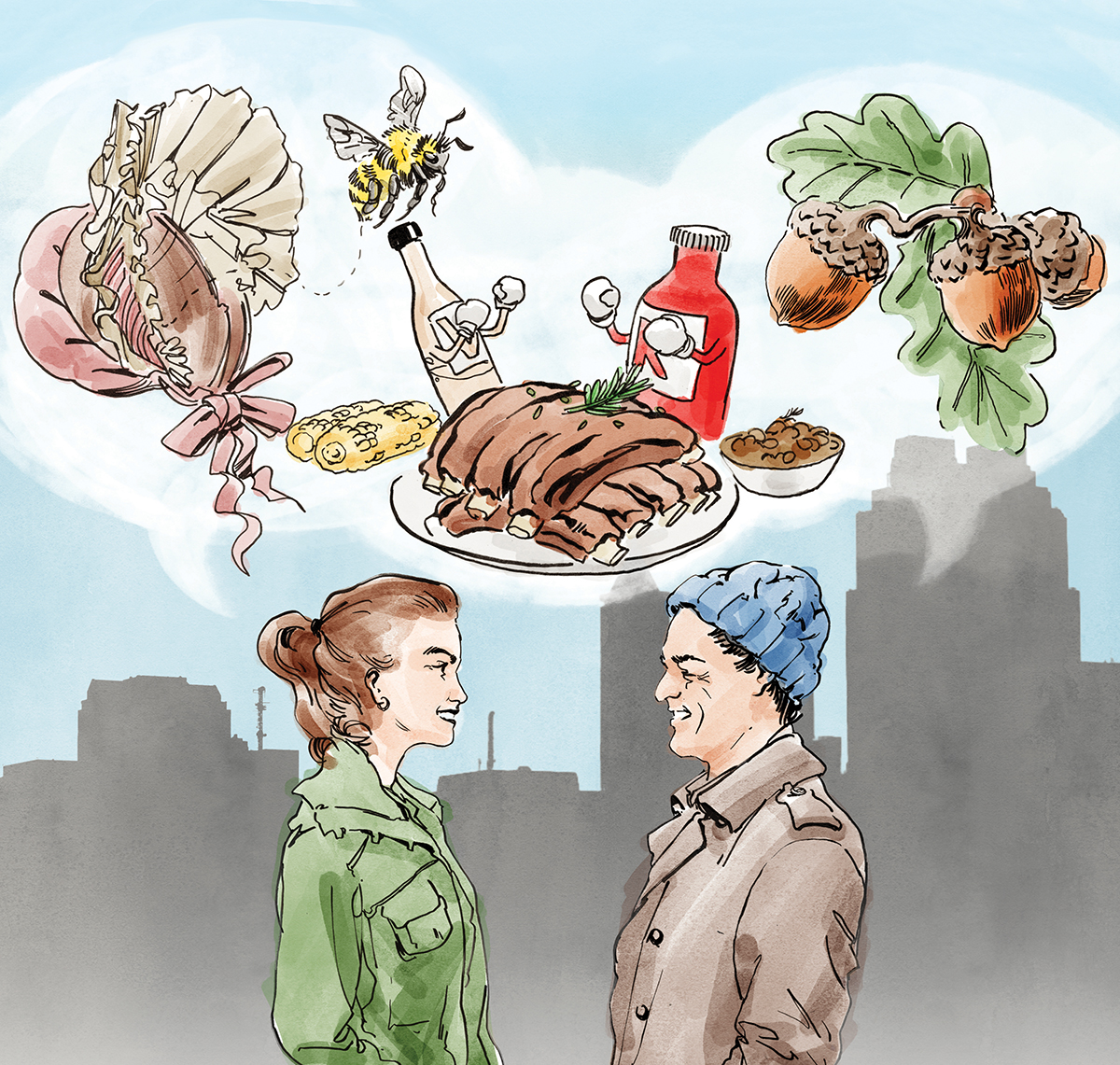
As accents and common phrases change, it’s safe to say that North Carolinians will still be gettingbees in their bonnets about whether barbecue should be vinegar-based or ketchup-based. But at least we can all agree that “barbecue” is a noun.

This article originally appeared in the April 2026 issue of WALTER magazine.