A former reporter on the North Carolina hurricanes that bring us together.
By Tommy Tomlinson | Illustration by Gary Palmer
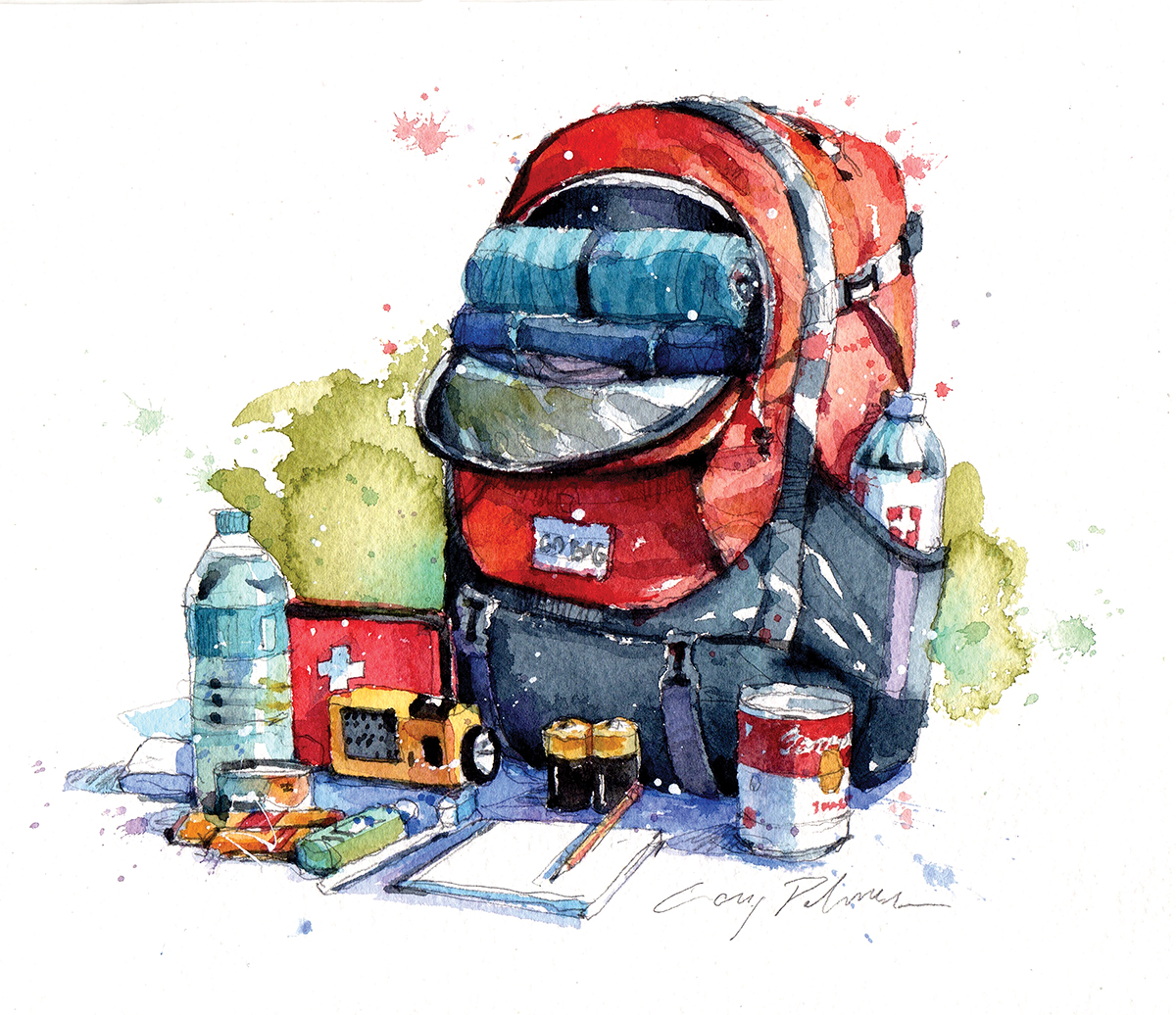
There’s always a moment late in the fall when I wake up groggy and wonder if my hurricane bag is packed.
I don’t have a hurricane bag anymore. But I did have one for years. Part of my job when I was at the Charlotte Observer was to head out to the coast when a hurricane was coming in.
It is such a strange feeling to be the only car heading down one side of the highway when thousands are fleeing in the opposite direction.
The contents of the hurricane bag: toilet paper, of course; a portable radio; extra batteries; bottled water; food with a shelf life (peanut butter, soda crackers, canned peaches, and Chef Boyardee); maps; a Swiss Army knife; a raincoat; bug spray; and a first aid kit.
We had a guide that we printed out and took with us: Get to a safe place and stay there until the hurricane moves through. Don’t drive into a puddle if you don’t know how deep it is. (A colleague of ours once drowned in a rental car.) Look out for critters: Hurricanes cause floods, and floods flush all sorts of animals out into the open. I discovered that was true when I covered Hurricane Floyd back in 1999. I was somewhere outside of New Bern, driving through a neighborhood. I saw a family cleaning up their flooded house and pulled over to talk to them. Their yard was knee-deep in water. I started wading across and noticed a clump of debris floating by. As it got closer, I could see it wasn’t debris. It was a flotilla of fire ants.
I backpedaled pretty fast, considering how deep the water was.
The water is often the biggest problem when a hurricane comes through, more than the wind. One time—I think it was Hurricane Bonnie in 1998—I checked into a hotel in Havelock as the storm rolled in from the coast. It was a mom-and-pop place, two stories tall. They gave me a second-floor room, and I grumbled about it as I hauled my luggage and gear up the steps. The storm came through during the night. The next morning I went downstairs to find that every room on the first floor had flooded.
Another time—Hurricane Fran in 1996, maybe—I stayed in a room with a sliding glass door that led out onto a balcony. When the hurricane hit, that door warped and wobbled like a rubber sheet. I crouched on the far side of the bed for hours, expecting the glass to shatter. It never did. I always wondered if the folks who made those doors prepared them for something like that.
Every time a hurricane strikes, it leaves shattered lives behind. Floyd alone led to the deaths of 52 people in North Carolina and caused more than $3 billion in damage. My job as a reporter covering those storms was to tell the stories of the people who lived through them the best I could. I always tried to remember that I was one of the lucky ones. In a few days I’d be going back to my warm, dry home. The folks I was talking to may have just lost theirs.
What struck me the most about covering hurricanes is how people look out for one another. “Look for the helpers,” Mister Rogers said, and that’s never truer than after a storm. When roads are flooded, folks with canoes and johnboats get stranded people out and supplies in. When power lines are down, people empty their freezers and fire up their grills to feed the neighborhood. A storm tends to flatten the fences that separate us. When we’re wet and hungry, we’re all the same.
I have been far away and covered even bigger storms. I spent a week south of New Orleans after Hurricane Katrina, and most days I would prefer not to think about that. And of course, the storms keep coming. Hurricane Helene was in 2024, but Asheville and the surrounding mountain towns are still recovering.
Not three months after I came to work for the Observer in 1989, Hurricane Hugo came right up I-77 and slammed into Charlotte in the middle of the night. I was living just south of the border in Lancaster, South Carolina. Nobody expected the hurricane to make it that far inland. I fell asleep, not sure if it was coming. I woke up to the sound of my front door being blown open. I lived in an old duplex, and the door was not quite square in the frame. I’d slam it shut, and the wind would blast it open again. At some point I realized I needed something heavy to brace against it. I grabbed the old Royal typewriter my mom and dad gave me when I was 12. I jammed it against the bottom of the door, and it held. I was grateful for my mom and dad and grateful for being a writer.
For the next several hours, I watched the pecan tree outside my bedroom window being bent to its limits. The wind was like a claw hammer trying to pry loose a stubborn nail.
Finally, it let go. I stepped into my front yard and saw my neighbors stumbling out of their houses. None of us said anything for a while. That’s the thing: the quiet just on the other side of a hurricane. Assessing the damage, helping the needy: That comes later. But first, you’re just stunned by nature’s power; your world forever changed.

This article originally appeared in the November 2026 issue of WALTER Magazine.