Tommy Tomlinson reflects on North Carolina’s unique natural beauty and the forests, beaches, marshes and bays that we call home.
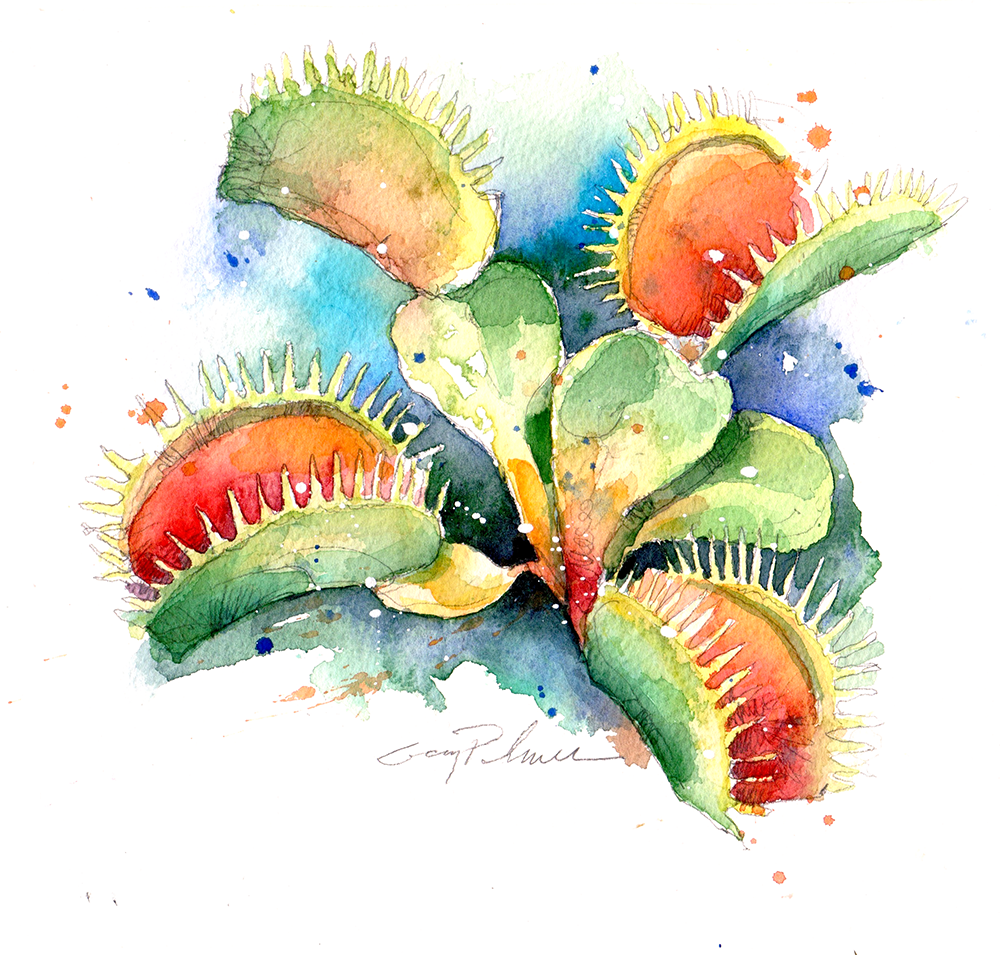
By Tommy Tomlinson | Illustration by Gary Palmer
This year my wife and I drove to Michigan for summer vacation. (July is way cooler up there than down here.) One day we were cruising on a highway somewhere south of Mackinaw City, headed for the Upper Peninsula. We rolled through mile after mile of farmland and trees. There was no way to count every shade of green.
In some ways it felt familiar. I’ve been down similar roads all over North Carolina. But it wasn’t… quite… right, like a picture that had been run through the copier one too many times. The shades of green up there weren’t the shades of green back home. My GPS — not the one on the screen, the one in my gut — told me I was somewhere else. I would’ve known that even if I had just awakened from a Rip Van Winkle nap.
It got me to thinking: What makes a landscape distinctive? And in particular, what makes North Carolina’s landscape distinctive? What are the clues that tell us where we are?
I’m not really thinking about pride of place, although maybe that’s a part of it. I grew up in Georgia, down on the coast. When we go back to visit, and we cross the Savannah River coming down from South Carolina, I look over at Alix and say: Ahhhh. We’re in God’s country.
(Sometimes I say it if I’m the only one in the car.)
But a North Carolina marsh is different from a Georgia marsh — and a South Carolina marsh, for that matter. North Carolina marshes, to me, feel smaller and more scattered. They play peek-a-boo with you as you drive down toward the coast. They even smell different. Every marsh has a salty funk — it comes from dead plants and animals decaying in the mud and washed by the tides. North Carolina’s marshes smell a little cleaner somehow. Maybe it just feels that way to me because I grew up near pulp mills in Georgia. Millworkers like to say it’s the smell of money. I guess that’s possible, if money smelled like rotten eggs.
North Carolina beach sand is its own thing, too. The sand on the Outer Banks is what I think of as sandbox sand — tan and clean. Georgia sand is grayer and a little muddier. Florida Gulf Coast sand, down around Panama City, is sugar-white and crunches under your feet. I would not bet money on this, but part of me thinks that if you put me on one of those beaches blindfolded, my toes would be able to figure out where I was.
(FYI, the Michigan beaches were nicer than I expected — they reminded me of North Carolina’s. Lots of rocks in the water, though.)
Coming off the coast, the natural feature I think about most in North Carolina is the longleaf pine forest. The strands we have in the Sandhills and down toward Wilmington are toward the northern edge of the longleaf habitat (it stretches south and west in scattered spots all the way to Texas).
Most of the woods we see from the highway are dark and thick. A longleaf pine forest feels like a planned community. The trees are spaced far apart, giving one another room to grow. The wiregrass underneath is a tasteful carpet. That orderly design depends on fire to come through every so often — a spring cleaning of sorts. When the natural cycles line up, what’s left is astonishing.
Years ago, a guide walked me a mile or so into a longleaf pine forest down in the southeast corner of the state. We were looking for Venus flytraps. You might know that a little circle down there, maybe a 75-mile radius from Wilmington, is the only place on earth where Venus flytraps grow naturally in the wild. We got to a tiny pond — no more than a big puddle, really — where clumps of flytraps grew a few yards off the bank. Not too dry, not too wet. If all you know of flytraps is Little Shop of Horrors, you might walk right past one without ever seeing it. They’re small and close to the ground. In the wild, most of the traps are no bigger than dimes.
You might also know that the tiny pond I described was probably a Carolina bay — one of thousands of shallow depressions strung along the East Coast all the way up to Delaware and New Jersey. Most of them are ovals aligned northwest to southeast. There are many scientific theories about how they came to be; the most intriguing theory is that they’re the result of a long-ago meteorite shower.
Of course, those are the scientific theories.
But when you’re standing next to one, surrounded by Venus flytraps, inside a longleaf pine forest that looks like it was designed by an interior decorator, your mind does start to wonder if North Carolina is some sort of Del Webb development for future retiring aliens.
I realize, at this point, that we have wandered far afield. This started out being about what makes North Carolina’s natural splendor distinctive and ended up being about what might make us the next Area 51.
Let’s just leave it here for now: Our beauty is unique. If you’ve lived in North Carolina long, you can smell it and feel it and taste it. It doesn’t mean we’re better than everybody else — although if you want to claim that, go ahead. It means that there are some things our bodies just know. And when we’re in North Carolina, we’re someplace special.
I hope the human race is not the only one to have figured this out.

This article was originally published in the September 2026 issue of WALTER Magazine.