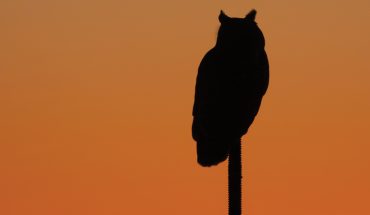
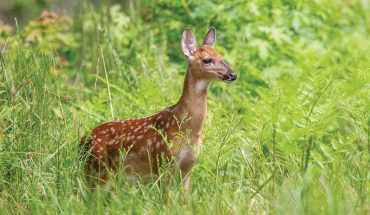
With its diversity of wildlife — including a heron rookery and nesting bald eagles — this park inspires legions of avid fans
by Sylvia Adcock | photography by Elaine Perkinson

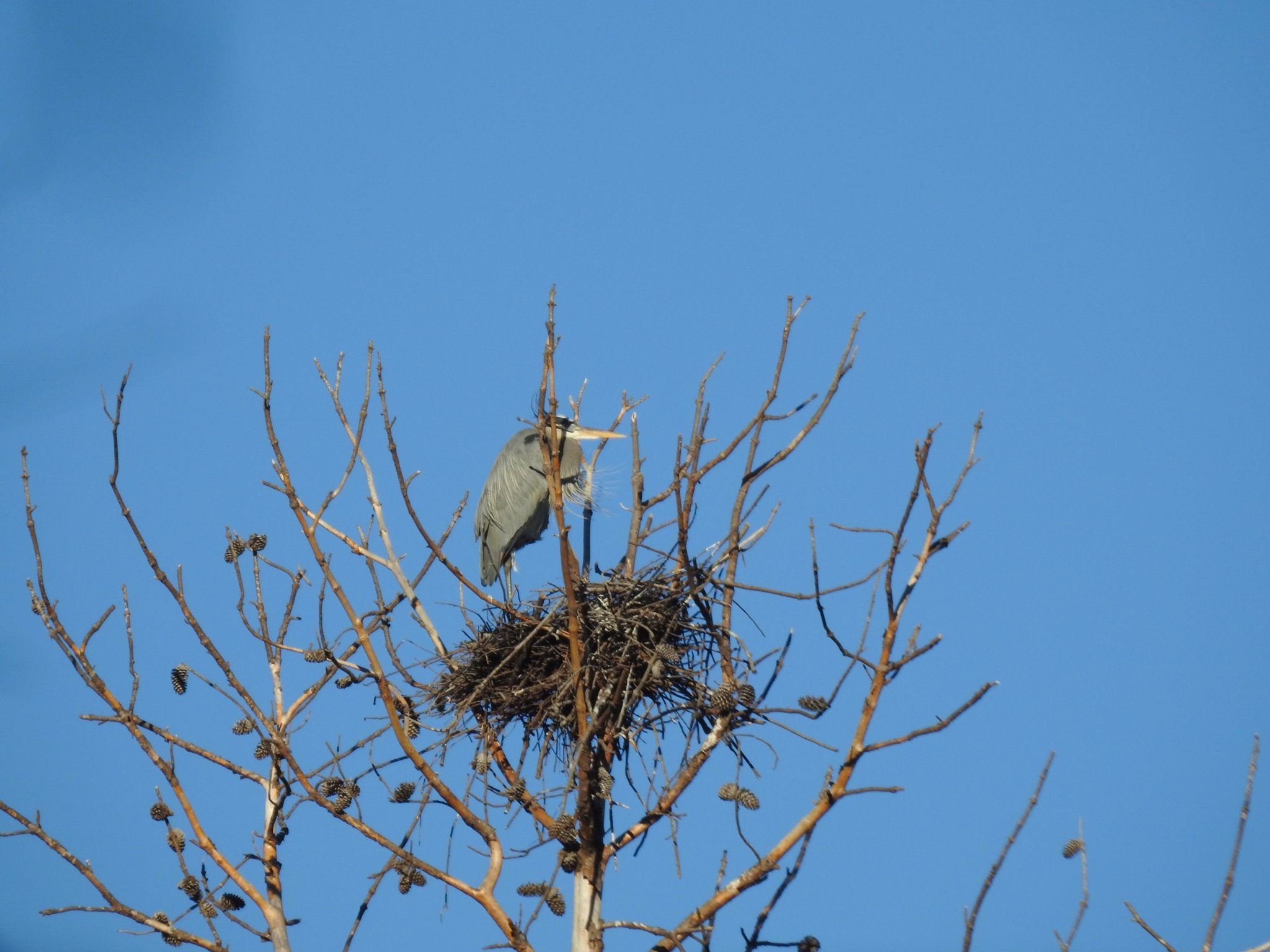
A Kingfisher chatters above the water as it prepares to dive for a snack. A young buck with velvety antlers gazes from the underbrush. A Red-headed woodpecker hammers on a pine. And high above this symphony, Great Blue herons have built a colony of stick-studded nests in the trees.
The heron colony, called a rookery, is one of many natural attractions at Shelley Lake, a stone’s throw from the Beltline and just up the road from Crabtree Valley Mall. Surrounded by subdivisions and apartment complexes, it’s an urban park that has attracted a surprising diversity of wildlife, and with it, a diverse community of humans who find solace in the natural world.
There are brigades of moms with strollers. Work-from-homers with earbuds. Lots of nature photographers lugging their long camera lenses. Serious runners and slow-walkers; native North Carolinians and newcomers alike. “There have been a few times when I have walked the park and not heard anyone speak English,” says Elaine Perkinson, who has been coming to Shelley Lake for more than 25 years. “But everyone understands hello and a smile.”
The lake was created in 1972, part of a project to control flooding in Crabtree Valley. The project created wetlands and marshy areas upstream of the dam, which brought a wide variety of wildlife to the space. Today, the park has 2 miles of paved trails and is one of the oldest sections of the city’s Greenway system. It’s also among the most heavily traveled, with close to 900 average daily visitors.
Perkinson is one of the park’s biggest boosters and a moderator of the Facebook page Shelley Lake Park Fans, which offers updates on trail conditions, volunteer clean-ups and wildlife sightings.
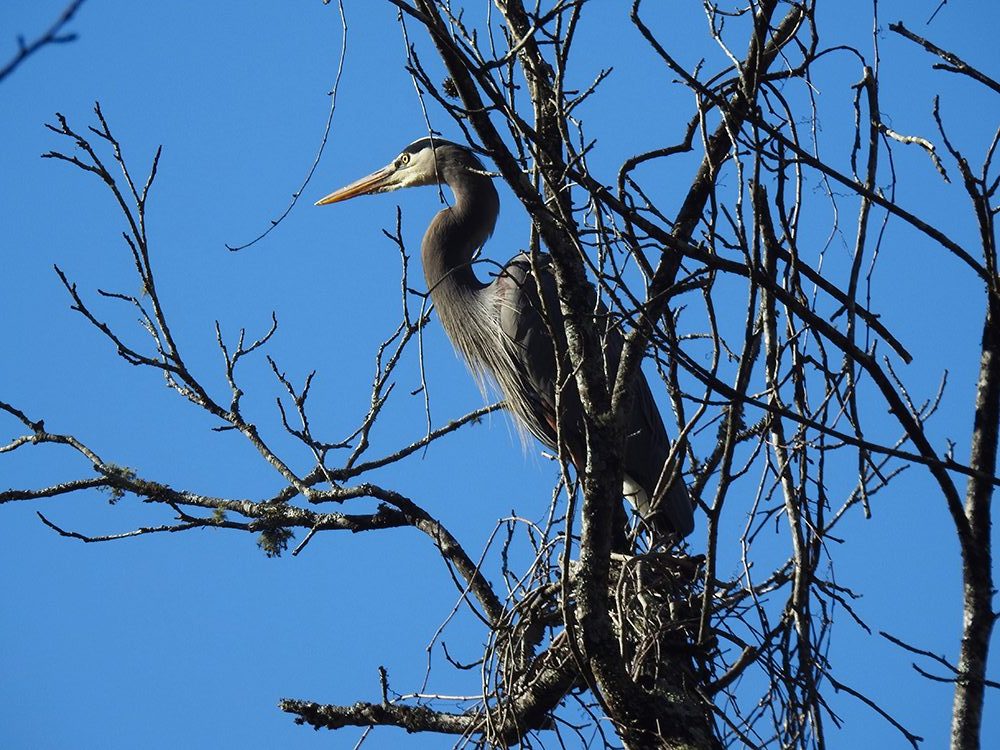
The lake is a rich environment for the photographers. “There’s so much biodiversity in such a small place,” said Deja Perkins, an urban ecologist and founder of Naturally Wild, an environmental education concern. She’s identified upwards of 30 species of birds during her bird walks. “There’s a huge variety of woodpeckers, including Pileated and Red-headed woodpeckers,” she says. “Plus Eastern box turtles, and the number of deer is amazing! They get so close to you.”
The Great Blue heron rookery is one of the unusual sights that attracts photographers to Shelley Lake. “We’re used to seeing herons hunting or fishing, but not nesting,” Perkins says.
To find the nests, she suggests looking for a lot of white splatter, Jackson Pollock-style, at the base of a tall tree, then look up. Several nests up to 4 feet wide may be found in a single tree. If the foliage is too dense to see them, you still might hear them, at least during nesting season. “The nestlings will clack their beaks together when the parents get near with food,” Perkins says. “And you’ll hear these almost prehistoric sounds, screeching, guttural and throaty.”
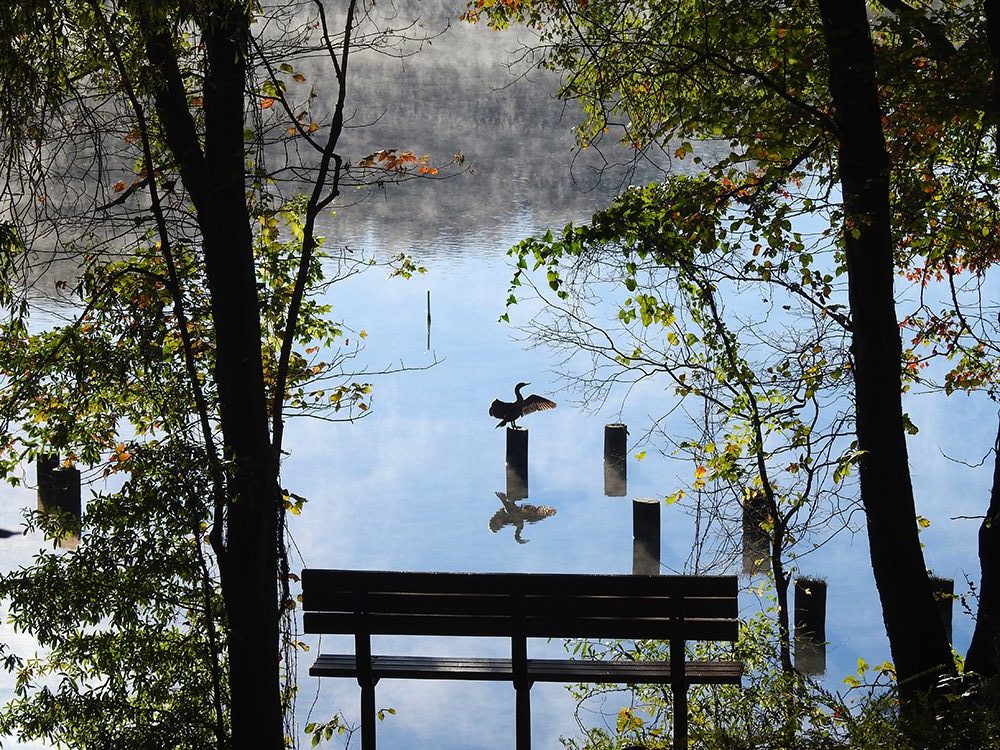
Another big draw is a pair of Bald eagles that have been nesting at Shelley Lake since 2018. The nest is visible from the trail, and spectators can see both parents bring food — maybe a fish or a squirrel — to feed the eaglets. Once they fledge, the juvenile eagles, which are similar in size to their parents but without the trademark white head, can often be seen perching near the nest tree.
The Facebook page keeps followers up to date on the eagles, who start bringing sticks to their nest in the fall, and provides information on unusual bird sightings. Sometimes there’s good news to share, like the sighting of a doe with a newborn fawn; other times the news is more somber, like noticing the number of ducklings decreasing over the spring as the laws of nature take over.
Sometimes, the animals become characters in their own right. For many years, a Pekin duck named Duchess lived at the lake. “Duchess was very special because she really loved people,” Perkinson says. “She would swim up and start talking as soon as anyone called for her.” In April 2021, one of Perkinson’s friends discovered Duchess beneath a bridge, likely killed by a coyote or a snapping turtle.
Perkinson and her friends buried her nearby and later raised money for a park bench in her honor. (Its plaque reads, “Our Special Pekin Duck — Beauty, Talker and Flirt!”) On a recent summer day, not far from Duchess’ bench, Humberto Barba of Raleigh had his camera lens trained on a heron standing on a piling. He comes often to photograph wildlife, he says, “just watching to see what will show up.” Nearby, a set of ducklings retreated to the shade and turtles broke the surface of the water while the foot traffic continued.
“The cool thing about Shelley,” Perkinson says, “is you can see something different every day.”
Visiting Shell Lake
There are two parking areas, both on Millbrook Road. The largest is at the Sertoma Arts Center (1400 W. Millbrook Road) and the other lot is about a half mile east on Millbrook (1140 W. Millbrook Road). The Sertoma entrance will put you on the west side of the lake; the other entrance will put you on the east side. The eagles’ nest is on the east side. There is a sign near the trail letting you know you’re near an active eagles’ nest. The heron rookery is on the west side, but can be seen across the lake from the east side trails. Both the eagles and herons start building or fortifying their huge nests in the fall, so bring binoculars and watch for large birds carrying sticks.

This article originally appeared in the September 2025 issue of WALTER magazine.