In 1887, the City of Oaks debuted its first municipal water tower, a stone-and-brick structure topped with a 100,000 gallon iron tank
by Ian F. G. Dunn | photography from the State Archives of North Carolina
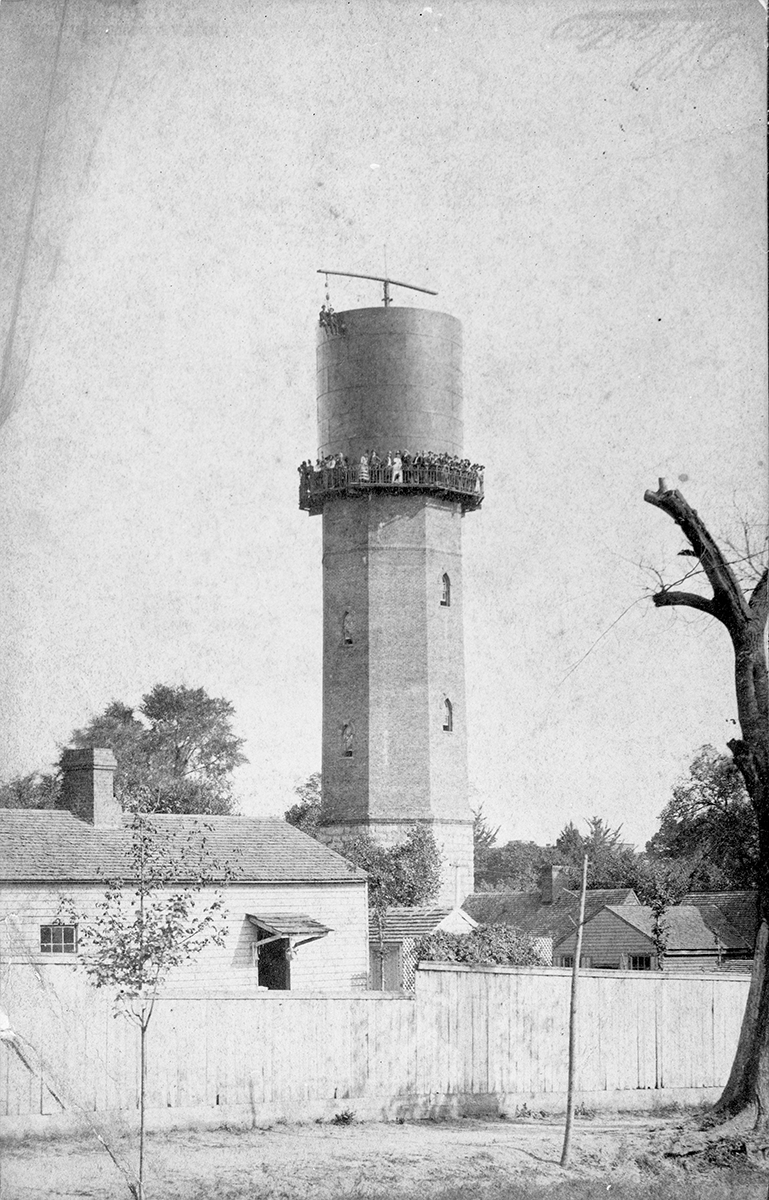
On Sept. 13, 1887, nearly three dozen intrepid souls ascended the newly completed Raleigh Water Tower on W. Morgan Street. They stepped out onto an iron balcony, taking in views from Raleigh’s tallest structure.
“The winding stairs, over one hundred feet, were counted without a halt, though to some it seemed as if there was no top anywhere. After reaching the top however, all exertion was amply repaid by the splendid view from the balcony,” reported The News & Observer in an article at the time.
In the late 1880s, Raleigh’s population had only just reached 10,000 people — roughly the size of present-day Wendell. For water, Raleigh residents relied on hand-dug wells or rainwater, with the vast majority of the population either hand-pumping their water or pulling up buckets. If you were wealthy enough to have indoor plumbing, you’d have an elevated cistern located on the roof or perhaps inside the attic to create the pressure needed to send the precious resource through the plumbing.
As reliable municipal water systems became more common in North Carolina cities in the mid-1880s, Raleigh leaders began planning for their own. Raleigh residents practically demanded it — not only for health and convenience, but for fire safety too. In the first half of the 19th century there were four major fires on Fayetteville Street, and in 1851 an exceptional conflagration destroyed 17 buildings on the 100 block of Fayetteville Street. (This event galvanized the city to improve its firefighting infrastructure, marking the beginning of a fire department organized into companies with a salaried fire chief.)
Due to limited funds and feeble technology, Raleigh’s early water infrastructure consisted of three underground cisterns placed along Fayetteville Street. In the event of fire, a hand-pumped engine would take water from the nearest cistern to, hopefully, extinguish the flames. The notion of a fire company merely hooking up a hose to a pressurized hydrant on the street and opening a valve would have seemed revolutionary. A municipal water system would eventually achieve this vision.
In late 1886, a 20-year franchise was granted to the National Water Works Construction Company to build, operate and maintain a system of waterworks for the City of Raleigh. Work on the system began with the purchase of a 30-acre tract of land south of the city, where water from Walnut Creek could be impounded, filtered, stored and ultimately pumped nearly a mile north to a standpipe in the city. Thankfully, the plan for a dull-looking standpipe was quashed in favor of a monumental stone and brick tower topped with a 100,000-gallon iron tank.
Construction on the tower began in March of 1887. Stone contractor Goodwin and Hiss sourced material from the quarry near Raleigh National Cemetery, the same quarry used in the construction of the State Capitol. However, only a few weeks into the project, Charles Goodwin became ill and the outfit withdrew their contract. The partial walls were demolished, and a new contractor began fresh, sourcing stone from a quarry near Henderson.
By the end of May, the granite base was nearly complete at a height of 30 feet. From there, brick masons took over and laid approximately 150,000 bricks, bringing the tower to a height of 83 feet.
Topping it all off was the iron tank. Local boilermaker Robert N. Mitchell set up a temporary forge at the base of the tower, complete with rollers, mills and a hole-punching machine he had built and designed himself. The massive iron plates, each 5 feet by 8 feet, were wrought into shape, prepared for rivets and hoisted skyward, where they were hammered into place.
Since workers securing rivets were required on both the inside and outside of the tank simultaneously, Mitchell devised a clever solution for those on the interior. A number of watertight wooden barrels were placed in the bottom of the empty tank. Atop the barrels a platform was constructed and as each section was complete, water was introduced into the tank that lifted the floating platform for the workers.
Just under two months later, Robert W. Wynne, the 7-year-old son of city alderman James S. Wynne, was hoisted over 100 feet in the air to ceremoniously strike the final blow on the last rivet.
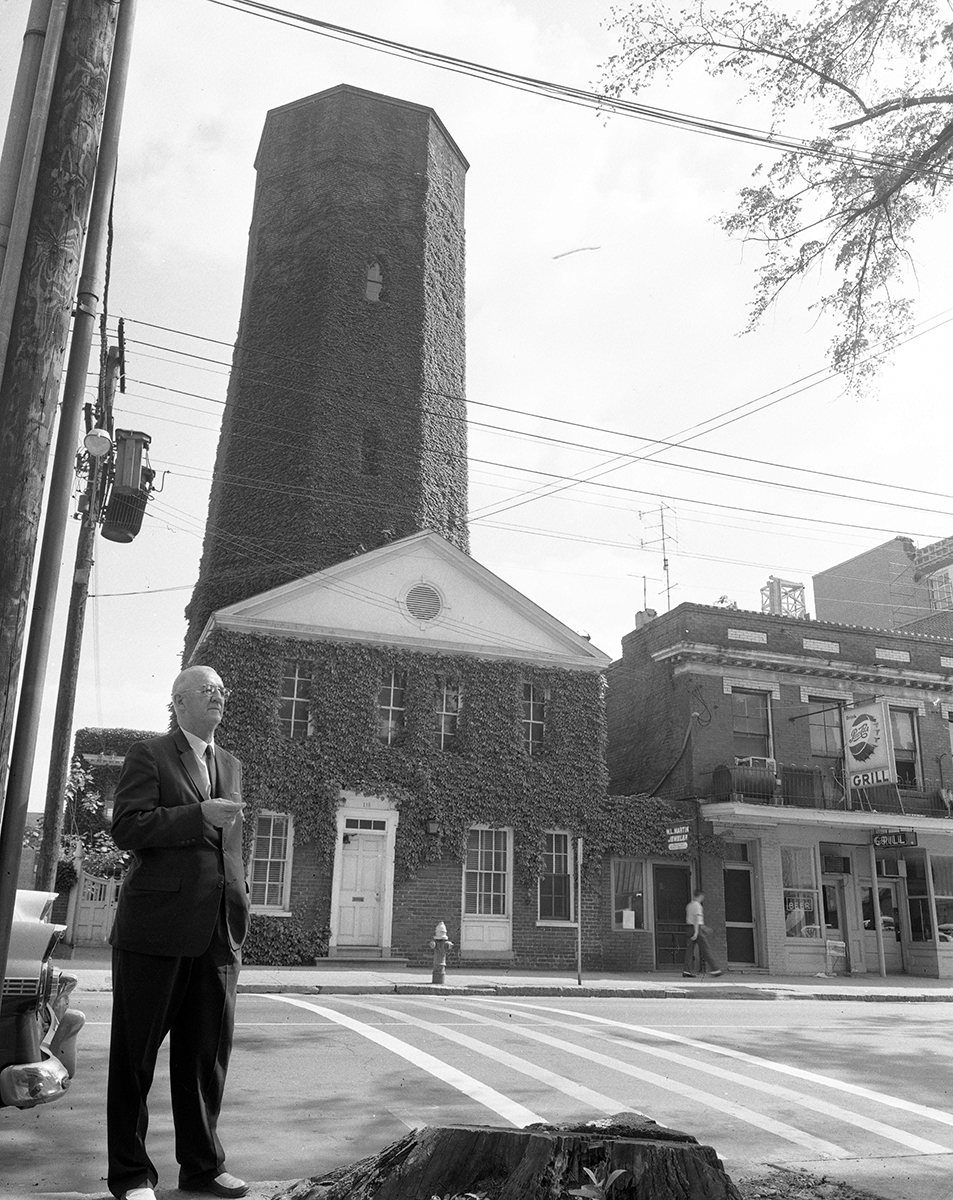
The two-story brick appendage on the front of the tower was completed just two months later. On the ground floor, behind a garage door on the right side, was a reel room for the Capital Hose Company (firefighters). On the left, the main office for the Raleigh Water Company.
The tower continued to serve the city of Raleigh until 1924, even as the population grew over 50%. At that point, the tower was abandoned and sat idle for nearly 15 years. In 1938, the city contemplated demolishing the tower — but Raleigh architect William Henley Deitrick purchased the property, converting it into his office in what many consider to be Raleigh’s first example of adaptive reuse.
Over the years, many Raleigh landmarks were conceived and brought to life within its eight walls, including a landmark on the other side of the architectural spectrum, Dorton Arena. After the untimely death of Matthew Nowicki, the building’s original architect, Deitrick’s firm finished the drawings and saw the project to completion.
Today the Raleigh Water Tower stands as a treasured and unique historic landmark — over the years serving as critical infrastructure, an influential architecture firm and now an escape room. It’s a tangible relic of a smaller Raleigh.

This article originally appeared in the July 2026 issue of WALTER magazine.