An educator and politician, those close to Malone remember his secret work behind the holidays
By Matthew Busch
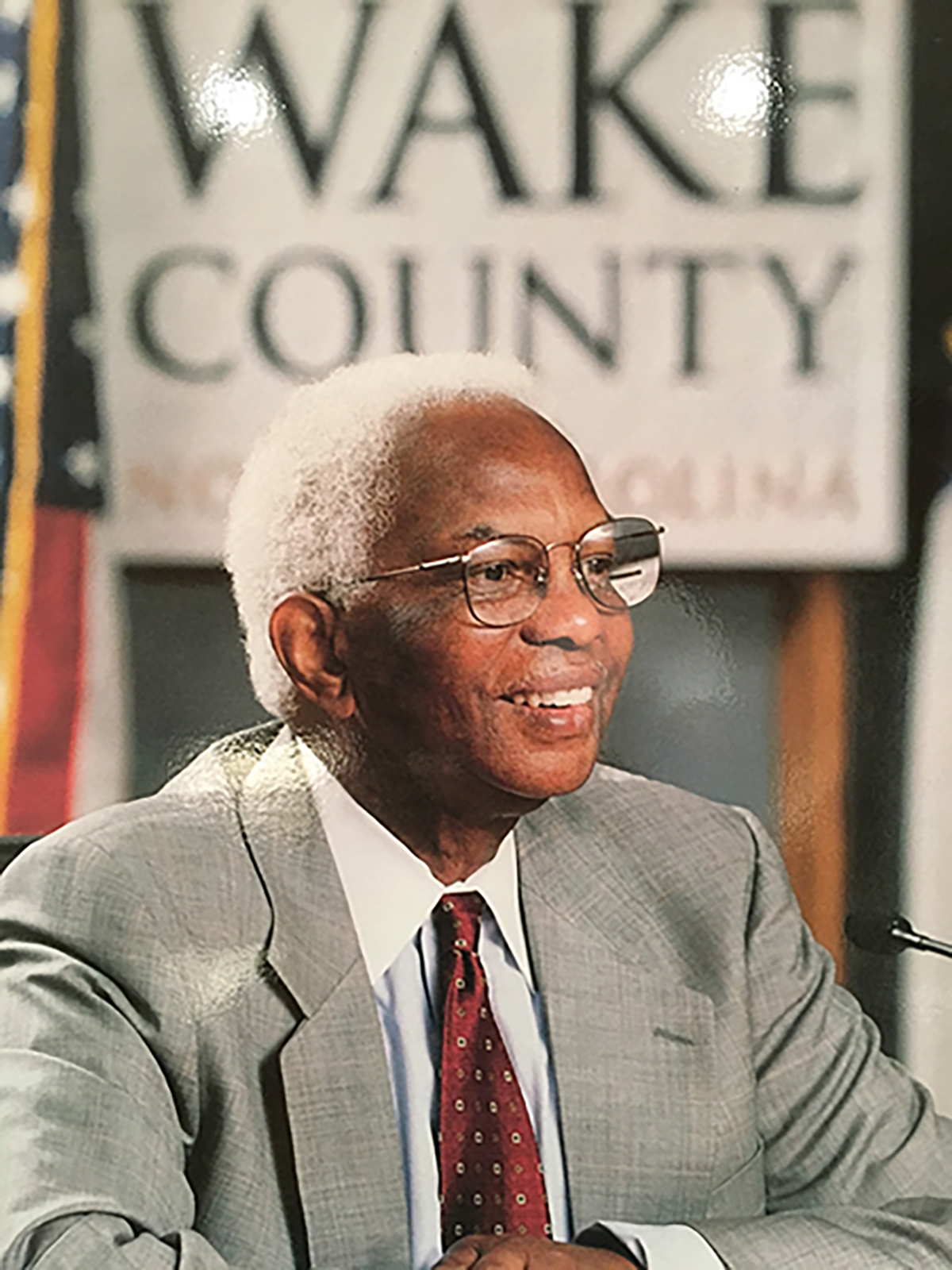
Vernon Malone’s name runs all through Wake County’s history. Born in Wake Forest five days before Christmas in 1931, he graduated from Shaw University, served in the Army and became a teacher in 1957. A longtime educator, he worked his way up to superintendent of the Governor Morehead School for the Blind. He chaired the Wake County Board of Education during the 1976 merger of the Raleigh city and Wake County school systems. He also chaired the Wake County Board of Commissioners, then went on to represent Wake County in the N.C. Senate from 2003 until his death in 2009. Today, a Wake County school bears his name.
But what the history books don’t record is Malone’s Christmas spirit. And for six decades, my mother, Lora Busch (née Cauthen), carried a secret about it.
In 1964, she was 15, a student at Broughton High School, working a seasonal job selling toys and wrapping gifts at the Christmas Caboodle Shop, on the lower floor of the Village Pharmacy in what’s now The Village District. Malone, then a young teacher at the Governor Morehead School, was working there too.
“I worked alongside Vernon. I wrapped gifts, and he taught me how to use the cash register,” says Busch. The two became good friends while working at the shop. “One day, Wally, who worked upstairs, told me: This is a big secret, but Vernon is collecting all his pay from working here and buying gifts for children at the blind school for Christmas,” Busch recalls.
Neither of Malone’s sons, Rod and Barry, had heard the story of the Christmas Caboodle Shop — but neither was surprised by it, either.
“After my father died, a number of people came up to me and told me these incredible stories of kindness that he had never mentioned to anybody, to my knowledge,” Rod says.
Many of those encounters involved strangers who told Rod how his father had helped them through housing troubles, employment difficulties or other personal challenges. Barry remembers much the same. “My dad did not talk about the things he did,” he says.
Christmas was one occasion when Malone’s giving spirit was on full display.
“He loved Christmas. It was one of his favorite holidays,” Rod recalls. Their home was decorated with three Christmas trees and wreaths in every window, and Malone hosted a large Christmas party for friends and family.
Barry remembers another family tradition: collecting Black Santa Claus figures at a time when they were difficult to find. His mother even enlisted his younger sister to paint a white Santa Claus brown. “After that, every time my mom and dad came in the door, they’d have a Santa Claus on their arm,” Barry says.
Malone’s enthusiasm for the holidays extended into the classroom. Yvonne Wright Kea, a former student at the Governor Morehead School, remembers him serving as master of ceremonies for a Christmas concert by the school’s Rhythm Kids. Though he was known as a stern teacher and strict disciplinarian, he told jokes and entertained the students at Christmas, revealing a playful side. Kea describes him as demanding but encouraging. “He gave you credit, he gave you a compliment if you deserved it. He was very, very frank,” Kea says.
Now 77, Kea vividly recalls a fifth-grade piano recital she participated in. The other girls wore grown-up dresses in soft colors, their hair styled to match. Kea wore a blue printed Easter dress with a white collar, her hair tied with white ribbons. “I just felt so inadequate compared to the other little girls,” she says.
The following day, Malone discussed the recital with his class. He complimented the girls’ performances and appearances, then mentioned one girl who had looked particularly special.
“He said she looked like a little fifth-grade girl should look,” Kea says. As she wondered whom he meant, Malone walked from behind his desk, approached her seat and placed his hand on her shoulder. She was the girl he had been describing. His words changed the way she felt. “It was a time of insecurity, and what he thought made me feel so secure,” she says.
Malone believed education should prepare students for life beyond the classroom. Barry remembers his father telling him that a four-year college wasn’t the only path to success.
“My dad would often say, you don’t have to go to college, but you’re gonna have to have a skill to get a job,” Barry recalls. Today, the Vernon Malone College and Career Academy offers students pathways toward college and careers.
Barry believes his father would be proud of the school bearing his name. “I think that school represents everything he would have thought about education,” Barry says. “If you want to go to a community college, you’re on the path to that. If you want to go into a career, they’ll put you on the path for it.”
For Malone’s sons, the connection between their father’s beliefs, his life’s work and the academy that carries his name is unmistakable. But it was at Christmas that his quiet generosity shone the brightest. “I always viewed it as his giving heart,” Rod says of his father’s love for the holiday. “That season represented selflessness and giving and love.” It’s a spirit Malone never asked anyone to notice, but one worth keeping.

This article originally appeared in the December 2026 issue of WALTER Magazine.