These silent predators add mystery and serenity to the night soundscape — learn about the three species you’re likely to see around Raleigh
by Mike Dunn
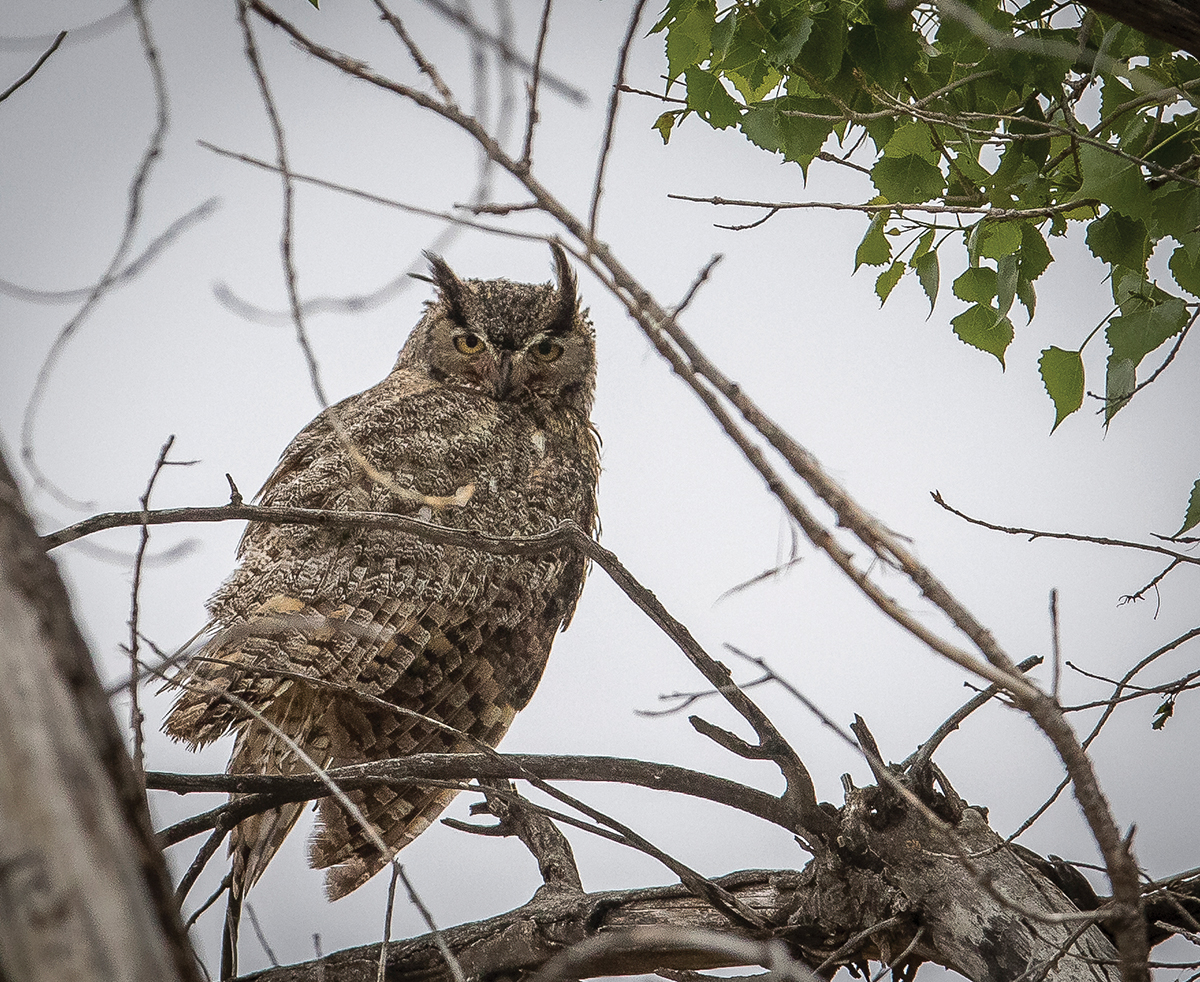
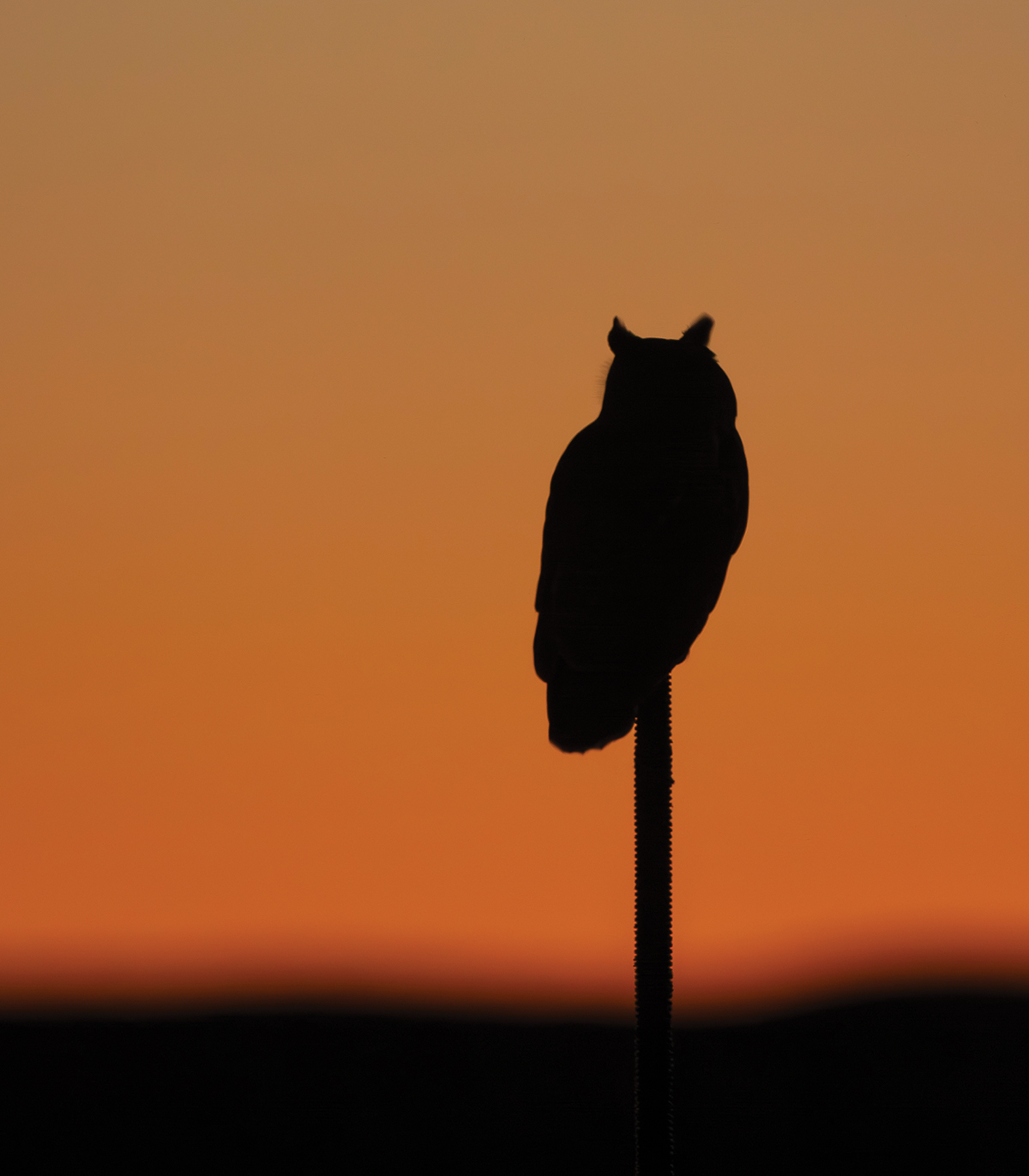
One morning after I started working at the North Carolina Museum of Natural Sciences (way back when it was still called NC Museum of Natural History), I saw a friend staring at one of the bird displays. When I greeted her, she said she was trying to figure out what had hit her while she was jogging. She explained that she was running at dawn on a trail in Duke Forest when something struck her in the back of the head. She turned, fists clinched, ready to take on her attacker — but there was no one there. She then noticed the silhouette of a large bird on a tree branch above the trail. We discussed her description: a large bird with “ears.” I suggested it was probably a great horned owl, and she confirmed the silhouette looked like the bird on display.
When she asked why the bird did that, we talked about the possibility of it having a nest nearby. But it was pretty late in the year for an occupied nest. Then, remembering something I had read in an old article, I asked if she had her hair in a ponytail that morning while jogging. She did. Then I asked if a white scrunchie was holding the ponytail. Again, the answer was yes. What I had read was that someone in a similar scenario had been hit in the head by a great horned owl. The writer speculated that the owl may have mistaken the back of their head and the bouncing ponytail with the scrunchie for a cottontail rabbit and started to take it as prey before realizing it was not a rabbit!
You’ve likely not been knocked in the head by an owl, but you may have heard one’s haunting call through an open window in summer or on an evening walk. There are three common owl species in North Carolina: eastern screech owl, great horned owl and barred owl. (There are several other species of owls that have been seen in our state — northern saw-whet, barn, short-eared, long-eared and snowy — but most people will never see or hear one of those.)
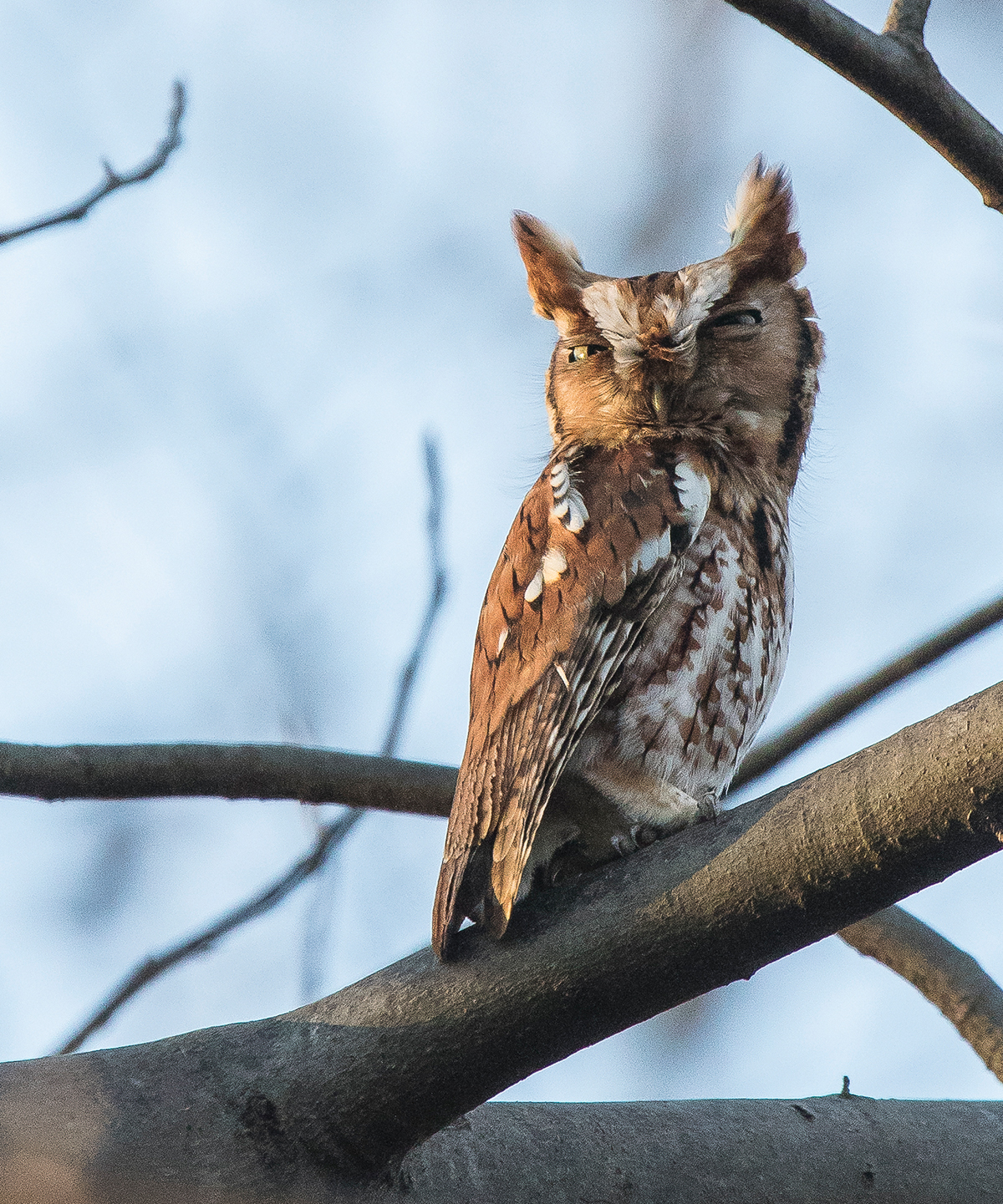
The eastern screech owl is smallest, about the size of a beefy robin, and perhaps the least common for us. There are two common color morphs, rufous (reddish) and gray. Most references say the gray is more common, but I have seen about equal numbers of both over the years. I occasionally hear their odd calls, which sound like a descending, high-pitched, horse-like whinny or an even-pitched tremulous trill. I have also captured video of eastern screech owls flying and landing in view of our trail cameras, but I have never seen one on our property.
I have had good luck elsewhere, especially in eastern North Carolina. At Pocosin Lakes National Wildlife Refuge, I often see them poking their heads out of wood duck boxes, usually in winter — eastern screech owls seem to enjoy soaking up the last rays of sun on a winter afternoon. I have also found them sitting at the edge of a hole in a hollow tree. They often will slide deeper into the hole if they sense your presence.
You can attract eastern screech owls to your yard by erecting an owl nest box, but I hesitated to do that on our property due to the overabundance of gray squirrels, who will take over an owl box. Screech owls prey on a variety of animals, from insects and crayfish to small rodents and birds. Driving home one night when I lived in Raleigh, I found an eastern screech owl perched in the road on a mourning dove it had killed. As I drove around it, I wondered how this tiny owl could fly off with prey that large.
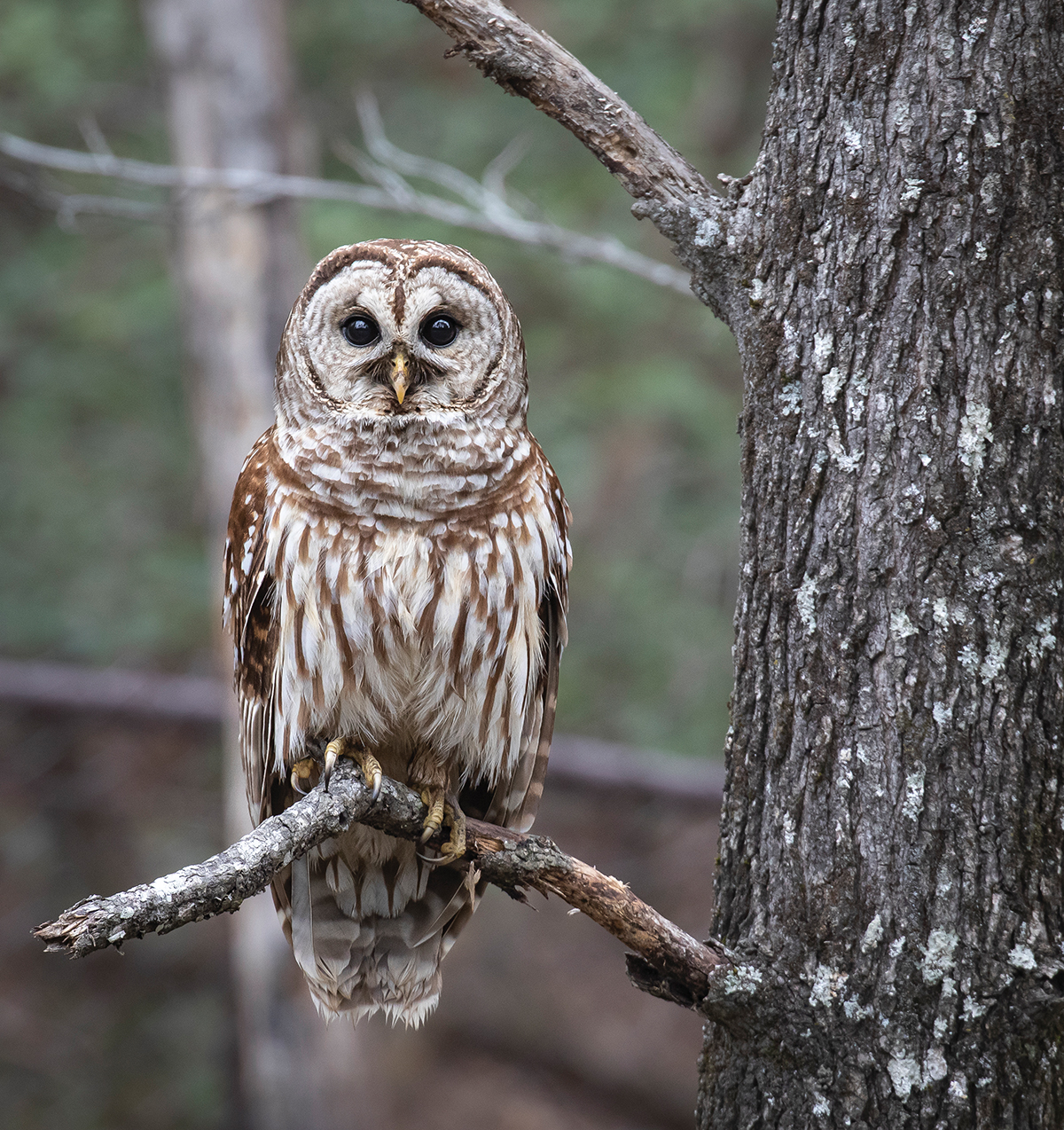
Barred owls are larger than screech owls, reaching total lengths of about 18 to 20 inches, with wingspans up to 40 inches. Named for the barred pattern of their feathers, this is probably our most familiar owl due to their endearing call, which sounds like “Who cooks for you, who cooks for you all?” I hear that call frequently both in the day and night, as barred owls hunt more in daytime than many other species. They prefer swamps or forests near water, but are equally at home in neighborhoods with adequate tree cover. My most memorable moments with this species have been in the swamps along the Roanoke River while canoe camping on the platforms maintained by Roanoke River Partners.
There is one platform named Barred Owl Roost that never fails to provide a soundscape of the calls, hoots and whistles. My favorite call is one that a pair often makes, called caterwauling. It’s a raucous cacophony of sounds that remind me of a troop of monkeys yelling at one another. Barred owls usually nest in hollow trees and typically lay two to three eggs. They feed on a wide variety of prey including rodents, birds, lizards, snakes, large insects and even fish. In the swamps of the Roanoke, I have seen them catch many crayfish and the occasional amphiuma (a large aquatic salamander resembling an eel).
Our largest owl is the great horned owl, a fierce predator that can capture large prey like rabbits and skunks. These are big birds, with a wingspan of 4 to 5 feet. They occur in many types of habitat but seem to prefer the same sorts of places you find red-tailed hawks — woodlands with edges along open spaces like fields and waterways. These owls may nest in hollow trees or take over abandoned nests of other birds, like hawks and ospreys.
I have even found one nest at the top of a broken tree trunk where a tangle of poison ivy vines had created a large platform. Great horned owls are among our earliest nesters, and I have seen them sitting on a nest during several of our Christmas Bird Counts.
Often called the hoot owl, you hear their plaintive series of hoots (some say it has the cadence of the phrase, “Who’s awake? Me too!”) more in the fall and winter, often at sunset and just before dawn. I have been fascinated by this owl for decades after reading about how some early ornithologists called them “flying tigers” for their predatory prowess and aggressive defense of their nests.
Owls are all well-adapted to their nocturnal lifestyle. They have big eyes relative to the size of their skull. (If our eyes were the same proportion to our heads, they would be as large as grapefruits!) Owl eyes also contain a large number of rod cells that detect light and motion. Like many other nocturnal animals, they have a reflective layer at the back of the eye (the tapetum lucidum) that bounces any incoming light around to be more efficiently absorbed. This also causes eyeshine in those animals.
Unlike our eyes, an owl’s eyes are fixed in place; they can’t move side to side or up and down. To compensate, owls have an extremely flexible neck (containing 14 vertebrae compared to our seven) allowing them to rotate their head about 270 degrees, compared with 90 degrees to each side for most humans.
Owls have a number of adaptations that allow them to fly almost silently through the night air to pounce on unsuspecting prey. Owl feathers have a soft, velvety surface that dampens sound. Their flight feathers have small comb-like slits on the leading edge that break up the turbulence in the air created during flight and a soft fringe on the trailing edge that also muffles sound.
Museum staff often demonstrate this by using two wings from the teaching collection — one from a red-tailed hawk, the other from a barred owl. When you flap the hawk wing, you hear a whooshing sound as air passes over the stiff feathers. Flap the owl wing and you hear… silence.
Owls also rely on their keen hearing to find prey and have several tools for this. Owl ears are asymmetrical on the sides of their head (one is higher than the other).
This gives them more precise directional hearing so they can pinpoint where a mouse or other prey is rustling in the leaves. In addition, their facial disks help focus sounds into their ears. (The ear tufts seen on many species, including the great horned owl, have nothing to do with hearing, but do enhance their camouflage when hiding against a tree trunk.)
You might discover an owl has been in your yard by something they leave behind: an owl pellet. Owls (and most raptors) can’t digest some parts of their prey, like the fur, feathers and bones. So after feeding, they compact these parts in their gizzard and later cough them up as a pellet. (I’ll always remember this quote from an elementary school student when he realized the pellet was coughed up rather than coming out the other end: “Oh, it’s owl pukey, not owl dookie.”)
Many science classes dissect sterilized owl pellets as a lesson on what animals eat. You can find jaw bones, teeth and other parts to help you identify the specific prey.
Owls are beautiful and important creatures in our area and help control rodent populations. Their calls add a touch of mystery and serenity to the night soundscape. Enjoy listening to and observing them, but don’t mess with their nest tree — and try not to look like a rabbit!

This article originally appeared in the December 2025 issue of WALTER magazine.