In the fall of 2013, there was a phenomenon called an irruption, a large-scale movement of northern bird species to areas far south of their usual wintering range
Words and photography by Mike Dunn
I love watching birds, but I’ve never considered myself a rare-bird chaser—you know, someone who hears about an unusual bird being seen and immediately drives hours to find it and add it to their list. But the year I retired from working at the North Carolina Museum of Natural Sciences, a report caught my attention.
In the fall of 2013, there was a phenomenon called an irruption, a large-scale movement of northern bird species to areas far south of their usual wintering range. These migration events are usually caused by low food availability, often in combination with high breeding success (and therefore more birds looking for food in the same area). That was the case for snowy owl populations in 2013. The primary prey of snowy owls in their Arctic breeding grounds are lemmings, a small rodent of northern tundra and polar habitats. Lemmings undergo population boom and bust cycles with peaks occurring every few years. In the spring and early summer of 2013, the lemming population exploded in Canada and the snowy owls responded in kind. With more eggs produced per clutch and higher survival rates of the young due to the abundance of food, the tundra was overflowing with snowy owls by summer’s end. That’s when thousands of these majestic raptors, especially juvenile birds, headed south in search of their own winter territories.
Reports started pouring in about snowy-owl sightings around the Great Lakes region and all along the East Coast. During November and December of 2013, there were three reported sightings of snowy owls in North Carolina: one on Cape Hatteras, one in Hyde County near Lake Mattamuskeet and one in Wake County, on the grounds of the City of Raleigh’s Neuse River Wastewater Treatment Plant.
Snowy owls inhabit vast open spaces and prefer similar habitats on their southern forays, so their rare occurrences usually happen along the open sand dunes of coastal areas and flat expansive areas of grasses, like the kind you find at airports. A young birder friend traveled from Raleigh to the Outer Banks to look for the snowy owl that had been sighted on Cape Hatteras. When he returned, he gave me its approximate location based on where he had seen the owl. I love birding our coastal areas in winter anyway, so I thought, what the heck, I’ll go.
The North Carolina birding community was well aware of this owl, so I drove down on a weekday to avoid the crowds. When I arrived at the old Bonner Bridge over Oregon Inlet, I had to stop near the top of the bridge for one of those movable stoplights indicating some sort of road construction in progress. I had my usual radio station (NPR) playing.
As I sat there looking at the gulls and pelicans flying near the bridge, a news report came on the radio. I was half-listening but thought I heard that the Department of Transportation had closed the Herbert C. Bonner Bridge over Oregon Inlet, effective immediately, due to safety concerns. It turns out an underwater survey discovered that ocean tides had washed away too much sand from around the bridge support pilings. Wait, what did I just hear?
I looked around. I was the only car on the bridge, but I saw no evidence of a closure. I tried to find another local radio station to see if what I thought I heard was accurate. The light turned green. I wondered if I should go home. Then I said to myself, I’m retired and I want to see that owl, so go ahead.
As soon as I drove off the bridge, some transportation employees pulled barricades across the road to close it. I pulled over and called a hotel to get a room for a couple of nights, since I’d be stuck on the island. Once I solved that, I headed to the off-ramp where the bird had been observed.
I lugged my spotting scope, tripod, binoculars and camera out onto the expanse of sand and started scanning. I soon spotted something white several hundred yards away with two people wearing binoculars walking towards it. The white object was a bird, and it flew in my direction as the people got near. This scene was repeated a few times with the bird — I could now see that it was indeed the snowy owl—flying a short distance in my direction each time the people approached. Finally, the owl flew within about 75 yards of where I was standing as the two people walked off the beach towards the parking area.
So, there I was, alone on a winter beach with a snowy owl. It was magical. I took a few photos, but it was too far away, so I set up the scope and just watched. What a beautiful creature.
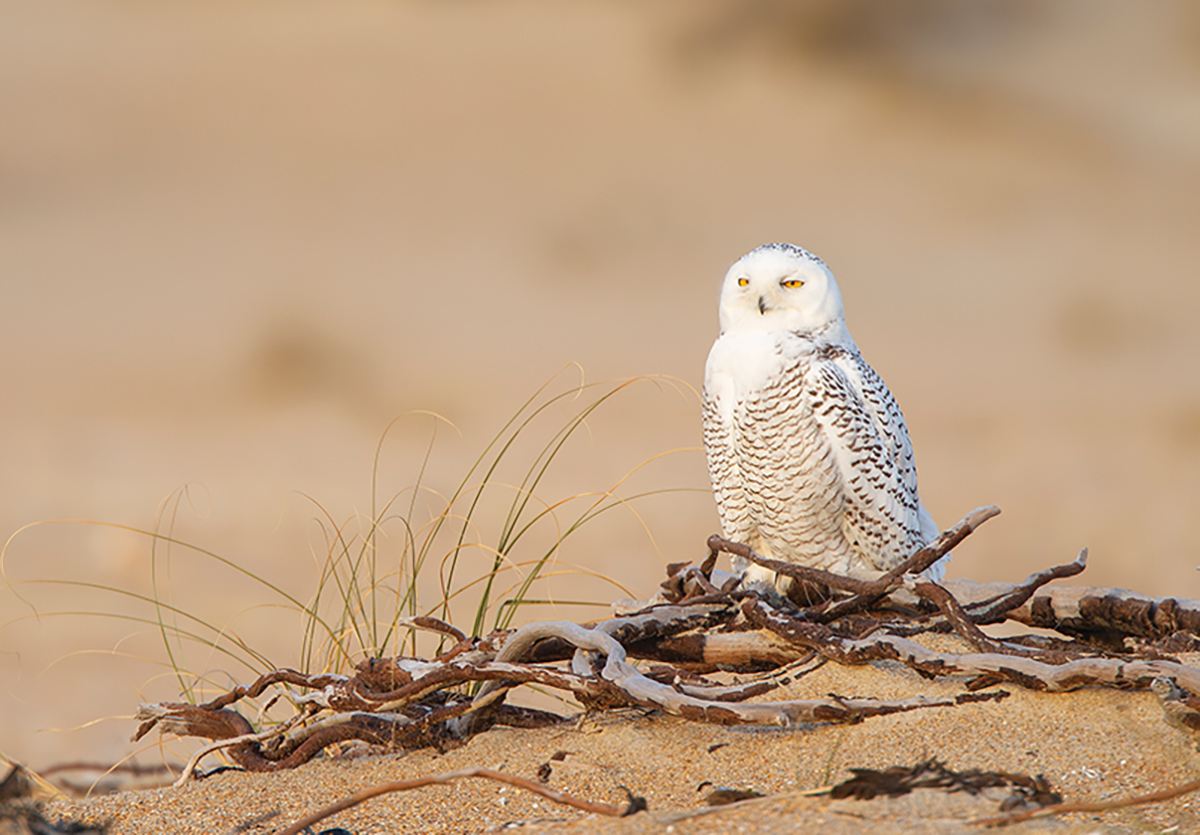
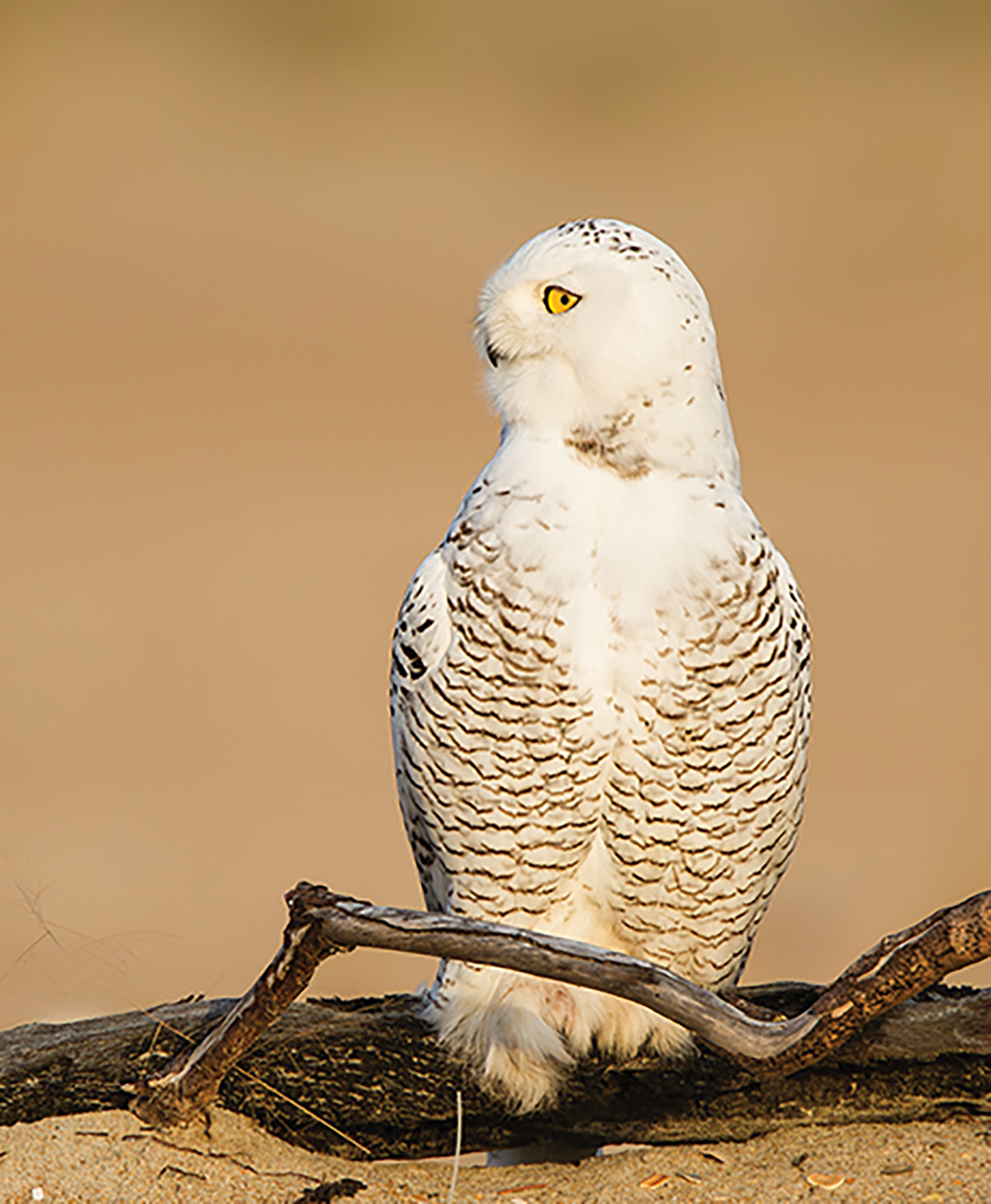
My first impression was that it was a very large bird, a bit bigger than our great horned owl. In fact, snowy owls are the bulkiest owls in North America, weighing in at about 4 to 6 pounds with a wingspan of 4 to 5 feet. The pure white face and neck feathers stood out against the tans of the beach. It had dark barring on its wings and back. Adult males are almost pure white, while females and immatures of both sexes have strong barring on the wings and back. It is likely this was an immature bird setting out on its first winter migration. Two other things stood out as I looked at the owl: its feathered feet armed with long, jet-black talons, and its huge yellow eyes. I saw a hint of blood on the feathers of one foot, suggesting a recent meal.
After surveying the scene, the bird began to preen, moving its head around and pulling feathers through its beak. I decided to inch my way closer, step by step, whenever the owl had its head turned away. After several minutes, I was close enough to start taking photos, but still far enough away so as not to disturb the owl. I took almost 1,000 images, figuring this might be my only chance at seeing one of these amazing birds.
Then I saw something that concerned me: a man walking out on the beach with an unleashed golden retriever. I worried the dog might spook the owl. But when the guy saw me with all my gear, he quickly leashed his pet and angled towards me, giving the owl a wide berth. As he approached, the owl flew, but landed in a particularly photo-worthy spot, right in line with the Cape Hatteras Lighthouse. He asked what the bird was—he had thought it was a gull from a distance—and when I told him, he asked if I minded if he called his girlfriend, who was fond of owls but had never seen one of these. She soon joined us, and we all stood there admiring this rare visitor from the far north in the golden light of late afternoon.
The next morning, I drove back out and saw the owl again. A small crowd was getting close to it, so I decided to not add more stress. I headed to the area where the emergency ferry operation was evacuating people off the island and headed home.
Later that winter, I drove to Florida to photograph wintering birds (another retired naturalist thing, I suppose). While I was there, I heard of a snowy owl along the beach in Jacksonville, an incredible distance out of their normal range. I did not see that one, but the winter of 2013-14 set records for sightings of snowy owls down the East Coast.
It was such a phenomenal event that it prompted a group of biologists and volunteers to create Project SNOWstorm (projectsnowstorm.org), a collaborative crowdfunded research project focusing on the movements and conservation of snowy owls. They have since fitted more than 100 owls with GPS transmitters in order to track their daily movements.
I’m hoping for another successful lemming year in the near future so maybe we can enjoy a unique type of white Christmas, one highlighted by some feathered guests from the north.

This article originally appeared in the December 2026 issue of WALTER Magazine.